In the ruthless arena of online business, your website’s design isn’t just a digital brochure; it’s your 24/7 salesperson, your lead magnet, and your profit engine. For eCommerce brands, ambitious startups, and growth-focused small businesses, the goal isn’t merely to “be online”—it’s to convert. It’s to take a casual browser and transform them into a loyal, paying customer.
This guide isn’t about fleeting trends or pretty pictures. It’s about the strategic architecture of a high-converting website design that actively drives revenue, builds trust, and positions you for exponential growth.
You can also use our [Website Redesign Checklist] to ensure that f you are doing a redesign your new site is built for growth
1. The Strategic Foundation: Conversion-First Architecture In Website Design
Before you pick a color palette or write a single line of code, you must define your conversion goal. Every element on your site should guide your audience toward a specific, measurable action. This isn’t just about design; it’s about deeply understanding your User Journey.
- Define Your Core Conversion: For an eCommerce store, it’s typically “Add to Cart” or “Complete Purchase.” For a service-based startup, it might be “Book a Consultation” or “Download a Free Guide.” Make this singular goal the north star for every page.
- Clear Value Proposition: Your homepage must answer three critical questions within 3 seconds: “What do you do?”, “How does it benefit me?”, and “Why should I trust you?” Clutter and ambiguity are conversion killers.
- Frictionless Pathways: Map out the shortest, clearest path from landing on your site to completing your core conversion. Eliminate any unnecessary clicks, steps, or information requests. Each point of friction is a potential lost customer.
2. Mobile-First & Responsive Website Design: The Modern Imperative

Over 60% of all web traffic now originates from mobile devices. If your website isn’t flawlessly optimized for every screen size, you’re not just ignoring a segment of your audience; you’re actively pushing them towards your competitors. Responsive web design isn’t a luxury; it’s a fundamental requirement for a high-converting site.
- Fluid Grids & Flexible Images: Your design must adapt seamlessly. Text shouldn’t overlap, images shouldn’t distort, and layouts should reflow intelligently, whether viewed on an iPhone, a tablet, or a massive desktop monitor.
- Touch-Friendly Elements: Buttons and clickable areas need to be large enough for thumbs, forms must be easy to navigate without zooming, and pop-ups should be designed not to obstruct mobile views.
- Prioritize Content: On smaller screens, only the most crucial content should be immediately visible. Condense, simplify, and ensure your core message and Call to Action (CTA) are always front and center.
3. Performance & Speed: The ROI of “Instant” In Website Design
In the blink-and-you’ll-miss-it pace of the digital world, speed is the ultimate conversion accelerator. Studies show that a mere 1-second delay in page load time can decrease conversions by 7%. For an eCommerce store processing thousands of orders or a startup battling for market share, that’s a revenue leak you simply cannot afford.
- Audit with Precision: Regularly use tools like Google PageSpeed Insights, GTmetrix, or Pingdom to identify performance bottlenecks. If your scores aren’t in the “Green,” you’re actively losing potential revenue.
- Image Optimization: Large, uncompressed images are the most common culprit for slow load times. Implement lazy loading, use modern formats (like WebP), and ensure images are sized correctly for their display area.
- Clean Code & Efficient Hosting: Beyond images, minifying CSS/JavaScript, leveraging browser caching, and choosing a fast, reliable Website Hosting provider are critical. Your server’s response time is the first impression your site makes.
4. Visual Hierarchy & Minimalist Design: Guiding the Eye to Conversion

Clutter is the enemy of clarity. Startups often overload their websites with too much information, thinking more is better. In reality, minimalism is authority; it guides the user’s eye, reduces cognitive load, and highlights your most important conversion elements.
- Strategic Use of White Space: Don’t fear empty space! It acts like a spotlight, drawing attention to your critical content, CTAs, and value propositions. It also makes your site feel premium and uncluttered.
- Clear Visual Hierarchy: Use varying font sizes, weights, and colors to create a clear reading path. Your H1 should be the most prominent, followed by H2s, then body text. Emphasize what you want users to see first.
- Brand Consistency: Use a consistent color palette and typography that reflects your Website Brand Identity. This builds recognition and trust across all touchpoints, from your site to your social media.
5. Social Proof: The Trust Accelerator for Startups & Small Businesses
When you’re not a household name, trust is your most valuable currency. New visitors, especially for eCommerce and startups, are looking for reasons to believe in your product or service. Social proof is the most powerful psychological lever you have.
- Strategic Placement: Don’t bury testimonials on a separate page. Place them near relevant product descriptions, pricing tables, or directly above your Call to Action.
- Diverse Proof Types:
- Customer Reviews & Ratings: Essential for eCommerce product pages.
- Testimonials: Quote happy clients for service businesses, ideally with photos or even video.
- Trust Badges: Display secure payment icons, privacy policy links, and industry certifications prominently.
- Case Studies: For higher-ticket services, detailed case studies demonstrate your impact.
- Media Mentions: If featured in relevant publications, showcase their logos.
6. SEO-Driven Design: Getting Found (and Staying Found)
A beautifully designed, high-performing website is pointless if nobody can find it. At marginsEyedigital.com, we believe SEO isn’t an add-on; it’s an integral part of the design process. Your website must be built to rank.
- Keyword Intent Integration: Every page, from your product listings to your blog posts, should target specific keyword clusters that your audience is actively searching for. Understand their search intent (informational, commercial, transactional).
- Clear Site Structure: Use logical navigation, proper URL structures, and internal linking to help search engines (and users) understand the hierarchy and relationships between your content.
- Optimized Content: Beyond keywords, your Website Content Strategy must deliver genuine value. Create comprehensive, authoritative content that positions you as an expert in your niche.
- Technical SEO Foundation: Ensure your site is crawlable, mobile-friendly (as discussed), and uses clean code. These are non-negotiable for higher rankings.
7. The Frictionless Checkout: Your Ecommerce Conversion Funnel
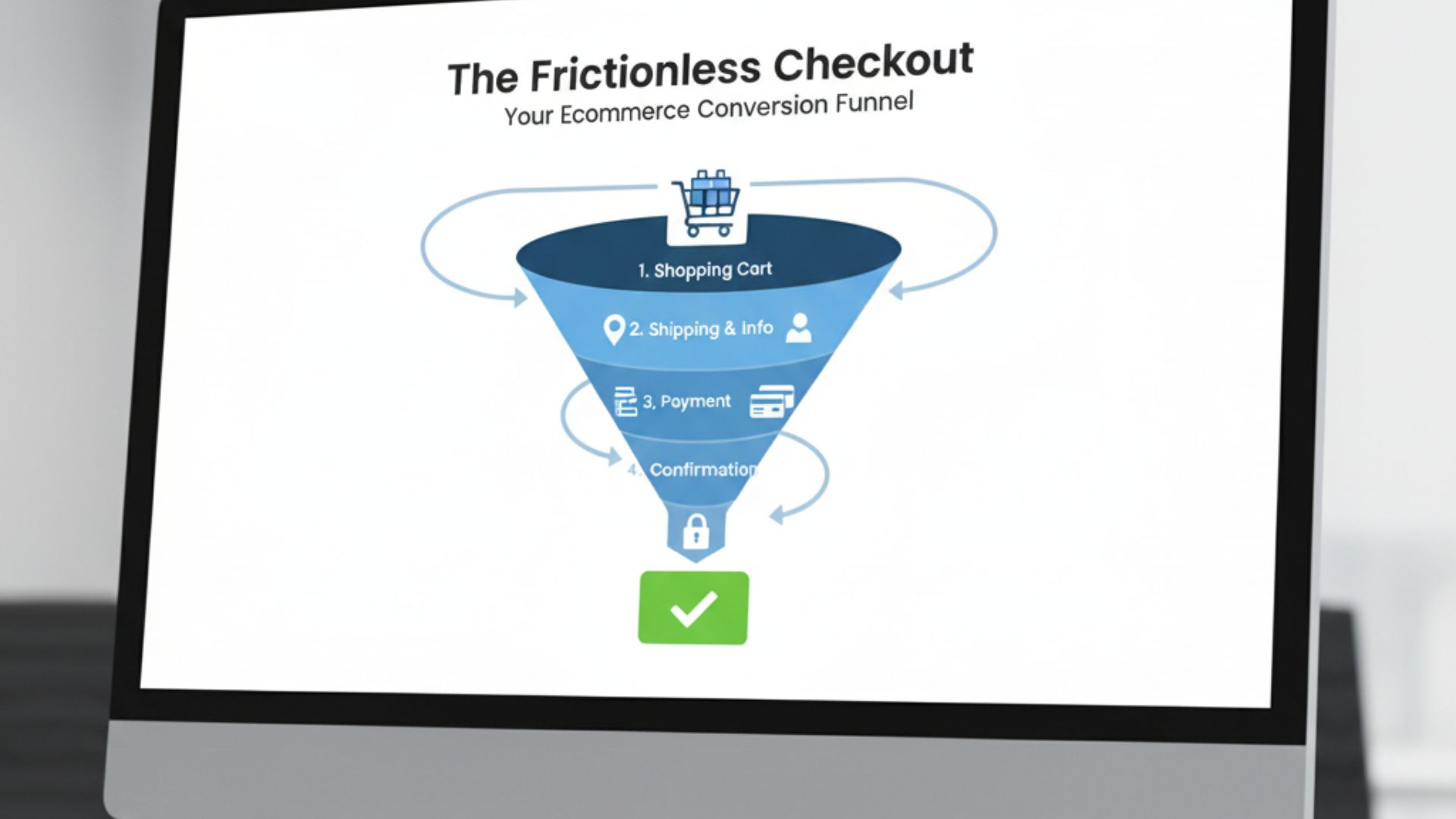
For eCommerce businesses, the checkout process is the make-or-break moment. A poorly designed checkout can lead to staggering cart abandonment rates (often over 70%).
- Guest Checkout Option: Never force a new customer to create an account before purchase. Offer a guest checkout; you can always encourage account creation post-purchase.
- Progress Indicators: Use clear progress bars (e.g., “1. Shipping > 2. Payment > 3. Review”) to manage expectations and reduce perceived effort.
- Minimize Distractions: Remove non-essential navigation elements from the checkout pages. Keep the focus solely on completing the purchase.
- Trust & Security: Reiterate security features (SSL certificates, secure payment badges) at every step of the checkout process.
- Clear Error Messaging: If a form field is incorrect, provide clear, immediate, and helpful feedback.
Building Your High-Converting Digital Powerhouse
For eCommerce brands, startups, and small businesses, your website is more than just an online presence; it’s your most potent tool for growth. By focusing on conversion-first strategy, mobile responsiveness, lightning-fast performance, persuasive design, robust social proof, integrated SEO, and a seamless checkout, you’re not just building a website—you’re constructing a digital powerhouse designed for one thing: results.
Your Next Strategic Move: Get Your Website Conversion-Ready
Ready to stop guessing and start growing? To help you benchmark your current site and identify key areas for improvement, I’ve prepared a comprehensive Website Redesign Checklist. It’s designed specifically for businesses looking to elevate their online presence and conversion rates.
FAQs: Turning Browsers Into Buyers
1. Does my website really need to be “beautiful” to convert? Beauty is subjective; clarity is universal. A high-converting site prioritizes a “Frictionless Path to Purchase.” If your site looks like a masterpiece but hides the “Buy Now” button or takes 10 seconds to load, your conversion rate will be zero. We build for speed, trust, and the “3-Second Rule”—users must know what you do and how to buy it within three seconds of landing.
2. How many pages does a high-converting site actually need? Less is almost always more. Every extra page is a chance for a lead to get lost. A high-converting system usually consists of:
- The Power Home Page: Solves the problem immediately.
- High-Intent Landing Pages: Dedicated to specific products or services.
- The Frictionless Checkout/Lead Form: Where the money happens. If a page doesn’t serve a specific goal in the sales funnel, it’s just digital noise.
3. Why is my current site getting traffic but no sales? You likely have a Trust or Friction problem.
- Trust: Do you have “Social Proof” (reviews, logos, results) near your call-to-action?
- Friction: Is your “Add to Cart” process too long? Do you ask for too much info in your forms? Traffic is the fuel, but your UX (User Experience) is the engine. If the engine is broken, the fuel is wasted.
4. Is mobile-first design still a “recommendation”? No, it’s a survival requirement. In Kenya, over 80% of your customers are likely viewing your site on a smartphone while on the move. If your site isn’t “thumb-friendly” or if it chokes on a 4G connection, you aren’t just losing rank on Google; you are actively handing your customers to your competitors.
5. How long does it take to see a return on a new site design? If the system is built correctly, the impact is instant. By fixing the “leaks” in your funnel (improving load speed, sharpening the CTA, and simplifying navigation), your conversion rate should jump the moment you go live. We don’t wait for “luck”; we build for the data.