How AI Search Tools Find and Recommended Service Providers
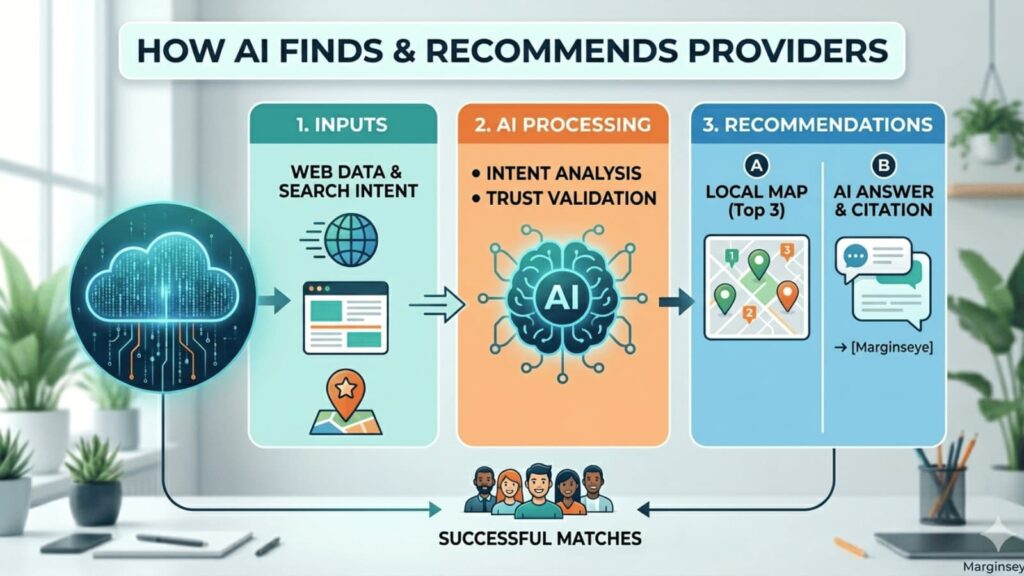
Most businesses still think search works the same way it did years ago. Type keyword. Get links. Click website. But AI Search Tools are changing that structure completely. Today, tools powered by artificial intelligence increasingly summarize answers directly, recommend businesses contextually, compare providers automatically, and reduce how often users even visit traditional search result pages. That changes visibility systems in a major way. The question is no longer: “Can your website rank?” The deeper question now is: “Can AI systems understand, trust, and recommend your business?” Because modern AI search engines do not simply scan keywords. They evaluate patterns. Authority. Clarity. Relevance. Trust signals. User behavior. Content structure. Reputation consistency. According to Google Search Central documentation, modern search systems prioritize helpful, people-first content built around expertise and trustworthiness. Meanwhile, AI-powered search experiences increasingly rely on structured information extraction rather than simple keyword matching alone.
This creates a major shift for service providers. Freelancers, consultants, agencies, coaches, developers, designers, and local businesses are now competing inside systems where discoverability depends heavily on machine understanding. Not just branding.
How to get your business recommended by AI search engines
AI search tools evaluate service providers using signals like website authority, structured content, online reputation, expertise indicators, user engagement, reviews, topical relevance, and trust consistency across the web. Businesses with clear positioning and reliable digital footprints are more likely to be recommended. At Marginseye Digital, we are already seeing a structural shift: Businesses optimized only for traditional SEO are beginning to lose visibility to businesses optimized for AI understanding. That difference matters. Because AI search systems are increasingly becoming recommendation engines. Not just search engines.
This guide is reviewed and updated quarterly. Last verified: May 8, 2026
Next update scheduled: August 8, 2026
Key Takeaways
- AI search tools evaluate trust and clarity, not just keywords.
- Structured content helps AI systems understand services more accurately.
- Authority signals influence which businesses AI tools recommend.
- Reviews, reputation consistency, and expertise indicators matter heavily.
- Businesses with weak digital footprints become harder for AI systems to trust.
- AI discoverability is becoming a competitive advantage across industries.
What Problems Do you Face With AI Search Tools In Search Visibility?
The biggest problem is that many businesses are still optimizing for old search behavior. Traditional SEO focused heavily on rankings and keyword placement. AI systems operate differently. They try to understand meaning and confidence. That creates problems for businesses with:
- Weak positioning
- Thin content
- Poor reputation consistency
- Incomplete service explanations
- Low-authority websites
- Confusing structure
According to Google’s guidance on E-E-A-T principles, expertise, experience, authority, and trustworthiness increasingly shape visibility quality across search systems. Another issue is fragmentation. Many businesses spread information inconsistently across platforms:
- Different service descriptions
- Outdated business information
- Inconsistent branding
- Missing expertise signals
- Weak case studies
AI systems struggle when digital identities feel incomplete or contradictory. In addition, many service providers still rely almost entirely on social media visibility. That creates dependency on algorithms built for engagement, not long-term discoverability. AI search systems prefer clearer infrastructure:
- Websites
- Structured pages
- Consistent authority signals
- Trustworthy citations
- Helpful content ecosystems
The system rewards clarity because machine understanding depends on structured interpretation.
How AI Search Tools Evaluate Service Providers
AI search tools work by combining multiple layers of signals together. Not just one ranking factor. The process is closer to reputation analysis than traditional keyword scanning. First, AI systems analyze topical relevance. They try to understand:
- What does this business actually specialize in?
- Is the expertise clear?
- Are services explained properly?
- Is there supporting evidence?
This is why vague websites struggle. For example: Weak positioning:
“We offer digital solutions.”
Stronger positioning:
“We help ecommerce brands improve organic traffic through technical SEO and conversion-focused web design.” The second example gives AI systems clearer context. Next, AI systems evaluate authority signals. That includes:
- Backlinks
- Mentions
- Citations
- Reviews
- Brand consistency
- Expert content
- User engagement
- Reputation signals
Additionally, AI tools evaluate content depth. Thin pages built only to rank keywords often perform poorly because AI systems prioritize information usefulness and clarity. Structured content matters heavily. That includes:
- Proper headings
- FAQ sections
- Service explanations
- Schema markup
- Internal linking
- Case studies
- Author information
Machine-readable clarity improves recommendation confidence. Furthermore, another major actor is behavioral trust. If users consistently engage with a website positively , spending time, exploring pages, converting, or returning, those patterns reinforce credibility signals over time. AI systems increasingly evaluate usefulness through observed interaction patterns.
Marginseye Digital Expert Insight
At Marginseye Digital, we have seen businesses with smaller social audiences outperform larger competitors simply because their digital infrastructure was clearer and more trustworthy. Notably, that surprises many people. But AI systems prioritize understanding. Specifically, not noise. Many businesses produce content constantly while failing to build structured authority systems underneath it. Meanwhile, however, businesses with strong positioning, detailed service explanations, optimized case studies, and consistent trust signals often become easier for AI systems to recommend confidently. Visibility is shifting from attention-based systems toward interpretation-based systems.
As a result, this changes strategy completely.
What Are the Benefits of Being Recommended by AI Search Tools?
The biggest advantage is trust acceleration. AI recommendations reduce user research time dramatically. Specifically, when AI systems confidently surface businesses during search experiences, users often perceive those businesses as pre-validated. As a result, that creates stronger credibility immediately. Furthermore, AI recommendations also improve discoverability beyond traditional SEO rankings.
Instead of only appearing in search results, businesses may appear:
- Inside AI summaries
- In conversational recommendations
- During comparison queries
- In local service suggestions
- Across voice search systems
Consequently, discoverability becomes broader and more contextual. Moreover, another major benefit is reduced dependency on advertising. Therefore, businesses with strong AI visibility systems may attract inbound opportunities organically through authority rather than continuous paid promotion.
Furthermore, this advantage compounds over time.
This is because recommendation systems increasingly favor established trust patterns.
Case Studies: How Businesses Improve AI Discoverability
Case Study 1 – SEO Consultant Improves AI Visibility
An SEO consultant struggled to appear consistently in AI-generated search summaries despite having strong technical skills. The issue was structural:
- Weak case studies
- Minimal author credibility
- Thin service pages
- Limited topical authority content
After restructuring the website with:
- Detailed educational articles
- FAQ sections
- Clear expertise positioning
- Author transparency
- Stronger service explanations
Visibility improved gradually. Consequently:
- More organic leads appeared
- AI-generated mentions increased
- Website engagement improved
The expertise had existed all along. However, the machine clarity improved dramatically.
Case Study 2 – Local Agency Builds Stronger Trust Signals
A small agency competed against larger firms with bigger ad budgets. Instead of focusing only on paid ads, the agency improved:
- Google Business Profile consistency
- Review quality
- Website structure
- Client testimonials
- Case study depth
- Local SEO authority
As a result:
- AI tools surfaced the business more often for local service queries
- Referral traffic increased
- Consultation requests improved
Therefore, the key shift was credibility infrastructure rather than aggressive promotion.
How to Optimize Your Business for AI Recommendations Step by Step
Step 1: Clarify Your Positioning
First, explain clearly:
- What you do
- Who you help
- What outcome you create
AI systems struggle with vague businesses. Specificity improves understanding.
Step 2: Build Detailed Service Pages
Every major service should have:
- Clear explanations
- FAQs
- Use cases
- Case studies
- Outcomes
- Internal links
As a result, thin service pages reduce recommendation confidence significantly.
Step 3: Create Helpful Educational Content
Publish content answering real industry questions. For example:
- “How technical SEO affects ecommerce visibility”
- “Why slow websites reduce conversions”
- “How AI search changes local SEO”
In addition, educational content builds topical authority over time.
Step 4: Improve Technical Website Structure
Ensure your website:
- Loads quickly
- Uses proper heading hierarchy
- Works on mobile
- Includes schema markup
- Has optimized metadata
- Uses clean URLs
Moreover, technical clarity helps machine interpretation considerably.
Step 5: Strengthen Reputation Signals
Encourage:
- Authentic reviews
- Testimonials
- Mentions
- Case studies
- Expert contributions
Importantly, AI systems evaluate trust consistency very heavily.
Step 6: Maintain Consistency Across Platforms
Your:
- Website
- Google Business Profile
- Directories
- Social platforms
…should communicate consistent information.
As a result, conflicting signals reduce AI confidence in your business.
What Signals Do AI Search Tools Use Most?
Ultimately, the deeper pattern is simple:AI systems reward businesses that are easier to understand and trust.
What Signals Do AI Search Tools Use Most?
| Signal Type | Why It Matters |
|---|---|
| Website authority | Indicates trustworthiness |
| Structured content | Helps machine understanding |
| Reviews and testimonials | Reinforces credibility |
| Expertise depth | Shows topical authority |
| Technical SEO | Improves crawlability |
| User engagement | Signals usefulness |
| Brand consistency | Builds confidence |
| Case studies | Demonstrates outcomes |
| Schema markup | Improves structured interpretation |
What Are the Pros and Cons of AI Search Visibility?
| Pros | Cons |
|---|---|
| Increased discoverability | Requires long-term consistency |
| Stronger trust signals | SEO alone is no longer enough |
| Better inbound opportunities | Building authority takes time |
| Reduced ad dependency | Technical optimization needed |
| Higher recommendation potential | Competition is increasing rapidly |
The important shift is this:
Visibility is becoming more interpretive than positional.
What Mistakes Should You Avoid With AI Search Optimization?
- Using vague business descriptions — AI systems need clarity.
- Publishing thin content — Weak pages reduce authority signals.
- Ignoring technical SEO — Machine readability matters heavily.
- Overdepending on social media — Owned platforms create stronger infrastructure.
- Neglecting reviews and reputation — Trust signals affect recommendations.
- Failing to explain expertise properly — AI tools evaluate topical authority.
- Using inconsistent branding online — Conflicting signals reduce confidence.
- Creating content only for keywords — AI systems prioritize usefulness increasingly.
The bigger issue is that many businesses still optimize for clicks while AI systems optimize for confidence.That difference changes discoverability systems completely.
Quick AI Visibility Checklist Use this AI discoverability audit checklist:
- ☐ Is your positioning extremely clear?
- ☐ Do service pages explain outcomes properly?
- ☐ Are reviews and testimonials visible?
- ☐ Is your website technically optimized?
- ☐ Are FAQ sections included?
- ☐ Is content educational and useful?
- ☐ Is branding consistent across platforms?
- ☐ Are case studies detailed and measurable?
If several answers are “no,” AI systems may struggle to recommend your business confidently.
Community Q&A: Real Questions About AI Search Visibility
Question 1: Will AI replace traditional Google search completely?
No. Traditional search still matters heavily, but AI systems are increasingly layered on top of search experiences to summarize, compare, and recommend information faster.
Question 2: Does SEO still matter in AI search?
Yes. SEO still forms the foundation of discoverability because AI systems rely heavily on crawlable, structured, authoritative web content.
Question 3: Can small businesses compete in AI search visibility?
Yes. Smaller businesses with clearer positioning and stronger trust systems can outperform larger competitors with weak digital infrastructure.
Conclusion
AI search tools are changing visibility systems fundamentally. The internet is moving from: “Who ranks highest?” Toward: “Who can be trusted confidently?” That changes how service providers must think about discoverability.
Keywords alone are no longer enough. Businesses now need:
- Clear positioning
- Structured expertise
- Technical clarity
- Trust signals
- Consistent authority
Because AI systems are becoming recommendation systems increasingly. And recommendation systems reward confidence. Not confusion. The businesses that become easiest to understand, verify, and trust online will increasingly become the businesses AI tools surface first.
Next Read>>>>>> The ultimate local seo guide to dominate locally
FAQ
1. How do AI search tools recommend businesses?
AI search tools recommend businesses by evaluating trust signals, relevance, expertise, and content quality. They analyze websites, reviews, authority signals, structured content, and user engagement patterns to determine which providers appear reliable and useful.
2. Does SEO still matter with AI search tools?
Yes, SEO still matters because AI systems rely heavily on structured, crawlable web content. Technical SEO, content quality, and website clarity remain foundational for discoverability. Get our AI Seo services today.
3. What makes a business easier for AI systems to understand?
Clear positioning, structured pages, FAQs, schema markup, and detailed service explanations improve machine understanding. AI systems struggle with vague or poorly organized websites.
4. Why are reviews important for AI recommendations?
Reviews help reinforce trust and credibility signals across the web. AI systems use reputation consistency to evaluate confidence levels when recommending businesses.
5. Can small businesses compete in AI-driven search visibility?
Yes, smaller businesses can compete effectively if their digital infrastructure is stronger and clearer. AI systems prioritize understanding and trust more than company size alone.
6. What role does content play in AI discoverability?
Educational content helps establish topical authority and expertise. AI systems favor businesses that consistently provide useful, structured information around their industry.
7. Does technical SEO affect AI visibility?
Yes, technical SEO improves machine readability and website accessibility. Fast-loading websites, proper headings, clean URLs, and schema markup all strengthen discoverability. Learn more on getting better site rankings and online trust.
8. What are AI search systems looking for in service providers?
AI systems look for expertise, clarity, consistency, trust signals, and helpful information. Businesses that explain services clearly and demonstrate real outcomes usually perform better.
9. How important are case studies for AI recommendations?
Case studies help demonstrate proof of expertise and measurable outcomes. They increase trust signals while helping AI systems understand business specialization more accurately.
10. Can social media alone improve AI discoverability?
Social media helps visibility, but websites remain the strongest authority infrastructure. AI systems rely heavily on owned web properties for deeper understanding and trust validation.
11. What is schema markup and why does it matter?
Schema markup is structured data that helps search engines and AI systems interpret website content more clearly. It improves machine-readable context for services, reviews, FAQs, and business information.
12. What is the biggest mistake businesses make with AI search optimization?
The biggest mistake is optimizing only for keywords instead of trust and clarity. AI systems increasingly prioritize usefulness, authority, and confidence signals over shallow ranking tactics.