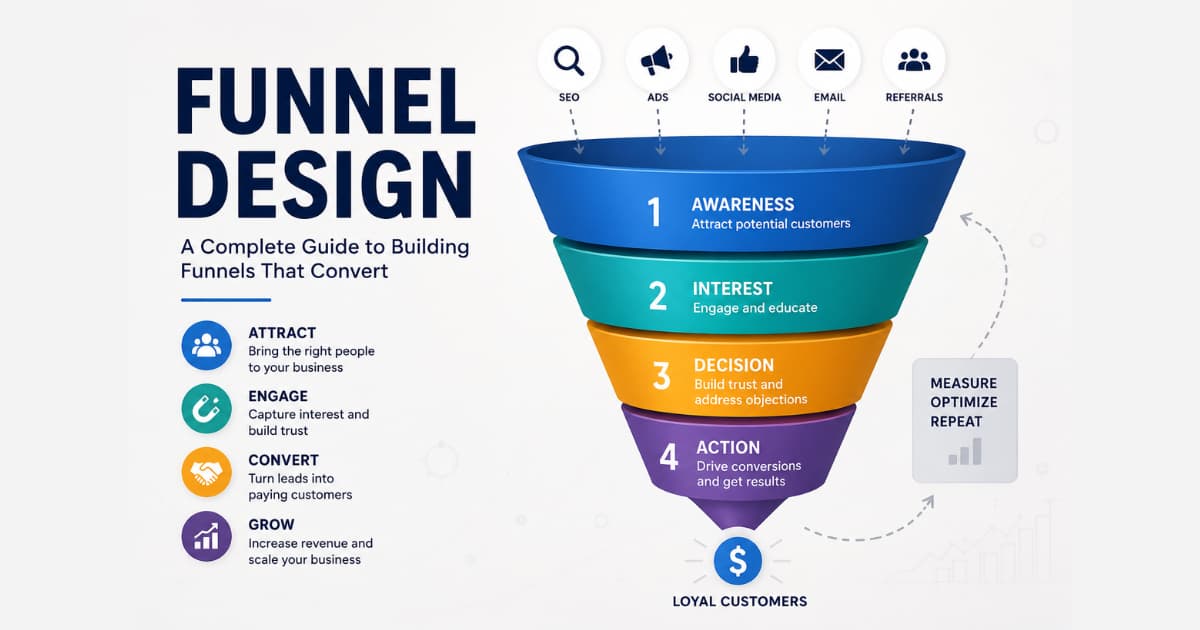
Funnel design is one of the most overlooked growth systems in modern marketing. Many businesses invest heavily in advertising, social media marketing, SEO, and content creation. However, they still struggle to generate consistent leads and sales.
The problem is rarely traffic alone.
In many cases, businesses attract visitors successfully but fail to guide them toward a meaningful action. As a result, marketing efforts produce attention without producing revenue.
Why Businesses Lose Potential Customers
Consider what happens every day online.
A visitor lands on a website and leaves without contacting the business. Meanwhile, another downloads a guide but never receives a follow-up message. In other cases, someone clicks an ad, shows interest, and disappears before making a purchase.
These situations are common. More importantly, they usually point to the same problem: there is no structured journey moving prospects from awareness to conversion.
Because of this, businesses often blame traffic sources when the real issue exists within the customer journey itself.
What Funnel Design Actually Does
This is where funnel design becomes important.
Funnel design is the process of creating a deliberate path that guides potential customers from their first interaction with a business to becoming paying customers. Instead of relying on chance, the process creates clear next steps at every stage.
For example, a prospect might discover a blog post, download a free resource, receive educational emails, and then schedule a consultation. Each action moves them closer to a decision.
As a result, prospects experience less confusion and businesses create more opportunities to convert interest into revenue.
At its core, funnel design combines several elements into one system:
• Customer psychology
• Messaging
• Content marketing
• Offers
• Marketing automation
• Conversion rate optimization
• Calls to action
Each component serves a specific purpose. Together, they create a smoother buying journey.
Why Funnel Design Matters for Growth
For small businesses, funnel design can transform unpredictable sales into a repeatable lead generation system. Similarly, marketers can use funnel data to identify where prospects lose interest and where improvements are needed.
A successful sales funnel is not about pressuring people into making a purchase. Instead, it focuses on providing the right information at the right time through the right channel.
Consequently, prospects feel more confident making decisions. At the same time, businesses improve conversion rates, increase marketing efficiency, and generate more qualified leads.
What You Will Learn in This Guide
In this guide, you will learn:
• How funnel design works
• Why funnel design matters for business growth
• The four stages of an effective sales funnel
• How to create a funnel strategy
• Which tools support funnel performance
• How to improve conversion rates through optimization
• A step-by-step blueprint for building a funnel that generates leads and sales
Why Funnel Design Matters
Many businesses spend significant time and money attracting visitors to their websites. However, far fewer invest the same effort into what happens after those visitors arrive.
As a result, they face a common challenge: high traffic numbers but very few leads or customers.
Funnel design solves this problem by creating a structured path that guides prospects from curiosity to commitment. Instead of leaving visitors to figure everything out on their own, a well-designed funnel provides the right message, offer, and next step at every stage of the journey.
Consequently, businesses create a smoother customer experience while improving their chances of conversion.
How Funnel Design Improves Lead Generation
One of the biggest benefits of funnel design is its ability to generate more qualified leads.
Rather than hoping visitors will return later, businesses capture contact information through lead magnets, forms, free resources, and special offers. For example, a website visitor may download a free funnel checklist in exchange for their email address.
As a result, the conversation continues long after the visitor leaves the website.
How Funnel Design Increases Conversion Rates
Attracting visitors is only part of the process. The real goal is helping them take action. Effective funnel design removes obstacles that prevent prospects from moving forward. Clear messaging, relevant offers, and strategic calls to action make decision-making easier. Consequently, more visitors become leads, and more leads become customers.
How Funnel Design Improves Marketing Efficiency
Marketing becomes far more effective when businesses understand how prospects move through the funnel.
For example, analytics can reveal where visitors engage, where they lose interest, and which channels generate the highest-quality leads.
Because of this visibility, businesses can focus their budget and effort on activities that produce measurable results.
How Funnel Design Builds Customer Trust
Trust rarely happens instantly.
Most prospects need time to evaluate a business before making a purchase decision.
A well-structured sales funnel supports this process by delivering valuable information over time. Educational content, case studies, testimonials, and follow-up emails help answer questions and address concerns.
As a result, prospects feel more confident when they reach the decision stage.
How Funnel Design Creates Predictable Growth
Many businesses rely heavily on a single marketing channel.
While this may work temporarily, it often creates instability.
A properly designed funnel provides a repeatable system for attracting, nurturing, and converting prospects. Therefore, lead generation becomes more consistent and less dependent on one source of traffic.
Over time, this creates a more predictable foundation for business growth.
Common Funnel Design Mistakes
Even experienced marketers make mistakes that reduce funnel performance. Fortunately, most of these issues are easy to identify and fix. Some of the most common mistakes include:
• Sending traffic to generic pages with no clear next step
• Using the same message for every audience segment
• Asking prospects to buy before trust has been established
• Creating lead magnets that fail to solve a meaningful problem
• Adding unnecessary steps that create friction and confusion
• Failing to follow up through email marketing or retargeting campaigns
• Focusing on traffic metrics while ignoring conversion data
• Building funnels based on assumptions instead of customer behavior
For example, a business may spend thousands on advertising while directing visitors to a homepage with no clear call to action. In that situation, traffic increases but conversions remain low.
What Successful Funnels Have in Common
The most effective funnel design strategies share several characteristics.
First, they focus on simplicity.
Second, they provide clear direction.
Finally, they align every page, email, and offer with customer intent. Because of this approach, prospects move naturally from one stage to the next instead of becoming confused or overwhelmed. When funnel design is built around customer needs rather than business assumptions, conversions tend to improve significantly.
Core Stages of a Funnel: Awareness, Interest, Decision, and Action
Every successful funnel design follows a structured customer journey.
Although tactics vary across industries, the underlying process remains remarkably consistent. Prospects first discover your business, then evaluate whether you can help them, decide whether they trust you, and finally take action.
Understanding these stages is important because each one requires different goals, content formats, and messaging strategies.
Awareness Stage: Getting on the Customer’s Radar
The awareness stage is the first point of contact between your business and a potential customer.
At this stage, prospects may discover your business through:
• Search engines
• Social media platforms
• Referrals
• Online communities
• Video content
• Paid advertising campaigns
However, most people are not ready to buy yet. Instead, they are trying to understand a problem, answer a question, or explore possible solutions. For example, a business owner searching for “why my website gets traffic but no leads” has already identified a challenge. However, they may not yet know that funnel design can help solve it.
Because of this, awareness-stage content should focus on education rather than selling.
Effective content formats include:
• Educational blog posts
• SEO-focused articles
• Social media content
• YouTube videos
• Industry reports
• Infographics
The objective is simple. Attract the right audience, establish credibility, and introduce your expertise. Once that foundation is in place, prospects become more willing to continue their journey through the funnel.
Learn how to structure website pages and attract local clients now
Interest Stage: Building Engagement and Trust
Once prospects discover your business, they move into the interest stage.
At this point, they want more information. More importantly, they begin evaluating whether your solution is worth their time and attention.
Unfortunately, this is where many businesses lose potential customers.
They successfully attract visitors through SEO, social media, or advertising. However, they fail to capture contact information or continue the conversation. As a result, interested prospects leave and never return.
How to Keep Prospects Engaged
A strong funnel design uses valuable content and lead magnets to maintain engagement.
The goal is simple: provide enough value to encourage prospects to take the next step.
Common examples include:
• Free guides
• Checklists
• Webinars
• Email newsletters
• Templates
• Industry research
For example, imagine a marketing agency offering a free Website Conversion Checklist. A visitor downloads the resource and shares their email address in return.
Consequently, the agency can continue building trust through educational emails, helpful resources, and relevant insights.
Instead of remaining anonymous, that visitor becomes an identifiable lead.
The primary objective during this stage is to transform curiosity into ongoing engagement.
Decision Stage: Removing Doubt
As prospects move deeper into the funnel, they enter the decision stage.
Here, they are no longer asking, “What is my problem?” Instead, they are asking, “Which solution should I choose?”
Trust becomes the deciding factor.
Before making a commitment, most people want evidence that a product or service can deliver results. Because of this, funnel design should focus on reducing uncertainty and answering questions before they become objections.
Effective decision-stage assets include:
• Customer testimonials
• Case studies
• Product demonstrations
• Free consultations
• Comparisons
• Success stories
For instance, a business looking for funnel design services may compare several agencies before making a decision.
One agency may talk about its services. Another may showcase measurable results, client success stories, and a clear process.
In most cases, the second option has a significant advantage because it provides proof rather than promises.
Building Confidence Before the Sale
Prospects rarely want more marketing messages.
Instead, they want reassurance that they are making the right choice.
Therefore, every piece of content during the decision stage should answer common concerns, demonstrate expertise, and reduce perceived risk.
When trust increases, conversions usually follow.
Action Stage: Turning Interest into Conversion
The action stage is where prospects finally take the desired step.
Depending on your business model, that action may look different.
Common examples include:
• Purchasing a product
• Booking a consultation
• Requesting a proposal
• Starting a free trial
• Scheduling a demo
At this stage, the prospect has already invested time learning about your business. Consequently, the process should be as simple as possible.
Remove Friction Wherever Possible
Many businesses unintentionally reduce conversions by making the final step too complicated.
For example, prospects may encounter lengthy forms, unclear pricing, confusing checkout pages, or too many choices.
As a result, potential customers abandon the process even when they are interested.
The highest-converting funnels remove these obstacles by:
• Using clear calls to action
• Reducing unnecessary form fields
• Highlighting benefits clearly
• Addressing final objections
• Offering guarantees when appropriate
Every additional click creates another opportunity for hesitation.
Therefore, simplicity becomes a major competitive advantage.
Why Every Funnel Stage Matters
A funnel is only as strong as its weakest stage.
For example, awareness may be excellent while trust remains weak. In that situation, traffic increases but conversions remain low.
Similarly, businesses may generate leads successfully but fail to nurture them. As a result, opportunities are lost before prospects reach the decision stage.
The most successful funnel design systems view every stage as part of one connected journey rather than a collection of separate marketing activities.
When awareness, interest, decision, and action work together, prospects move through the funnel naturally and conversion rates improve.
Designing a Funnel Strategy: Goals, Audience Segmentation, Messaging, and Offers
Many businesses struggle with funnel design because they start with tools instead of strategy.
They purchase software, build landing pages, create email campaigns, and launch advertisements. However, they often skip the planning process that determines whether the funnel will succeed.
Unfortunately, no tool can fix a weak strategy.
Before building pages, automations, or campaigns, focus on four essential elements:
• Goals
• Audience segmentation
• Messaging
• Offers
Together, these components create the foundation of an effective funnel.
Start with Clear Funnel Goals
Every successful funnel begins with a specific objective.
Without a clear goal, measuring success becomes difficult. Additionally, it becomes almost impossible to know whether the funnel is performing as expected.
Common funnel goals include:
• Generating qualified leads
• Booking consultations
• Increasing product sales
• Growing an email list
• Encouraging free trial signups
• Promoting webinars or events
For example, a local accounting firm may focus on consultation bookings. Meanwhile, an ecommerce business may prioritize product sales.
Although the tactics differ, both funnels begin with a clearly defined outcome.
Focus on One Primary Action
Before building your funnel, ask yourself one question:
“What is the single action I want visitors to take?”
The answer should guide every decision that follows.
Landing pages, emails, offers, and calls to action should all support that primary objective.
When goals are clear, funnel design becomes far more effective.
Segment Your Audience Before Building the Funnel
Not every visitor arrives with the same needs, challenges, or level of buying intent.
However, many businesses treat all prospects exactly the same.
This is one of the most common funnel design mistakes.
Audience segmentation helps businesses deliver more relevant messages, offers, and experiences.
Common ways to segment audiences include:
• Industry
• Business size
• Traffic source
• Customer behavior
• Buying stage
For example, a visitor arriving through a Google search often requires educational content. In contrast, someone clicking a retargeting advertisement may already understand the problem and be closer to making a decision.
Because of this difference, the messaging should also change.
The more relevant your communication becomes, the higher your chances of converting prospects into customers.
Create Messaging That Matches Customer Intent
Effective funnel design starts with understanding what prospects need at each stage of their journey. Different stages require different conversations.
For example, someone who has just discovered your business needs education. Meanwhile, a prospect comparing solutions needs proof and reassurance.
Because of this, your messaging should evolve as people move through the funnel.
Match Your Message to the Funnel Stage
One of the biggest mistakes businesses make is using the same message for everyone.
However, prospects at different stages have different questions, concerns, and expectations.
Instead, align your messaging with customer intent:
• Awareness: Focus on problems and opportunities
• Interest: Focus on education and solutions
• Decision: Focus on trust and proof
• Action: Focus on benefits and next steps
For example, an awareness-stage visitor may need help understanding why leads are not converting. In contrast, a decision-stage prospect may want evidence that your funnel design service can deliver results.
When messaging aligns with customer intent, prospects move through the funnel more naturally. As a result, conversion rates often improve.
Develop Offers for Every Funnel Stage
Many businesses focus exclusively on the final offer.
Unfortunately, this approach overlooks the fact that most prospects are not ready to buy immediately.
Successful funnel design includes multiple offers that help prospects progress from one stage to the next.
Awareness-Stage Offers
At the top of the funnel, the goal is to attract attention and provide value.
Effective awareness offers include:
• Blog articles
• Educational videos
• Industry reports
• Free resources
These offers help prospects understand their problem and begin exploring solutions.
Interest-Stage Offers
Once prospects show interest, they need deeper engagement.
Useful offers at this stage include:
• Checklists
• Templates
• Webinars
• Email courses
For instance, a business owner who downloads a website conversion checklist is showing stronger intent than someone who only reads a blog post.
Decision-Stage Offers
At the decision stage, prospects want proof and guidance.
Effective offers include:
• Product demos
• Consultations
• Free trials
• Strategy sessions
These offers help reduce uncertainty while building confidence.
Action-Stage Offers
At the bottom of the funnel, prospects are ready to act.
Common action-stage offers include:
• Service packages
• Product purchases
• Membership plans
• Long-term contracts
The objective is to make the next step clear, simple, and low-risk.
Build the Funnel Around One Customer Journey
The most effective funnel design strategies feel natural because every step builds on the previous one.
For example, a prospect may:
- Discover a blog article through Google.
- Download a checklist.
- Join an email sequence.
- Watch a case study video.
- Book a consultation.
- Become a customer.
Although each interaction is different, they all serve the same purpose.
Every piece of content answers a question.
Every offer removes uncertainty.
Every step moves the prospect closer to a decision.
When goals, segmentation, messaging, and offers work together, funnel design becomes much more than a marketing tactic. Instead, it becomes a predictable system for turning strangers into customers.
Tactics for Each Funnel Stage: Content Types, Channels, CTAs, and Lead Magnets
Understanding the stages of a funnel is important. However, understanding what to do at each stage is what drives results.
Different prospects require different experiences. Therefore, content, channels, and calls to action must change as people move through the funnel.
The goal is not to sell immediately. Instead, the objective is to provide the right experience that encourages the next logical step.
Awareness Stage Tactics
At the awareness stage, prospects are searching for information, answers, or possible solutions.
However, they are not ready to buy yet.
Because of this, your primary objective is to attract attention and establish credibility.
Best Content Types for Awareness
Educational content performs best at this stage.
Examples include:
• Blog posts
• SEO-focused articles
• Educational videos
• Social media content
• Infographics
• Industry insights
For example, a company offering funnel design services could publish an article titled “Why Your Website Gets Traffic but No Leads.”
This type of content attracts relevant visitors while introducing the problem your service solves.
Best Marketing Channels for Awareness
To reach new audiences, focus on channels that support discovery:
• Google Search
• Social media platforms
• YouTube
• Industry forums
• Online communities
The goal is to meet prospects where they are already looking for information.
Effective Calls to Action
Awareness-stage CTAs should encourage exploration rather than commitment.
Examples include:
• Learn More
• Read the Full Guide
• Discover the Solution
• Watch the Video
Recommended Lead Magnets
Lead magnets at this stage should educate rather than sell.
Effective options include:
• Beginner guides
• Industry reports
• Research summaries
• Resource libraries
When done correctly, these resources create trust while generating qualified leads.
Interest Stage Tactics
Once prospects engage with your content, the focus shifts from attraction to relationship building.
This is where lead generation becomes essential.
Rather than letting visitors leave anonymously, you want to capture their contact information and continue the conversation.
Best Content Types for Interest
Content at this stage should provide practical value.
Examples include:
• Checklists
• Templates
• Email courses
• Webinars
• Educational workshops
• Detailed guides
These resources help prospects move from understanding a problem to exploring solutions.
Best Marketing Channels for Interest
Because communication becomes more personal, the following channels work particularly well:
• Email marketing
• Landing pages
• Webinar platforms
• Marketing automation systems
As a result, businesses can nurture prospects over time instead of relying on a single interaction.
Effective Calls to Action
Interest-stage CTAs should encourage engagement.
Examples include:
• Download the Checklist
• Get the Free Guide
• Access the Template
• Register for the Webinar
These actions signal growing interest and help identify qualified leads.
Recommended Lead Magnets
The best lead magnets provide immediate value while encouraging further engagement.
For example:
• Checklists for quick wins
• Templates for implementation
• Webinars for deeper education
• Email courses for long-term nurturing
The objective is to keep prospects engaged while building trust.
Decision Stage Tactics
As prospects move closer to a decision, proof becomes more important than promotion.
At this stage, they are actively evaluating whether your business is the right choice.
Therefore, your content should focus on credibility and results.
Best Content Types for Decision
High-performing content often includes:
• Case studies
• Customer testimonials
• Product demonstrations
• Comparison pages
• Success stories
• Detailed FAQs
These assets help answer questions and reduce hesitation.
Best Marketing Channels for Decision
Channels that support direct communication tend to perform best:
• Email sequences
• Retargeting campaigns
• Sales presentations
• Consultation calls
Each interaction should help prospects feel more confident about moving forward.
Effective Calls to Action
Decision-stage CTAs should encourage commitment.
Examples include:
• Schedule a Consultation
• Book a Strategy Call
• Watch a Demo
• Request a Proposal
Trust-Building Assets
Trust is often the deciding factor.
Because of this, include:
• Verified reviews
• Before-and-after results
• Customer success stories
• Industry certifications
• Portfolio examples
For instance, showing how a client increased lead generation by 45% is often more persuasive than simply describing your service.
Tools and Technology for Funnel Design
A funnel is only as effective as the systems supporting it.
While strategy should always come first, the right technology makes it easier to capture leads, automate follow-up, measure performance, and improve conversion rates.
Fortunately, building an effective funnel design system does not require dozens of tools.
In most cases, businesses can achieve excellent results using four core technology categories:
• CRM software
• Email marketing platforms
• Funnel-building tools
• Analytics and automation platforms
The key is choosing tools that support your strategy rather than complicating it.
Customer Relationship Management (CRM)
A Customer Relationship Management (CRM) system helps businesses organize and manage leads throughout the customer journey.
Without a CRM, valuable opportunities can easily be lost. For example, follow-ups may be forgotten, sales conversations may go untracked, and qualified leads may slip through the cracks.
As a result, conversion opportunities are missed.
What a CRM Helps You Do
A CRM system allows businesses to:
• Store lead information
• Track customer interactions
• Monitor sales pipelines
• Schedule follow-ups
• Measure lead quality
For instance, a prospect may download a guide, attend a webinar, and later book a consultation. A CRM records each interaction and provides a complete view of the customer’s journey.
Consequently, sales and marketing teams can make more informed decisions.
Why CRM Systems Matter
As lead volume grows, keeping track of customer interactions manually becomes difficult.
A CRM creates structure and accountability. More importantly, it ensures prospects receive consistent follow-up throughout the funnel.
When used correctly, CRM software helps improve lead management and increase conversion rates.
Email Marketing Platforms
Email remains one of the most effective tools in funnel design.
Although many marketing channels have evolved, email continues to provide a direct line of communication with prospects.
Most people do not buy immediately. Instead, they need time to learn, evaluate options, and build trust.
Because of this, email marketing plays a critical role in moving prospects through the funnel.
What Email Marketing Platforms Do
Email marketing platforms help businesses:
• Deliver automated follow-up sequences
• Segment audiences
• Personalize communication
• Promote offers
• Track engagement metrics
As a result, businesses can nurture leads without relying on manual communication.
A Simple Funnel Email Sequence
Many successful funnels use a sequence similar to the following:
• Welcome email
• Educational email series
• Case study email
• Offer email
• Follow-up email
Each message serves a specific purpose.
Together, they help move prospects from interest to decision while building trust along the way.
Funnel Building and Landing Page Tools
Landing pages are often where conversions happen.
Unlike traditional websites, funnel pages focus on a single objective. Rather than offering multiple navigation options, they guide visitors toward one action.
Because of this focus, landing pages often convert better than general website pages.
What Funnel Builders Help You Create
Most funnel-building platforms make it easy to create:
• Landing pages
• Sales pages
• Lead capture forms
• Checkout pages
• Thank-you pages
Additionally, many platforms include drag-and-drop editors, templates, and built-in conversion tracking.
As a result, businesses can launch funnels faster without requiring advanced technical skills.
Why Landing Pages Matter
A visitor who arrives on a landing page should immediately understand what action to take.
Therefore, every element on the page should support a single conversion goal.
The fewer distractions you provide, the easier it becomes for prospects to move forward.
Analytics and Tracking Tools
One of the biggest advantages of digital marketing is measurability.
Every click, form submission, page view, and conversion can be tracked.
Without analytics, improving funnel performance becomes largely guesswork.
However, data provides clarity.
Questions Analytics Can Answer
Analytics tools help businesses understand:
• Where visitors come from
• Which pages convert best
• Where prospects leave the funnel
• Which channels generate the most leads
• Which campaigns produce the highest revenue
For example, analytics may reveal that a landing page receives significant traffic but converts poorly.
This insight helps identify opportunities for improvement.
Why Data Matters
Many businesses make decisions based on assumptions.
Unfortunately, assumptions often lead to wasted time and budget.
Analytics replaces guesswork with evidence. Consequently, optimization efforts become more effective and predictable.
Marketing Automation Tools
As funnels become more sophisticated, manual management becomes increasingly difficult.
This is where automation becomes valuable.
Marketing automation helps businesses scale communication while maintaining consistency.
What Marketing Automation Can Do
Automation platforms can:
• Send follow-up emails
• Assign leads to sales teams
• Trigger notifications
• Segment audiences
• Personalize customer journeys
For instance, when someone downloads a lead magnet, the system can automatically send a welcome email and place them into a nurturing sequence.
Meanwhile, the sales team receives notifications when lead engagement reaches a specific threshold.
As a result, prospects receive timely communication without requiring constant manual effort.
Recommended Technology Stack for Small Businesses
Many business owners assume they need expensive software to build an effective funnel.
In reality, a simple technology stack is often enough.
The objective is not to build a complicated system.
Instead, focus on selecting tools that work together efficiently and support your customer journey.
A practical funnel stack typically includes:
• A CRM for lead management
• An email platform for nurturing
• A funnel builder for landing pages
• Analytics tools for performance tracking
• Automation software for scaling processes
Keep Technology Simple
The most successful funnels are not always the most complex.
In many cases, simple systems outperform complicated ones because they are easier to manage, optimize, and maintain.
Ultimately, technology should support your funnel strategy rather than become the strategy itself.
Once the funnel is operational, the next challenge is improving performance. This is where metrics, testing, and optimization become essential for long-term growth.
Metrics and Optimization: KPIs, A/B Testing, and Continuous Improvement
Building a funnel is only the beginning.
The businesses that achieve the best results from funnel design are not always the ones with the largest budgets or the most traffic. Instead, they are the ones that consistently measure performance and improve their funnels over time.
Every funnel contains opportunities for improvement.
For example, a landing page can convert more visitors. An email sequence can generate higher engagement. Similarly, a sales page can turn more prospects into customers.
The key is knowing what to measure and how to improve it.
Track the Metrics That Matter
Many businesses focus on vanity metrics.
Page views, impressions, and social media likes may look impressive. However, they do not always contribute to business growth.
Instead, effective funnel design focuses on metrics directly connected to lead generation and revenue.
Key performance indicators (KPIs) include:
• Conversion rate
• Lead generation rate
• Cost per lead
• Customer acquisition cost
• Email open rate
• Email click-through rate
• Sales conversion rate
• Return on investment (ROI)
These metrics provide a clearer picture of funnel performance and profitability.
Understand What the Numbers Are Telling You
Collecting data is only the first step.
The real value comes from understanding what the numbers mean.
For example, a high conversion rate may indicate strong messaging and a compelling offer. In contrast, a low lead generation rate may suggest problems with your landing page or lead magnet.
Therefore, every metric should help guide future decisions.
Identify Funnel Bottlenecks
Every funnel has a weakest point.
The challenge is finding it before it limits growth.
For instance:
• High traffic but few leads often points to a landing page issue
• Strong lead generation but low engagement may indicate weak email nurturing
• High engagement but poor sales performance often suggests trust or offer problems
Rather than making random changes, focus on identifying where prospects stop moving forward.
Once you find the bottleneck, optimization becomes much easier.
Use A/B Testing to Improve Results
A/B testing is one of the most effective ways to improve funnel performance.
Instead of relying on assumptions, businesses compare two versions of the same element and allow data to determine the winner.
Common elements to test include:
• Headlines
• Calls to action
• Landing page layouts
• Form lengths
• Email subject lines
• Button placement
• Pricing presentation
• Offer structure
For example, changing a button from “Submit” to “Get My Free Guide” may increase conversions because the value is immediately clear.
Small improvements often produce surprisingly large results over time.
Start with High-Impact Elements
Many businesses test too many variables at once.
As a result, they struggle to understand what caused the outcome.
Instead, focus on high-impact elements first.
Start with:
• Headlines
• Calls to action
• Landing page offers
• Form fields
Once those areas are optimized, move to smaller design and layout changes.
This approach produces faster and more reliable insights.
Follow a Continuous Improvement Process
The best funnel design systems are never truly finished.
Customer behavior changes. Markets evolve. Competitors improve.
Because of this, optimization should become an ongoing process rather than a one-time project.
A simple optimization framework looks like this:
- Measure performance
- Identify bottlenecks
- Form a hypothesis
- Run a test
- Analyze results
- Apply improvements
- Repeat
Over time, this process turns funnel optimization into a predictable growth system.
Focus on Incremental Gains
Many business owners look for dramatic breakthroughs.
However, consistent small improvements often create the greatest long-term impact.
For example:
• A 15% increase in landing page conversions
• A 10% increase in email engagement
• A 12% increase in consultation bookings
Individually, these gains may seem modest.
Combined, they can significantly increase the number of customers generated from the same amount of traffic.
Ultimately, successful funnel design depends on continuous measurement, testing, and refinement. The goal is not perfection. Instead, the goal is building a system that improves steadily over time.
Common Funnel Design Mistakes and How to Avoid Them
Many businesses invest in funnel design with high expectations.
However, not every funnel delivers the desired results.
In most cases, the problem is not the funnel itself. Instead, the issue lies in how the funnel was designed, implemented, or managed.
Understanding these mistakes can save significant time, money, and frustration.
Mistake 1: Focusing on Traffic Instead of Conversions
One of the most common mistakes is assuming that more traffic automatically leads to more sales.
Unfortunately, that is rarely true.
Traffic only becomes valuable when visitors move through the funnel and take action.
For example, a website receiving 1,000 highly targeted visitors may outperform another receiving 10,000 untargeted visitors.
How to avoid it:
• Measure conversion rates alongside traffic
• Prioritize lead quality over visitor volume
• Improve landing pages before increasing ad spend
Mistake 2: Using the Same Message for Everyone
Different prospects have different needs.
Likewise, they have different concerns, goals, and buying intentions.
Because of this, generic messaging often reduces engagement and conversion rates.
How to avoid it:
• Segment audiences based on behavior
• Personalize email sequences
• Match messaging to funnel stages
• Create relevant offers for different audiences
Mistake 3: Asking for Too Much Too Soon
Many businesses attempt to close sales before earning trust.
However, prospects who have just discovered your brand are rarely ready for a major commitment.
Effective funnel design gradually guides people toward a decision.
How to avoid it:
• Provide value first
• Use educational content
• Offer lead magnets
• Build trust through case studies and testimonials
Mistake 4: Weak Calls to Action
A prospect may be interested in your offer.
However, they still may not convert if the next step is unclear.
Weak calls to action create uncertainty.
Examples include:
• Click Here
• Submit
• Learn More
More effective alternatives include:
• Get Your Free Funnel Checklist
• Book Your Strategy Session
• Download the Conversion Guide
Specific calls to action communicate value more clearly.
Mistake 5: Creating Too Many Steps
Complex funnels often create unnecessary friction.
Every additional page, form field, or decision increases the likelihood that prospects will leave.
Therefore, simplicity matters.
How to avoid it:
• Remove unnecessary steps
• Simplify forms
• Keep navigation focused
• Guide visitors toward one primary action
Mistake 6: Neglecting Follow-Up
Many businesses work hard to generate leads.
Unfortunately, they often fail to nurture those leads afterward.
Most prospects require multiple interactions before making a purchase decision.
Without follow-up, valuable opportunities disappear.
How to avoid it:
• Create automated email sequences
• Use retargeting campaigns
• Schedule follow-ups
• Continue providing value after lead capture
Mistake 7: Ignoring Data
Some businesses make decisions based on opinions instead of evidence.
As a result, changes may actually reduce performance.
Data-driven decisions are almost always more reliable.
How to avoid it:
• Track KPIs consistently
• Review analytics regularly
• Run controlled A/B tests
• Use data to guide improvements
Mistake 8: Treating Funnel Design as a One-Time Project
Many business owners assume a funnel is finished once it launches.
However, markets, competitors, and customer expectations continue to change.
Therefore, ongoing improvement is essential.
How to avoid it:
• Schedule regular reviews
• Test continuously
• Update content and offers
• Monitor customer feedback
Conduct a Regular Funnel Audit
If your funnel is underperforming, start with a simple audit.
Ask yourself:
• Is the conversion goal clear?
• Are audiences properly segmented?
• Is follow-up automation in place?
• Are conversion rates tracked consistently?
• Does every page have a clear next step?
Answering these questions often reveals opportunities for improvement.
Fortunately, most funnel problems are fixable. In many cases, a few targeted changes can produce significant gains in lead generation and conversion rates.
Step-by-Step Funnel Design Blueprint: Create a Funnel Today
Understanding funnel design is valuable.
Building one is where results happen.
The following blueprint provides a practical framework that small businesses, marketers, and service providers can use to create an effective sales funnel from scratch.
Whether your goal is lead generation, consultation bookings, or direct sales, these steps provide a clear path forward.
Step 1: Define Your Primary Conversion Goal
Before creating pages, writing emails, or launching campaigns, determine the one action you want prospects to take.
Examples include:
• Book a consultation
• Request a quote
• Purchase a product
• Start a free trial
• Download a lead magnet
Many funnels fail because they pursue multiple objectives at once.
Therefore, start with one primary conversion goal.
Step 2: Identify Your Target Audience
Next, define exactly who the funnel is designed for.
Document:
• Customer demographics
• Pain points
• Desired outcomes
• Common objections
• Buying triggers
The better you understand your audience, the easier it becomes to create messaging that resonates.
Step 3: Map the Customer Journey
Before building assets, map the customer journey.
Ask:
• How will prospects discover us?
• What information do they need?
• What concerns might they have?
• What action should they take next?
This process helps ensure every stage of the funnel supports the next.
Step 4: Create a Lead Magnet
A lead magnet provides value in exchange for contact information.
The best lead magnets solve one specific problem quickly.
Examples include:
• Funnel audit checklists
• Industry templates
• Planning worksheets
• Strategy guides
• Resource libraries
Focus on usefulness rather than complexity.
Step 5: Build a Dedicated Landing Page
Every landing page should support one objective.
Avoid distractions such as unnecessary navigation links or unrelated offers.
High-converting landing pages typically include:
• A clear headline
• A compelling value proposition
• Key benefits
• Social proof
• A strong call to action
• A simple lead capture form
Every element should support conversion.
Step 6: Create an Email Nurturing Sequence
Most leads do not buy immediately.
Therefore, email nurturing becomes essential.
A simple sequence may include:
• Welcome email
• Educational content
• Case study email
• Offer email
• Follow-up email
The objective is to build trust while guiding prospects toward a decision.
Step 7: Add Trust and Proof Elements
Trust often determines whether a prospect converts.
Include:
• Testimonials
• Reviews
• Case studies
• Success metrics
• Client logos
• Certifications
The more proof you provide, the easier it becomes for prospects to move forward.
Step 8: Launch, Measure, and Optimize
Once the funnel goes live, begin collecting data immediately.
Monitor:
• Traffic sources
• Lead generation rates
• Landing page conversions
• Email engagement
• Sales performance
Do not expect perfection on launch day.
Instead, use real-world data to improve performance over time.
Turn the Blueprint Into a Growth System
Following this blueprint transforms funnel design from a collection of marketing activities into a repeatable business system.
The funnel does not need to be complex.
Instead, it needs to be intentional, measurable, and continuously improved.
Conclusion: Funnel Design Is a System, Not a Page
One of the biggest misconceptions about funnel design is that it is simply a landing page or an email sequence.
In reality, it is a complete customer acquisition system.
Throughout this guide, we’ve explored funnel stages, audience segmentation, messaging strategies, technology tools, optimization methods, and practical implementation steps.
More importantly, we’ve seen how each element contributes to lead generation, stronger conversion rates, and sustainable business growth.
The businesses that generate consistent results are rarely the ones with the most traffic.
Instead, they are the ones with the clearest customer journey.
They understand customer intent. They remove friction. Additionally, they improve their funnels using real performance data.
Your Next Steps
To begin building your funnel today:
• Define your primary conversion goal
• Identify your ideal audience
• Create a valuable lead magnet
• Build a focused landing page
• Develop an email nurturing sequence
• Add trust-building assets
• Configure analytics
• Launch and optimize
Successful funnel design is not about convincing everyone to buy.
Instead, it is about helping the right prospects move confidently toward a decision.
When done correctly, a funnel becomes more than a marketing asset. It becomes a predictable system for generating leads, acquiring customers, and supporting long-term business growth.
Want to build a Funne for your business that works, Lets help you build one Today!
Next Read>>>>>>>>>>>> Global Website Design, how to build for global audiences
Frequently Asked Questions About Funnel Design
1. What is funnel design?
Funnel design is the process of creating a structured customer journey that guides prospects from discovering your business to becoming paying customers. It combines content, messaging, offers, automation, and conversion strategies to move people through different stages of the buying process.
2.What is the difference between funnel design and a sales funnel?
A sales funnel is the overall journey a prospect takes before becoming a customer. Funnel design refers to the strategy and implementation used to build and optimize that journey. In simple terms, the sales funnel is the framework, while funnel design is the process of creating and improving it.
3. Why is funnel design important for small businesses?
Funnel design helps small businesses generate more leads, improve conversion rates, and create a repeatable customer acquisition process. Instead of relying on random sales opportunities, businesses can build a system that consistently turns visitors into customers.
4. What are the four stages of a funnel?
The four primary funnel stages are:
• Awareness
• Interest
• Decision
• Action
Each stage requires different content, messaging, and calls to action to move prospects closer to a purchase decision.
5. How does funnel design improve conversion rates?
Funnel design improves conversion rates by reducing friction, addressing customer concerns, and guiding prospects toward the next step. As a result, more visitors become leads and more leads become customers.
6. What makes a high-converting funnel?
A high-converting funnel typically includes:
• Clear messaging
• A strong value proposition
• Relevant lead magnets
• Trust-building content
• Effective calls to action
• Consistent follow-up
• Ongoing optimization
Most importantly, every stage should align with customer intent.
7. What is the best funnel design strategy for lead generation?
The most effective lead generation funnels usually begin with valuable educational content, followed by a lead magnet, email nurturing sequence, and a clear offer. This approach builds trust while gradually moving prospects toward a decision.
8.Which tools are commonly used for funnel design?
Businesses commonly use:
• CRM software
• Email marketing platforms
• Landing page builders
• Analytics tools
• Marketing automation software
The right combination depends on business goals, budget, and funnel complexity.
9. How long does it take to build a sales funnel?
A simple funnel can often be built within a few days. However, more advanced funnels with automation, multiple offers, and extensive testing may take several weeks to develop and optimize properly.
10.How much does funnel design cost?
The cost of funnel design varies depending on complexity, tools, and whether the work is done in-house or by an agency. Basic funnels may require only software subscriptions, while custom funnel design services can range from hundreds to thousands of dollars.
11.What are the most common funnel design mistakes?
Common mistakes include:
• Focusing on traffic instead of conversions
• Using the same message for every audience
• Weak calls to action
• Poor follow-up processes
• Ignoring analytics
• Making the conversion process too complicated
12. How do I know if my funnel is working?
A funnel is working when prospects consistently move from one stage to the next and key metrics improve over time. Important indicators include lead generation rates, conversion rates, customer acquisition costs, and overall return on investment.
13. Can funnel design work for service-based businesses?
Yes. In fact, service businesses often benefit significantly from funnel design because it helps generate consultations, qualify leads, build trust, and shorten the sales cycle.
14. How often should a funnel be optimized?
Funnels should be reviewed regularly. Many businesses analyze performance monthly and conduct optimization tests quarterly. However, high-traffic funnels may require more frequent testing and refinement.
15.What should I create first when building a funnel?
Start by defining your primary conversion goal. Then create a lead magnet, build a landing page, and develop an email nurturing sequence. These components form the foundation of most successful funnel design strategies.