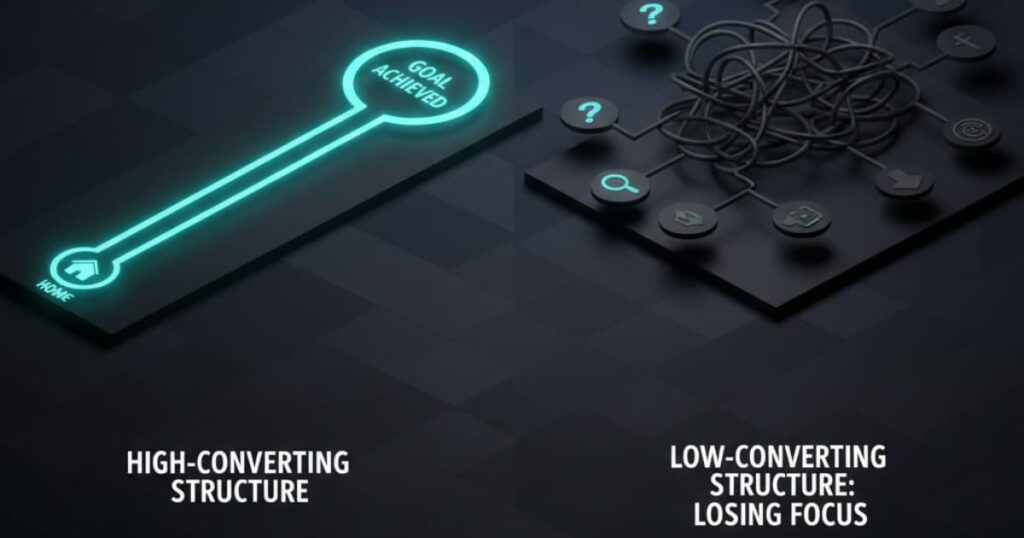
A high-converting website structure is not a layout, a theme, or a page template. It’s the decision system that determines whether a visitor moves from uncertainty to action without friction. Most websites look functional. They load fast. They explain the offer. They even get traffic. And still—leads are weak, sales are slow, and teams keep “optimizing” without results.
That’s not a performance issue. It’s a structural one. This article explains how high-converting website structure actually works, why most sites quietly fail, and how to evaluate structural options without guessing or copying trends.
Key Takeaways
- Website structure governs decision flow, not visual appeal
- Most conversion problems come from mis-sequenced information, not poor copy
- Redesigns fail when they decorate the same broken decision system
- High-converting sites reduce risk before asking for action
- Choosing structure requires criteria, not templates
Why Traffic and Redesigns Don’t Fix Conversion
When conversion underperforms, teams default to visible levers:
- more traffic,
- better copy,
- cleaner design.
These feel logical because they’re tangible and easy to change. But traffic and design only amplify what already exists. If visitors don’t quickly understand:
- where they are,
- why this page matters to them,
- what decision is expected next, then additional traffic just scales hesitation. This is why many sites experience the same pattern:
Redesign → brief engagement lift → flat conversions.
The structure didn’t change. Only the surface did.
The Most Common Misunderstanding About Website Structure
Most businesses assume website structure is a layout decision: which sections appear, in what order, on which page. That belief exists because structure is usually discussed visually. Templates, screenshots, and wireframes make conversion look like an arrangement problem.
But structure is not what appears on a page. It’s when and why something appears. When structure is mistaken for layout, teams redesign instead of diagnose. They replace sections without understanding what decision those sections were meant to support.
The result: a site that looks different but behaves the same.
What High-Converting Website Structure Actually Controls
A high-converting website structure controls three invisible variables:
1. Decision clarity
At every point, the visitor should know:
- what problem is being addressed,
- who this is for,
- and what choice comes next.
If users need to interpret before deciding, conversion slows.
2. Information sequencing
Conversion depends on order, not volume. Effective structure follows a predictable sequence:
- Orientation – where am I?
- Relevance – does this apply to me?
- Proof – can I trust this?
- Action – what do I do now?
When this order is reversed, visitors hesitate even if the message is strong.
3. Commitment timing
Calls-to-action only work after uncertainty has been reduced. Asking for contact, signup, or payment before addressing risk forces visitors to defer instead of decide. This is why many CTAs technically “exist” but rarely work.
How Structural Failure Shows Up in Real Websites
Structural issues don’t announce themselves. They surface as patterns:
- Multiple CTAs competing on the same page
- Trust signals buried below the decision point
- Navigation reflecting departments instead of user intent
- Homepages that explain everything but orient nothing
- Forms introduced before confidence is earned
Individually, these look minor. Collectively, they create cognitive drag that no headline tweak can fix.
Why Surface Fixes Rarely Work
Copywriting, CRO tools, and visual redesigns optimize parts of a site. Structure governs the system. Without fixing structure:
- Better copy increases engagement but not commitment
- New CTAs increase noise, not action
- CRO tests optimize the wrong sequence
This is why teams feel like they’re working hard but moving nowhere. They’re optimizing output without changing the system that produces it.
The Criteria That Actually Define a High-Converting Structure
If you strip away tactics, five criteria determine whether a website structure converts.
| Criterion | What It Governs | Universal or Situational |
|---|---|---|
| Decision clarity | Can users orient instantly? | Universal |
| Information sequence | Is confidence earned in the right order? | Universal |
| Risk reduction timing | Is doubt addressed before action? | Universal |
| Focus control | Is there one primary decision at a time? | Universal |
| Intent alignment | Does structure mirror user thinking? | Situational |
Any recommendation that ignores these criteria is cosmetic.
Comparing Common Structural Approaches
| Approach | What It Optimizes | Where It Works | Where It Fails |
|---|---|---|---|
| Templates | Speed | Simple, low-risk offers | Complex, trust-based sales |
| CRO tools | Incremental gains | Known decision flows | Broken structure |
| Redesign agencies | Visual brand | Repositioning | Conversion logic |
| Structural audits | Decision clarity | Revenue-critical sites | Quick aesthetic fixes |
The difference isn’t budget. It’s whether the decision path is addressed directly.
When Templates Help—and When They Hurt
Templates work when:
- the problem is familiar,
- the decision risk is low,
- and trust requirements are minimal.
They fail when:
- the offer is complex or high-ticket,
- the buyer needs reassurance,
- or multiple stakeholders influence the decision.
Copying layouts from unrelated industries breaks sequence without anyone noticing—until conversion stalls.
Choosing the Right Path Forward
Different situations require different solutions.
- DIY builders
Good for early-stage projects. Risk increases as revenue reliance grows.- CRO tools
Useful once the decision flow is already correct.- Full redesigns
Necessary for repositioning, not diagnosis.- Structural audits (e.g. Marginseye Digital)
Fit when traffic exists but conversion logic is unclear.
Structural audits don’t replace design or copy. They make those investments finally work.
Maintenance and Long-Term Reality
Structure isn’t static. As offers evolve and markets shift, decision paths drift. New pages get added. Old assumptions remain. Conversion decays quietly. High-converting sites are reviewed structurally, not just visually.
Regional Pricing Context (Why It Varies)
Pricing for structural work varies less by country and more by risk tolerance.
- US / UK / Australia: higher strategic emphasis
- Kenya / Nigeria / India: tighter ROI scrutiny
The logic stays the same. Only justification depth changes.
Common Structural Mistakes to Avoid
- Asking for action before clarity
- Adding options instead of reducing them
- Treating analytics as explanations rather than symptoms
- Improving aesthetics while ignoring decision order
Each mistake feels reasonable. Together, they stall conversion.
The Correct Framing to Keep
A high-converting website structure does one job: It removes reasons not to decide , in the correct sequence. If visitors hesitate, the structure is asking too much, too early.
Conclusion
Most websites don’t fail due to lack of effort. They fail because the decision system was never designed. Once structure is understood as the path through which confidence is built, conversion stops being mysterious. It becomes diagnosable. The real question isn’t whether your site looks modern.
It’s whether it knows when to ask, and whether it has earned the answer.
Next Read: Website Conversion Audits: How to Diagnose Structural Failure
FAQs
A structure that sequences information to reduce uncertainty before asking for action.
No. Layout is visual. Structure is behavioral.
Because copy cannot correct poor decision order.
Only when risk has already been reduced.
Yes, in low-risk, simple contexts.
Whenever offers, markets, or buyer intent changes.
No. CRO improves parts. Structure governs outcomes.
Strong interest with weak commitment.
Yes. It reflects how you think users decide.
Teams trained to analyze systems, not just pages.
