First-Party Data Advertising Strategy: Your Competitive Advantage in the Age of AI
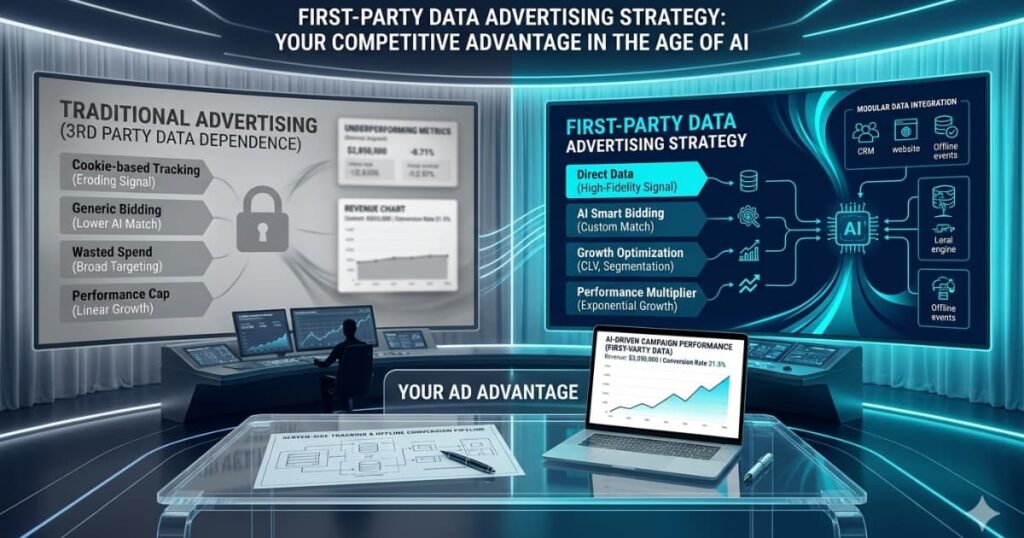
A first-party data advertising strategy is now the most important competitive variable in paid media — and most advertisers are still treating it as optional. When Google phases out a tracking mechanism, or Meta tightens its data-sharing policies, advertisers without a first-party data foundation watch their audience sizes shrink, their retargeting pools dry up, and their cost-per-acquisition climb. Those with one barely notice. The difference compounds every quarter.
AI-driven advertising systems on Google, Meta, and every other major platform run on conversion signals. The quality, volume, and architecture of the data you feed those systems determines what the AI can do with your budget. First-party data is the highest-quality input available. How you collect, structure, and deploy it is now a core competency of AI advertising performance management.
This article explains exactly what a first-party data advertising strategy involves, why it has become structurally essential, how to build one that feeds AI systems effectively, and what it means for campaign performance at a practical level.
Key Takeaways
✓ First-party data is the foundation of AI advertising performance — the quality of signals you feed platform AI systems directly determines how well they bid, target, and allocate your budget.
✓ Third-party data is eroding — browser privacy changes, iOS restrictions, GDPR, and eventual deprecation of third-party identifiers are systematically dismantling the tracking infrastructure most advertisers still depend on.
✓ Server-side tracking is the single highest-impact upgrade most advertisers can make — capturing 10–30% more conversions that browser-side pixels miss, directly accelerating AI model training.
✓ CRM segmentation multiplies lookalike quality — uploading a segmented customer list by lifetime value, recency, or channel produces audience models calibrated to your best customers, not your average ones.
✓ Offline conversion import closes the attribution gap for B2B and service businesses — passing real revenue outcomes back to the platform so AI optimises toward customers, not just leads.
✓ The performance advantage compounds — each week of accurate signal data improves the AI model while competitors with weaker data infrastructure fall progressively further behind.
✓ First-party data strategy is not a one-time setup — it requires a continuous refresh cycle: updating CRM lists, auditing conversion events, and expanding data sources as your business grows.
What First-Party Data Means for Your Advertising Strategy
First-party data is information collected directly from your audience through their interactions with your own channels — your website, your app, your CRM, your email list, your loyalty programme, your customer service touchpoints. It is data you own, data your audience has consented to share with you, and data that no platform change, regulatory update, or competitor can take away from you.
In advertising terms, first-party data functions as conversion signal infrastructure. When a user purchases from your site, subscribes to your list, books a consultation, or reaches a high-value page, that event is a signal. When you collect, store, and pass those signals back to advertising platforms in a structured, privacy-compliant way, you are feeding the AI systems that control bidding, audience modelling, and creative delivery with the most accurate and relevant data available.
This is what separates first-party data from its alternatives. Third-party data — purchased audience segments, contextual proxies, platform-inferred interests — tells the AI something about users in aggregate. First-party data tells the AI something specific about the people who actually convert with your business. The difference in signal quality is not marginal. It is the difference between a model calibrated to your actual customer base and one calibrated to a statistical approximation of it.
Three Categories of First-Party Data That Power Your Advertising Strategy
Not all first-party data carries equal weight in an advertising context. Understanding which categories matter most — and why — is the starting point for building a strategy that actually improves campaign performance.
Conversion event data is the most performance-critical category. This includes purchases, form submissions, phone calls, app installs, subscription sign-ups, and any other action that represents a meaningful business outcome. These events, when passed to platforms via server-side tagging or enhanced conversions, directly train AI bidding models. The volume, consistency, and accuracy of these signals determine how quickly and effectively AI systems can optimise toward your objectives.
CRM and customer list data — email addresses, phone numbers, customer identifiers — can be uploaded to platforms like Google Ads and Meta to create Customer Match audiences. These audiences serve two functions: direct targeting of known customers for retention, upsell, or reactivation campaigns; and lookalike modelling, where the platform’s AI uses your customer list as a seed to find users with similar characteristics. The quality of your CRM data determines the quality of both outputs.
Behavioural and engagement data from your website and app — page views, scroll depth, time on site, product views, cart additions, video plays — provides contextual signals that supplement conversion events. In high-ticket or long-cycle purchase environments where conversion volume is low, behavioural signals help platforms build audience models even before sufficient conversion data accumulates.
Why First-Party Data Strategy Has Become Structurally Essential
The shift from optional advantage to structural necessity happened along two parallel tracks: platform automation and signal deprecation. Understanding both tracks explains why a first-party data advertising strategy is no longer a sophistication layer for advanced advertisers — it is the baseline requirement for competitive performance.
The Platform Automation Track
Over the past several years, every major advertising platform has progressively replaced manual campaign management with AI-driven automation. Google’s Performance Max consolidates inventory across Search, Display, YouTube, Gmail, Maps, and Discover, with the AI controlling budget allocation, bidding, audience expansion, and creative assembly. Meta’s Advantage+ campaign architecture automates audience targeting, placement selection, and creative optimisation. LinkedIn, TikTok, and Amazon have introduced equivalent automation layers.
These systems share a common dependency: they are only as effective as the conversion signals training them. A Performance Max campaign with a well-structured conversion signal architecture — server-side tracking, enhanced conversions, offline conversion imports — will consistently outperform the same campaign with incomplete or inconsistent signals. With better data, the AI makes better decisions. As a result, the performance gap compounds over time as the model’s confidence in its predictions grows.
First-party data is what makes that signal architecture possible. Platforms cannot infer your actual customer behaviour from third-party data at the precision required to drive efficient AI optimisation. You have to provide it. Understanding how AI-powered PPC management tools use these signals helps clarify why data quality is the deciding variable.
The Signal Deprecation Track
Simultaneously, the third-party data infrastructure that paid media has historically relied on has been systematically dismantled. Apple’s App Tracking Transparency framework significantly reduced the signal fidelity available to mobile advertisers. Increasing browser privacy defaults, ad blockers, and regulatory constraints under GDPR and CCPA have reduced the reliability of pixel-based tracking.
Advertisers whose audience targeting, conversion measurement, and retargeting strategies depend on third-party data are operating on an eroding foundation. Each platform update, each regulatory change, each browser privacy enhancement narrows the data available to their campaigns. First-party data strategies are not affected by these changes in the same way. The data is yours, the consent is direct, and the signal quality is not subject to third-party platform decisions.
How a First-Party Data Advertising Strategy Feeds AI Systems: Technical Architecture
Understanding the strategic importance of first-party data is one thing. Building the technical infrastructure to deploy it effectively is another. The following describes how first-party data connects to AI advertising systems at a functional level — and what the gaps in that connection cost you in performance terms.
Server-Side Conversion Tracking
Traditional pixel-based conversion tracking fires a JavaScript tag from the user’s browser when a conversion event occurs. This approach is increasingly unreliable: browser privacy settings, ad blockers, and iOS restrictions mean a material percentage of conversions are not captured. Underreported conversion data means the AI bidding model is training on an incomplete picture of your actual results.
Server-side conversion tracking resolves this by sending conversion data directly from your server to the platform’s API, bypassing browser-side interference. Google’s Enhanced Conversions and the Meta Conversions API are the primary implementations. Server-side tracking improves conversion match rates, increases the volume of signals available to the model, and reduces the attribution gap between actual business outcomes and what the platform records. For AI bidding systems that require a minimum of 30–50 conversions per campaign per week to exit the learning phase, improving signal capture directly accelerates optimisation.
Customer Match and Audience Upload
CRM data — customer email addresses, phone numbers, loyalty identifiers — can be hashed and uploaded to Google Ads, Meta, and LinkedIn to create Customer Match audiences. These audiences enable precise targeting of existing customers for retention and upsell campaigns, and provide high-quality seed data for lookalike audience generation.
The performance value of Customer Match audiences depends on the quality and recency of your CRM data. A segmented customer list — separating high-value customers, recent purchasers, lapsed customers, and trial users — produces more targeted and more effective audience inputs than a single undifferentiated upload.
Offline Conversion Import
For businesses where the conversion event happens offline — a phone sale, an in-store purchase, a signed contract following a sales call — offline conversion import closes the attribution loop between ad spend and actual revenue. By matching CRM records of closed deals back to the ad clicks or calls that preceded them, you provide the AI bidding system with revenue-level conversion data rather than lead-level proxies.
Smart Bidding strategies become dramatically more effective when fed with offline conversion data rather than proxy metrics.
First-Party Audiences for Prospecting
Beyond retention and reactivation, first-party data enables more effective prospecting through lookalike and similar audience generation. Platform AI uses your customer data as a seed to build probabilistic models of users likely to behave similarly. Advertisers who segment by customer lifetime value, purchase category, or acquisition channel get lookalike audiences calibrated to their highest-value customer profiles.
Building a First-Party Data Advertising Strategy: A Practical Framework
Stage 1: Audit Your Current Data Collection Infrastructure
Before deploying first-party data in advertising systems, audit your conversion tracking implementation — confirming that events are firing correctly, that they represent meaningful business actions rather than engagement proxies, and that your pixel and server-side implementations are not duplicating or missing events. Review your CRM data for completeness and recency. Map all conversion events from micro-conversions like email sign-ups to macro-conversions like purchases or contract signings.
Stage 2: Implement or Upgrade to Server-Side Tracking
If you are relying exclusively on browser-side pixel tracking, implementing server-side conversion tracking via Google’s Enhanced Conversions or the Meta Conversions API is the single highest-impact technical change available to most advertisers. The improvement in conversion match rates — typically 10–30% more conversions captured — directly increases signal volume and accelerates exit from the learning phase.
Stage 3: Structure Your CRM Data for Advertising Use
Customer data sitting in a CRM is inert until structured and deployed. Segmenting by customer lifetime value, product category, recency of purchase, lead stage, and acquisition source turns a single data asset into multiple precision audience inputs: seed audiences for lookalikes, reactivation pools, acquisition exclusions, and nurture audiences for conversion-focused creative.
Stage 4: Design Campaign Objectives That Align With Real Business Outcomes
AI bidding systems optimise toward whatever conversion objective you define. Aligning campaign objectives with real business outcomes requires either tracking revenue and profit directly, or using offline conversion import and value-based bidding to pass that information back to the platform. First-party data makes this alignment possible. Without it, campaign objectives are proxies.
Stage 5: Establish a Continuous Data Refresh Cycle
First-party data depreciates. A first-party data advertising strategy requires a regular cadence of data refresh: updating CRM uploads, reviewing conversion event accuracy, auditing audience segment definitions, and incorporating new data sources as they become available.
The Performance Implications: What Changes When You Get This Right
How Your First-Party Data Advertising Strategy Compounds Results
When first-party data infrastructure is well-architected and consistently maintained: AI bidding models reach their optimisation ceiling faster. Audience models are calibrated to your actual customer base, reducing wasted impression spend. Attribution accuracy increases, making budget allocation decisions more reliable. And the performance advantage compounds — each week of accurate signal data improves the AI model while competitors with weaker infrastructure fall further behind.
The inverse is equally important to understand. This is compounded further when considering the role of AI-powered ad creatives, where the creative delivery algorithm also depends on high-quality first-party signal data to make effective asset selections.
Summary
A first-party data advertising strategy is the practice of collecting, structuring, and deploying data you own — from your customers, your website, your CRM — to improve the performance of AI-driven paid media campaigns. It matters because AI advertising systems run on conversion signals, and first-party data provides the highest-quality signals available.
If you are managing advertising through a digital agency, ensuring your agency has a defined first-party data strategy should be a non-negotiable requirement.
Frequently Asked Questions
What is a first-party data advertising strategy?
A first-party data advertising strategy is the systematic collection, structuring, and deployment of data owned directly by your business — from customers, website interactions, CRM records, and app behaviour — to improve the performance of paid media campaigns.
Why does first-party data matter for AI advertising?
AI advertising systems make bidding, audience, and creative decisions based on conversion signals. First-party data provides the most accurate and relevant signals, resulting in faster model training, better audience targeting, and more efficient budget allocation.
How do you deploy first-party data in Google Ads?
Google Ads supports first-party data through Enhanced Conversions (server-side tracking), Customer Match (CRM list uploads), and offline conversion import. Each feeds different parts of Google’s AI systems with first-party signals.
What is the difference between first-party data and third-party data in advertising?
First-party data is collected directly from your audience through your own channels. Third-party data is collected by external parties. First-party data provides more accurate signals and is not subject to privacy regulation pressures affecting third-party targeting.
How much first-party data do you need for AI advertising to work effectively?
Platform AI bidding systems typically require 30–50 conversions per campaign per week to exit the learning phase. In lower-volume environments, micro-conversions like email sign-ups and key page visits can supplement signal volume.
Does a first-party data strategy require large technical resources?
The core implementations — server-side tracking and CRM list uploads — are accessible for most businesses with developer support. The highest-impact components are often the most straightforward to implement.