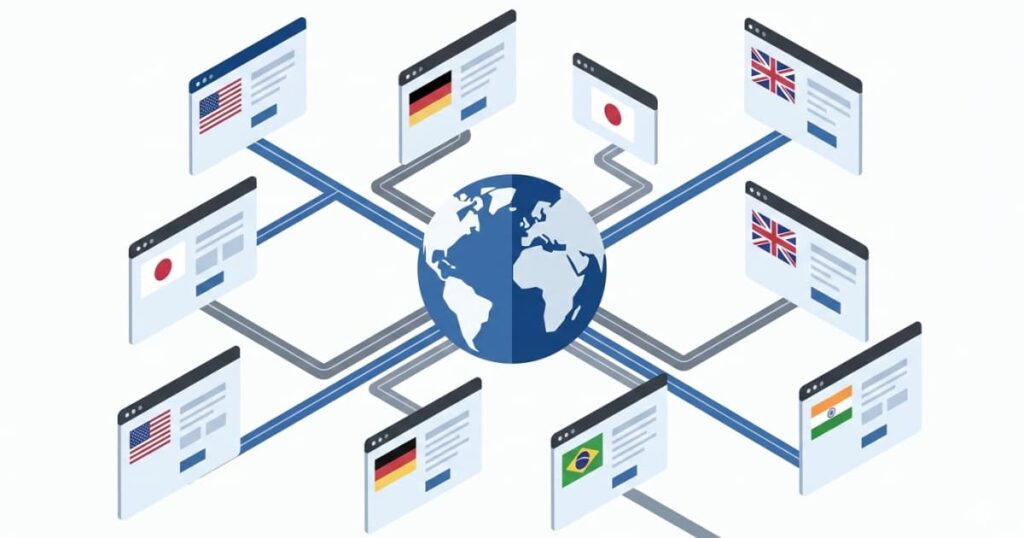
If your business serves more than one country, language, or customer segment, you have probably encountered some version of these questions:
- Should each market have its own domain, or should everything live under one roof?
- If I create separate sections for each region, does that dilute my overall site authority?
- How do I ensure search engines show the right version of my site to the right audience?
These are not simple questions. The decisions you make here affect how search engines index your content, how authority consolidates or splits across domains, and how your brand is perceived in each market you enter.
This article maps the structural options for multi-market website architecture, explains the mechanisms behind each approach, and lays out the tradeoffs clearly so your decision can be grounded in your specific situation rather than a generic recommendation.
| Key Takeaways – Multi-market website structure is primarily a decision about authority concentration vs. localisation flexibility. – Subdirectories (example.com/uk/) consolidate domain authority. Subdomains and ccTLDs split it , hreflang tags tell search engines which page serves which locale. Without them, multi-market sites create self-competition. – Content duplication across markets signals to both users and search engines that your brand lacks regional depth. – The right structure depends on your resources, brand positioning, and how differentiated each market actually needs to be. |
What Multi-Market Website Architecture Actually Means
Definition
Multi-market website architecture refers to how a website is organised to serve audiences in different geographic regions, languages, or customer segments through a single digital property or a coordinated set of properties. It is not simply about translating content. It covers decisions around URL structure, domain strategy, crawlability, indexation signals, and how authority accumulates and distributes across your web presence.
Why It Exists
As businesses expand beyond their original market, the website becomes a coordination challenge. A German-speaking user searching for a software tool expects German-language results, local pricing context, and regional case studies. A US-based user expects something different. Serving both audiences well, without confusing search engines about what belongs where, requires deliberate structural thinking.
The Three Primary Structural Models
| Structure | Example | Authority Impact | Localisation Flexibility |
| Country Code TLD (ccTLD) | example.de / example.co.uk | Authority splits per domain | High — each domain is independent |
| Subdomain | de.example.com | Partial split; treated as near-separate | Medium — shared brand, separate crawl |
| Subdirectory | example.com/de/ | Consolidates under root domain | Medium — shared infrastructure |
Why the Choice Matters
The choice between these models has compounding consequences. A ccTLD approach signals strong local commitment to search engines but requires building domain authority independently in each country. A subdirectory approach allows authority built through global backlinks and brand recognition to benefit every regional section, but requires a more sophisticated internal architecture to maintain.
The Authority Fragmentation Problem
What Fragmentation Means in Practice
Authority fragmentation occurs when the signals that search engines use to assess trustworthiness, topical depth, and relevance are spread too thinly across too many properties. When a business launches a new domain for each market without adequate investment, they often find that none of the domains rank well. Not because the content is poor, but because each domain is starting from zero authority while competing with established local players who have been building regional trust for years.
The Common Misunderstanding
Many teams assume that a market-specific domain automatically signals local commitment. In some cases it does. A well-resourced organisation with dedicated regional teams, local link-building capacity, and distinct product offerings per market can maintain separate domains effectively.
But for most organisations, the more common outcome of the ccTLD approach is a collection of underperforming domains, each lacking the content depth and backlink profile needed to compete independently.
| The Core Tradeoff ccTLDs offer the strongest local signal but each domain is an independent authority-building challenge. Subdirectories keep authority consolidated but require careful content differentiation to avoid thin-content penalties. Subdomains sit in the middle, sharing a brand signal but often crawled as separate entities. There is no universally correct answer. The right model follows from your resources, not your ambition. |
How Authority Builds and Breaks Across Structures
The Link Equity Mechanism
When an external website links to your domain, it transfers a portion of its authority. With subdirectories, all links point to one root domain and the authority flows across every section, including your regional directories. With separate ccTLDs, a link to example.de does not strengthen example.co.uk. Each domain accumulates and deploys authority independently.
hreflang: The Coordination Signal
hreflang is an HTML attribute that tells search engines which version of a page is intended for which language and region. It is the mechanism that prevents multi-market sites from competing against themselves.
Without properly implemented hreflang, a search engine may rank your US English page for a UK English query, or index only one version of a page that exists across multiple languages. The result is inconsistent regional performance caused not by content quality, but by missing coordination signals.
| Common hreflang Implementation Errors Only tagging some pages and not others — partial implementation creates mixed signals. Not including a self-referencing hreflang tag on each page. Mismatching language codes (using ‘en’ when you mean ‘en-GB’). Not maintaining reciprocal tags — if page A references page B, page B must reference page A. Implementing via JavaScript only — search engines may not execute JS during initial crawl. |
| Need a structured audit of your multi-market architecture? MarginsEye runs technical audits that map authority flow, hreflang coverage, and structural gaps across regional properties. |
Content Strategy Across Markets: Differentiation vs. Duplication
The Duplication Risk
One of the most common mistakes in multi-market SEO is treating localisation as a translation task. A team translates their US content into French, publishes it under /fr/, and considers the market covered.
Search engines evaluate content for depth, relevance, and originality. Translated content that carries the same structure, examples, and claims as the original, only in a different language, often underperforms. It lacks the local context, regional keyword alignment, and cultural specificity that locally-produced content carries.
What Differentiation Actually Requires
Meaningful content differentiation across markets means more than swapping currency symbols. It means:
- Addressing market-specific search intent, which may differ structurally from your primary market
- Incorporating regional industry context including regulations, market maturity, and competitive landscape
- Using locally relevant examples, case studies, and data sources
- Reflecting local pricing and product availability accurately
Shared vs. Market-Specific Content
Not all content needs differentiation. Thought leadership, methodology explanations, and technical documentation can often serve multiple markets with minimal adaptation. Invest in differentiation where it drives commercial outcomes: product pages, pricing, case studies, and content that directly supports conversion.
| Content Type | Differentiation Priority | Rationale |
| Product and service pages | High | Pricing, features, and compliance vary by market |
| Case studies | High | Regional relevance drives credibility |
| Blog and thought leadership | Medium | Localise examples; core argument can be shared |
| Technical documentation | Low | Usually universal; accurate translation sufficient |
| FAQs | Medium | Search intent and common questions differ by market |
| Pricing pages | High | Currency, tax, and packaging often differ significantly |
Structural Models in Practice: When Each Approach Makes Sense
Subdirectory Model
The subdirectory model (example.com/uk/, example.com/de/) is the most commonly recommended approach for organisations building international presence without dedicated regional domain budgets and link-building capacity.
The primary advantage is authority consolidation. Every backlink to any page under example.com contributes to the root domain’s authority, which benefits all regional sections. This is especially valuable for newer brands still building overall authority.
The tradeoff is flexibility. A single CMS must serve all markets, regional design customisation can be complex, and some users in certain markets perceive a local ccTLD as a stronger trust signal.
Subdomain Model
Subdomains (de.example.com) are often chosen for operational reasons: separate teams, different CMS platforms, or distinct product lines. From an SEO perspective, subdomains are treated more like separate sites than subdirectories, meaning authority does not consolidate as cleanly.
For very large organisations with distinct regional operations and the capacity to build authority independently per subdomain, this model can work. The risk is assuming the shared brand name is sufficient. From a search engine perspective, it is not.
ccTLD Model
The ccTLD model (example.de, example.co.uk) sends the strongest geographic targeting signal to search engines and can provide a meaningful trust advantage with local audiences. But it comes with the full cost of authority-building for each domain independently.
Organisations that execute this well typically have established global brand equity that generates organic inbound links across markets, local marketing teams capable of building regional link profiles, and a long-term horizon for market development.
| Decision Framework: Which Model Fits Early-stage expansion, limited resources: Subdirectory model Large organisation, independent regional teams, long-term commitment: ccTLD model Distinct product lines or platforms per region: Subdomain model Entering a market where local trust signals matter significantly: Consider ccTLD with dedicated authority investment Consolidating fragmented existing domains: Migrate to subdirectory with 301 redirects and hreflang |
Technical Implementation: The Variables That Determine Outcomes
URL Structure Consistency
Regardless of which model you choose, URL consistency within each regional section matters. Inconsistent patterns, such as mixing translated slugs with English slugs or varying the hierarchy across languages, create indexation noise and complicate hreflang implementation.
Canonical Tags and Their Interaction with hreflang
Canonical tags and hreflang tags serve different purposes and interact in specific ways. A canonical tag tells search engines which version of a page is primary. An hreflang tag tells search engines which version serves which locale. When both are present, the canonical tag takes precedence in resolving duplication. If you set a canonical tag from your German page pointing to your English page, search engines may ignore the hreflang tags entirely.
Site Speed and Regional Performance
Page experience signals apply per region. A site that performs well in the US but loads slowly in Southeast Asia because content is served from US-based servers will underperform in regional rankings. CDN configuration and regional server caching are not just infrastructure decisions. They affect SEO performance directly.
Crawl Architecture
For large multi-market sites, internal linking between regional sections should be intentional rather than accidental. If your German section links heavily to your English section through navigation elements or related content modules, you are distributing crawl budget and link equity in ways you may not intend. Regional navigation should be self-contained unless there is a deliberate reason to link across regions.
Authority Maintenance Across Markets: The Long Game
Building Regional Link Profiles
Authority in a specific market is built through regional relevance signals: links from local publications, directories, industry associations, and media coverage within that market. A strong global backlink profile does not automatically translate to regional authority in a new market.
This is why launching into a new market requires a link-building strategy, not just a content strategy. The content makes the case for authority. The links validate it in the eyes of search engines.
AI Search and Regional Retrieval
As AI-powered search interfaces mature, the retrieval mechanisms that surface content are changing. AI systems tend to favour content with clear entity relationships, structured schema markup, and demonstrated expertise. Multi-market sites that invest in structured data, including LocalBusiness schema, language-specific Organisation markup, and FAQ schema per region, will be better positioned as these retrieval mechanisms evolve.
| Build a Multi-Market Website Architecture That Holds MarginsEye works with growing businesses to design scalable, authority-first website structures for international expansion. |
Structured Summary
Multi-market website architecture is a decision about tradeoffs: between authority consolidation and localisation flexibility, between operational simplicity and regional customisation, between speed of market entry and depth of market authority.
The three structural models, subdirectory, subdomain, and ccTLD, each have legitimate applications. The mistake is not choosing the wrong model in the abstract. It is choosing a model that exceeds your current capacity to execute.
Authority fragmentation is the most common outcome of under-resourced multi-market expansion. The solution is to match your structural ambition to your actual resourcing, build the technical foundations correctly, and invest in regional content and link-building with a realistic timeline.
The businesses that build durable multi-market authority do it incrementally: one well-structured, well-supported regional presence at a time.
Frequently Asked Questions
What is the difference between international SEO and multi-market website structure?
International SEO is the broader practice of optimising a website to perform across multiple countries and languages. Multi-market website structure is the specific architectural decision about how to organise URLs, domains, and content sections to support that goal. Structure is foundational. The wrong structure creates problems that content and links cannot fully resolve.
Does Google treat subdirectories and subdomains differently?
Yes. Google’s official guidance states that both are understood, but in practice subdirectories consolidate authority more reliably under the root domain. Subdomains may be treated as separate sites in crawling and indexation decisions, though this is not absolute. For most growing businesses, subdirectories offer more predictable authority consolidation.
How important is hreflang for multi-language sites?
Essential. Without hreflang, search engines have no reliable signal for which language or regional version of a page to serve in which market. The result is self-competition, where your own pages compete against each other, producing inconsistent regional performance. Correct hreflang implementation is non-negotiable for any site serving multiple languages or regions.
Can I migrate from a ccTLD structure to a subdirectory structure without losing authority?
Yes, but it requires careful execution. The migration involves 301 redirects from old ccTLD URLs to new subdirectory URLs, updated hreflang implementation, and a monitoring period during which rankings may fluctuate as search engines process the change. Authority built on the ccTLD domain transfers through the redirects, but the process takes time. Incorrect implementation can result in significant ranking loss.
How do I decide how much content to localise versus translate?
Start with search intent analysis per market. If users in your target market search for your core topics in structurally different ways, with different terminology or context, localisation is required. If search behaviour is largely aligned with your primary market, accurate translation with local examples may be sufficient. Budget convenience is not a valid basis for this decision.
What schema markup is most relevant for multi-market websites?
LocalBusiness schema for regional offices or service areas, Organisation markup with language-specific name variants, FAQ schema for regionally differentiated FAQ content, and BreadcrumbList schema that reflects the regional URL hierarchy. As AI search retrieval becomes more structured, schema investment at the regional level will matter increasingly.
Does site speed affect multi-market SEO performance?
Yes. Core Web Vitals are measured per page and per region. If your hosting infrastructure delivers slower load times to users in a specific market, those pages will underperform in that region’s search results relative to locally-hosted competitors. CDN coverage and regional caching configuration are technical SEO issues, not just infrastructure preferences.
How long does it take to build authority in a new market?
A realistic expectation for a well-structured, actively supported new regional section is 6 to 18 months before organic traffic reaches meaningful scale. The variables are root domain authority, regional link-building activity, content depth, and market competitiveness. Underfunded market entries take considerably longer.
What is the biggest structural mistake organisations make when expanding internationally?
Launching too many regional presences simultaneously without the resources to support each one. The result is a collection of thin regional sections or domains, each with insufficient content, weak backlink profiles, and poor crawl coverage. It is structurally preferable to do one or two markets deeply than five markets superficially.
Should my primary domain language always be English?
No. Your primary domain language should reflect your primary market. If your core audience is French-speaking, structuring your root domain in French and treating English as a secondary market is more coherent than the reverse. Search engines do not penalise non-English root domains, and the authority consolidation benefits of the subdirectory model apply regardless of which language sits at the root.
