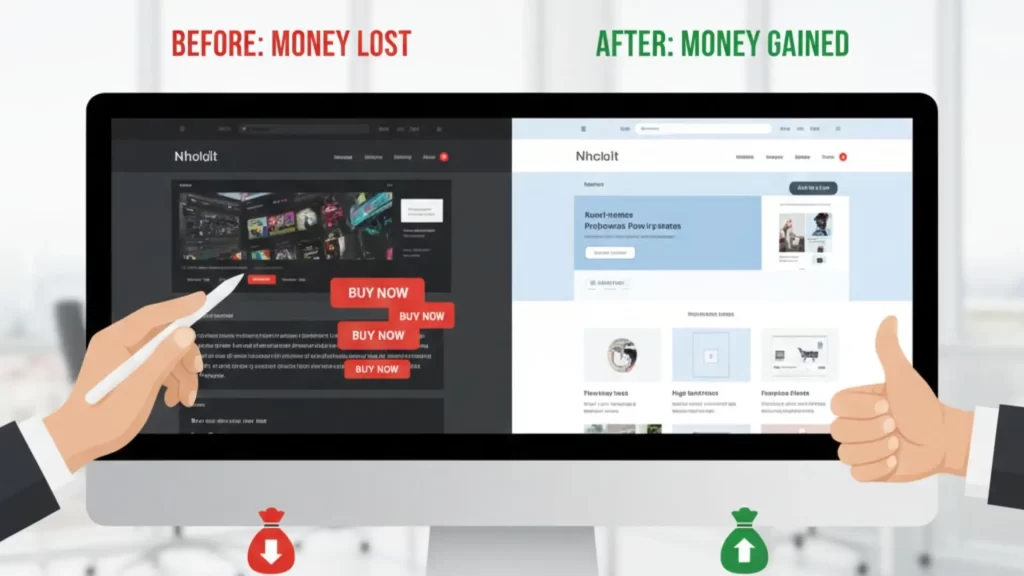
- Most Kenyan business websites lose customers because they are slow and poorly optimized for mobile.
- Websites that take more than 5 seconds to load can lose over 20% of potential sales.
- Visitors leave when they cannot quickly understand what a business does or what action to take.
- Weak calls to action and long forms drastically reduce inquiries.
- Most of these problems are simple and inexpensive to fix.
Look, I’m not here to sugarcoat things. Your website might be bleeding money right now and you don’t even know it.
Every day, potential customers land on your site, look around for a few seconds, then leave to give their money to your competitor. Not because your service is bad — but because your website quietly pushed them away.
Over 23 million Kenyans are online. About 85% are browsing on their phones — in matatus, in queues, late at night. They’re searching for services, comparing prices, and making decisions. If your website isn’t set up properly, you’re invisible to them.
Let’s break down the most common website design mistakes costing Kenyan businesses real money — and how to fix them.
What website design mistakes cost businesses the most money?
The most expensive website design mistakes are poor mobile usability, slow loading speeds, unclear messaging, and weak calls to action. These issues cause visitors to leave before contacting or buying. Most losses happen within the first five seconds of a visit.
Why does mobile design matter so much in Kenya?
Over 80% of Kenyan internet users browse on mobile phones, often on slower connections. Websites designed primarily for desktops load slowly, break on budget Android phones, and drive users away.
Yet many business websites are still designed on large computer screens, with no thought for how they look on a Tecno or Samsung A12 using 3G data.
I worked with a Nairobi restaurant that had a beautiful website. Stunning food photos, elegant layout. Their mobile bounce rate was 87%. People found them on Google, clicked through, then left immediately because the site was unusable.
After redesigning the site mobile-first — same content, same branding — the bounce rate dropped to 34%, and online orders increased by 156% in three months.
What mobile optimization actually means
- Design for thumbs, not mouse cursors
- Make buttons easy to tap (minimum 44px)
- Compress images aggressively (under 200KB)
- Test on cheap phones and slow internet
- Simplify menus to 3–5 items
- Keep forms short
How does website speed affect sales and conversions?
Every additional second a website takes to load reduces conversions by about 4–5%. Sites that load in over five seconds can lose more than 20% of potential customers, even with the same traffic.
Many Kenyan websites load fine in offices with fibre internet but fall apart on mobile data. Huge images, autoplay videos, dozens of plugins, and cheap hosting slow everything down.
If your site takes eight seconds instead of three seconds to load, you are losing money before anyone even sees your offer.
How to speed up your website
- Upgrade from cheap shared hosting
- Use a CDN like Cloudflare
- Lazy-load images below the fold
- Remove unused plugins and scripts
- Enable browser caching
- Test regularly using Google PageSpeed Insights
Aim for under 3 seconds on mobile. Over 5 seconds is dangerous.
Why do unclear websites fail to convert visitors?
Visitors leave when they cannot understand what you do within five seconds. Vague taglines and generic language force users to guess — and when people have to guess, they leave.
“Solutions for your business needs” means nothing.
“Professional services” means nothing.
Specificity converts.
Instead of:
- We provide innovative digital solutions
Say: - We build e-commerce websites for Kenyan retailers in under 4 weeks
When people land on your homepage, they should instantly know:
- What you do
- Who you do it for
- Why it’s easy to work with you
What makes a strong call to action on a website?
A strong call to action tells people exactly what will happen next and makes taking action easy. Clear wording, visible buttons, repetition, and minimal friction dramatically increase inquiries.
Most websites hide their CTAs in menus or use weak buttons like Learn More.
Better CTAs:
- Get a Free Quote
- Call Us Now
- Book a Free Consultation
Make them visually obvious, repeat them across the page, and remove unnecessary form fields.
I worked with a law firm whose only CTA was a small “Contact Us” link. After adding a clear “Free 30-Minute Consultation” button and simplifying the form, inquiries increased by 240% — same traffic, better clarity.
Why do websites break on different devices and browsers?
Websites often break because they are tested on only one device and browser. Budget Android phones, different browsers, and slow internet expose issues that make a business look unprofessional.
If your site breaks on the phones most people actually use, you’re losing customers silently.
Test your site on:
- Multiple browsers (Chrome, Safari, Firefox)
- Real Android phones, not just iPhones
- Different screen sizes
- Mobile data, ideally 3G
Why should businesses use Google Search Console?
Google Search Console shows how Google views your website and highlights indexing, mobile usability, speed, and security problems. Ignoring it means missing free information that directly affects visibility and traffic.
It tells you:
- Which pages aren’t indexed
- Which pages have mobile issues
- How your site performs for real users
- Whether Google sees security problems
Most businesses never check it — and keep paying the price.
Why does most website content fail to convert customers?
Most website content talks about the business instead of the customer’s problem. Visitors aren’t there for your story — they’re there for a solution.
Content that converts:
- Leads with benefits, not features
- Addresses objections directly
- Uses customer language, not corporate jargon
- Is easy to scan and skim
- Includes testimonials and proof
Many sites have long “About Us” pages and thin service pages. That’s backwards. Your services page should do the heavy lifting.
Why is HTTPS still critical in 2025?
HTTPS is required for security, trust, payments, and search rankings. Sites without it are flagged as unsafe, ranked lower, and avoided by customers.
Browsers warn users before they even read your content. Payment processors won’t work without it. Google explicitly favors HTTPS sites.
Most hosting providers include free SSL certificates. If yours doesn’t, change hosts.
Why do long forms reduce leads?
Every extra form field increases abandonment. Short forms consistently generate two to five times more leads than long forms using the same traffic.
Ask only for what you need now:
- Name
- Phone or email
- Short message
You can get the rest later.
How does outdated design affect trust and sales?
Outdated design signals unprofessionalism. People judge credibility in seconds based on layout, typography, and visuals.
Signs your site looks outdated:
- Shiny 3D buttons and heavy gradients
- Rotating sliders
- Fake-looking stock photos
- Tiny text
- Desktop-first layouts
Design doesn’t need to be fancy — it needs to feel current.
What should businesses do next?
Businesses should:
- Test their site on mobile immediately
- Run a speed test and fix major issues
- Rewrite their homepage for clarity
- Simplify forms and CTAs
- Review Google Search Console
- Refresh outdated design elements
These fixes don’t require huge budgets. They require attention.
The difference between a website that works and one that bleeds money comes down to fundamentals. Get them right, and your website becomes an asset. Ignore them, and you keep funding your competitors.
Your website should work as hard as you do. Want to know how to build your website better ,start today. You can choose the best website design company today.
