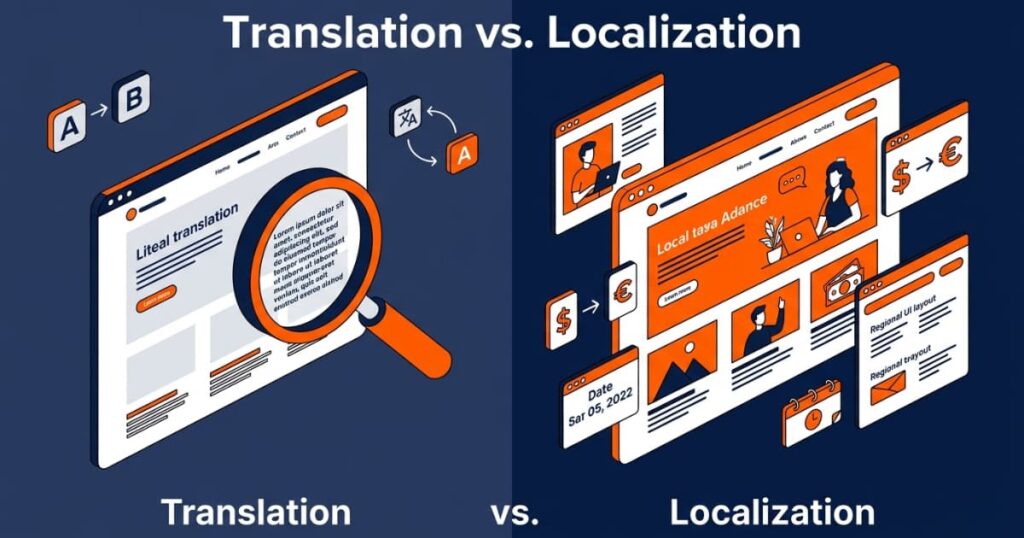
If you’ve ever watched a well-funded brand enter a new market and quietly fail, the reason is rarely the product. It’s usually the message. And more specifically, it’s usually what happened , or didn’t happen , when that message crossed a language border. Here’s what most teams get wrong: they confuse translation with localization. They treat them as points on a spectrum when they are, in fact, two different operations serving two different objectives. One converts language. The other converts meaning. This article explains what website localization vs translation actually is, and what the gap between the two costs in real international market performance.
Key Takeaways
1. Translation converts words. Localization converts the full user experience — tone, structure, cultural context, and commercial intent.
2. Most international market failures attributed to ‘low demand’ are actually localization failures in disguise.
3. Website localization affects SEO, conversion rates, trust signals, and long-term brand equity — not just language accessibility.
4. The cost of under-localization compounds over time. It is not a one-time content expense — it is a compounding market positioning decision.
5. Translation-only execution is appropriate in narrow contexts. Knowing when to deploy which strategy is itself a strategic skill.
How the Market Frames This — and Why That Framing Is Incomplete
The standard framing goes like this: translation handles language, localization handles culture. That is not wrong. But it understates what localization actually governs, and it allows teams to treat localization as a premium add-on rather than the baseline requirement it often is.
The word ‘localization’ gets applied inconsistently. In some organizations it means adding a currency symbol. In others it means full UX restructuring, legal compliance, and regional keyword strategy. That range of definitions creates confusion at the budget level, and confusion at the budget level creates underfunded execution.
What is consistently missing from the standard framing is this: localization is not primarily a language operation. It is a market-entry operation that uses language as one of its instruments.
Understanding that distinction changes how resources get allocated, how timelines get planned, and how performance gets measured.
Defining the Terms Precisely
What Translation Is
Translation is the process of converting written content from one language into another, with the goal of preserving the meaning of the source text. It operates at the sentence and word level. A skilled translator produces output that is linguistically accurate and grammatically sound in the target language.
Translation does not, by default, account for whether the translated content will resonate commercially, rank in local search, or convert a local audience. Those outcomes require a different layer of work.
What Website Localization Is
Website localization is the process of adapting a website — its content, structure, design, functionality, and market positioning — to meet the expectations and behavioral norms of a specific regional market. Translation is one component of localization, but it is not sufficient on its own.
Full localization includes:
- Linguistic translation with regional dialect and register calibration
- Local keyword research and SEO restructuring for regional search behavior
- UI/UX adjustments for reading direction, layout conventions, and screen usage patterns
- Currency, date format, unit of measurement, and legal compliance adaptation
- Cultural adaptation of imagery, color usage, social proof elements, and trust signals
- Hreflang implementation and technical internationalization (i18n) for search engine clarity
- Tone and formality calibration based on regional communication norms
Translation vs. Localization: Scope Comparison
| Dimension | Translation | Website Localization |
| Primary objective | Linguistic accuracy | Market performance |
| Scope | Content text | Full user experience |
| SEO impact | Minimal unless adapted for local keywords | Significant — requires local keyword research |
| Cultural adaptation | None by default | Core requirement |
| Technical changes required | No | Often yes (hreflang, i18n, layout) |
| Conversion optimization | Not addressed | Central consideration |
| Typical use case | Legal documents, internal communications | Market-entry, revenue-generating web properties |
| Resource intensity | Lower | Higher — cross-functional |
The Mechanism: How Each Operates Beneath the Surface
How Translation Works as a Process
Translation workflows typically follow a linear path: source content is passed to a human translator or machine translation (MT) engine, reviewed for accuracy, and returned as target-language content. Quality assurance focuses on linguistic correctness — grammar, syntax, vocabulary fidelity.
The output is measured against the source. The question being answered is: does this say the same thing in the new language?
How Localization Works as a Process
Localization workflows are non-linear and cross-functional. They require input from translators, local market specialists, UX designers, SEO analysts, legal reviewers, and often regional sales or customer success teams. Quality assurance extends beyond linguistic accuracy to include market appropriateness.
The output is measured against the target market’s expectations. The question being answered is: will this perform in this market?
Those are fundamentally different evaluation criteria, and they produce fundamentally different outputs from the same source material.
The Role of Local SEO in This Gap
This is where many international strategies break down silently. A translated website is not an internationally optimized website. Local search behavior differs significantly across markets — not just in language, but in query structure, intent pattern, and SERP feature behavior.
A French-speaking market does not simply search for the French translation of an English keyword. Regional markets have their own search vocabulary, their own question framing, and their own search volume distribution. A localization strategy accounts for this. A translation strategy does not.
The performance gap shows up in organic traffic. Translated sites frequently see low international search visibility not because the content is poor, but because it was optimized for the wrong queries in the wrong language variant.
If you’re planning international expansion or auditing an existing multilingual web presence, MarginsEye covers the full framework for international SEO architecture — including hreflang implementation, local keyword strategy, and CMS internationalization. Explore the International SEO series for structured guidance.
What the Difference Actually Costs: Performance Implications
Conversion Rate Impact
A user who lands on a translated page but encounters content that feels misaligned with local norms — whether in tone, imagery, pricing logic, or trust signals — has a higher likelihood of exiting without converting. The language barrier has been removed, but the cultural and commercial barrier remains.
This shows up as unexpectedly low conversion rates in international markets that receive adequate traffic. Teams often attribute this to low market demand or poor traffic quality when the actual variable is an experience gap between the user’s expectation and what the site delivers.
Trust Signal Misalignment
Trust signals are not universal. Testimonials, social proof formats, badge types, and authority indicators carry different weight in different markets. A review format that builds credibility in a North American context may not function the same way in a Southeast Asian or Middle Eastern market.
Localization identifies and adapts these elements. Translation leaves them intact from the source market, which means the trust architecture of the site is effectively invisible or muted to the local audience.
SEO Performance in Local Markets
International search visibility requires more than translated content. It requires:
- Correct hreflang implementation to signal language and regional targeting to search engines
- Local keyword strategy built from regional search data, not translated source keywords
- Domain and URL structure decisions (ccTLD vs. subdomain vs. subfolder) with long-term SEO implications
- Local link building and authority signals from regionally relevant sources
Translation-only execution typically addresses none of these. The result is a website that exists in a target language but is not visible in target-market search environments.
Long-Term Brand Equity
Markets carry memory. A brand that enters a market with content that feels generic, culturally indifferent, or tone-deaf is building a reputational baseline that is difficult to reverse. Localization-first entry builds brand equity from first contact. Translation-first entry often requires a costly correction cycle later — re-engagement campaigns, UX overhauls, and reputation repair — that is significantly more expensive than initial localization would have been.
Performance Risk by Strategy
| Metric | Translation-Only Risk | Localization-Optimized Outcome |
| Organic search visibility | Low — optimized for wrong keywords | Higher — built on local search data |
| Conversion rate | Below market baseline | Aligned with regional user behavior |
| Bounce rate | Elevated — experience mismatch | Reduced — cultural alignment maintained |
| Trust perception | Neutral to negative | Positive — locally calibrated |
| Brand recall | Weak — generic market presence | Stronger — differentiated positioning |
| Cost to correct later | High — rework, re-engagement | Low — built correctly from entry |
When Translation Alone Is the Right Decision
This is worth stating clearly: translation without full localization is appropriate in specific contexts. Conflating the two operations means knowing which to deploy and when.
Translation is appropriate when:
- The audience is internal, professional, or bilingual and the purpose is informational access, not commercial conversion
- The content is regulatory, legal, or technical documentation where literal accuracy supersedes cultural resonance
- The market is being tested at minimal investment before a full localization commitment is justified
- The product or service category carries minimal cultural dependency — certain B2B SaaS tools, for example, operate across markets with relatively low cultural variance
Full localization is required when the objective is sustained commercial performance in a new regional market. The threshold is not arbitrary — it is determined by how much cultural, behavioral, and contextual variance exists between the source market and the target market, and how much that variance influences conversion.
An Application Framework: How to Evaluate Your Current Position
Step 1: Audit Existing International Pages
Identify which pages in target-language versions are translations only versus pages that have received localization treatment. Separate these into two groups for performance benchmarking.
Step 2: Benchmark Against Local Search Performance
Use regional keyword research tools to identify the top local queries for your category in each target market. Compare these against the keywords your translated pages are currently optimized for. The gap between the two is your localization deficit in SEO terms.
Step 3: Evaluate Trust Signal Architecture
Review your social proof, testimonial, certification, and authority signal formatting across regional versions. Identify elements that were carried over from the source market without regional adaptation. Flag these for localization review.
Step 4: Prioritize by Revenue Potential
Not all markets require the same localization depth at the same time. Prioritize full localization effort for markets with the highest revenue potential or the highest existing traffic that is not converting. Apply translation-level effort to markets in early testing phases.
Step 5: Establish a Localization Maintenance Protocol
Localization is not a one-time project. Markets evolve, search behavior shifts, and product positioning changes. A sustainable international presence requires a content maintenance workflow that keeps regional versions current, not just launched.
Forward-Looking Considerations: AI, Search, and Localization
The emergence of AI-generated content and machine translation has lowered the cost of translation dramatically. This creates a structural risk: the economics now favor translation-only approaches in a way they did not three years ago, which means more markets will be entered with translation-level execution while localization becomes a competitive differentiator rather than a standard practice.
Simultaneously, AI-powered search and answer engine retrieval are increasingly sensitive to the authority and cultural specificity of content. Pages that feel generic — the primary characteristic of under-localized content — are less likely to be cited or surfaced in AI retrieval contexts than pages that demonstrate deep, regional-specific expertise.
The implication is directional: as AI tools make translation cheaper and easier, the performance premium on genuine localization will increase rather than decrease. Organizations that invest in full localization are building a content asset that becomes more competitively defensible over time, not less.
Structured Summary
Translation and website localization are distinct operations with different objectives, different processes, and different performance implications. Translation converts language. It is appropriate when the goal is informational access and cultural variance is low. Localization converts the full user experience. It is required when the goal is commercial performance in a regional market and cultural, behavioral, or structural variance between source and target markets is material.
The cost of treating localization as translation is measurable across multiple performance dimensions: organic search visibility, conversion rate, trust signal effectiveness, and long-term brand equity. These costs compound over time and are significantly more expensive to correct after market entry than to address at the point of entry.
The strategic question is not whether to localize. It is which markets require what depth of localization, and when.
Next Step for Your International Strategy
If you are planning market entry or auditing an underperforming international web presence, start with a localization gap analysis. Identify where your current execution is operating at translation depth in markets that require localization depth. The gap between the two is your first optimization priority.
MarginsEye covers international SEO architecture, multilingual content strategy, and structured market entry frameworks for organizations building durable international digital presence.
Next Read
Global Website Design in 2026: How to Build for International Audiences.
Frequently Asked Questions
1. Is machine translation ever sufficient for website localization?
Machine translation can produce linguistically functional output, but it does not perform localization tasks — cultural adaptation, local SEO, trust signal calibration, and UX adjustment all require human judgment and market-specific expertise. MT is appropriate for first-draft speed in low-stakes content; it is not sufficient for revenue-generating web pages in new markets.
2. How much does website localization cost compared to translation?
The cost differential depends heavily on market complexity and content volume, but localization typically costs 3–5 times more per word than translation alone when SEO, cultural review, and UX adaptation are included. The relevant comparison, however, is not translation cost versus localization cost — it is localization cost versus the cost of entering a market with under-performing content and correcting it later.
3. What is hreflang and why does it matter for localization?
Hreflang is an HTML attribute that signals to search engines which language and regional version of a page to serve to which users. Correct implementation is a technical requirement for international SEO performance. Translated pages without proper hreflang configuration are frequently misrouted in search results, causing cannibalization between language versions or reduced visibility in target markets.
4. Should every market receive the same level of localization?
No. Localization depth should be proportional to market revenue potential, cultural variance from the source market, and the commercial objective. High-priority markets with material cultural distance from the source require full localization. Emerging or test markets may operate at translation depth until performance data justifies increased investment.
5. What content elements are most commonly missed in localization?
The most frequently under-localized elements are: local social proof formats, trust badges and certifications, imagery and color usage, CTA phrasing and commercial tone, pricing and payment method presentation, and legal or compliance disclosures. These are elements that translation tools and workflows do not flag because they are structural rather than linguistic.
6. How does localization affect SEO specifically?
Localization affects SEO through local keyword strategy (target market queries differ from translated source queries), hreflang implementation, URL structure decisions, local content depth, and regional link authority. A translated site ranks for different — and typically lower-volume — queries than a fully localized site built on local search data.
7. What is the difference between internationalization (i18n) and localization (l10n)?
Internationalization is the technical process of building a website to support localization — structuring the codebase, CMS, and architecture to accommodate multiple languages and regional variants. Localization is the content and experience adaptation applied to specific markets. Internationalization is the infrastructure; localization is the execution that runs on it.
8. Can AI tools replace human localization specialists?
AI tools currently accelerate localization workflows — particularly in translation, terminology management, and content scaling — but they do not replace the judgment required for cultural adaptation, market-specific SEO strategy, or brand voice calibration. The correct frame is AI-assisted localization rather than AI-replaced localization. Human oversight remains a performance variable, not an optional upgrade.
9. How do I know if my international pages are under-localized?
Key indicators include: international pages receiving traffic but converting below the site baseline, low organic visibility in target-market search results for relevant queries, high bounce rates on regional pages compared to the source-language equivalent, and user research or customer support data indicating experience confusion or brand misalignment in target markets.
10. What industries see the highest cost from translation-only execution?
E-commerce, financial services, healthcare, legal services, and hospitality consistently show the highest performance gaps from under-localization because conversion in these categories is heavily influenced by trust, cultural expectation alignment, and locally calibrated social proof. B2B SaaS with technically sophisticated audiences tends to show lower cultural variance and can tolerate translation-level execution for longer before performance gaps become material.
11. How long does a full website localization project take?
Timeline depends on content volume, market complexity, and whether internationalization infrastructure is already in place. A mid-size commercial website entering two to three new markets typically requires 8–16 weeks for full localization when local keyword research, UX adaptation, and technical implementation are included. Translation-only timelines for the same content volume are typically 2–4 weeks. The time differential reflects the scope differential.
12. What is the right internal team structure for managing localization at scale?
Sustainable localization at scale requires ownership at the intersection of content, SEO, and regional market expertise. This is typically structured as a central localization program office coordinating with regional market teams, supported by a translation management system (TMS) and a vetted network of in-market linguists and cultural reviewers. The critical failure mode is routing localization entirely through a content team without regional market input — this produces translation-quality output at localization-quality cost.
