Website Templates vs Custom Design: Which One Do You Actually Need
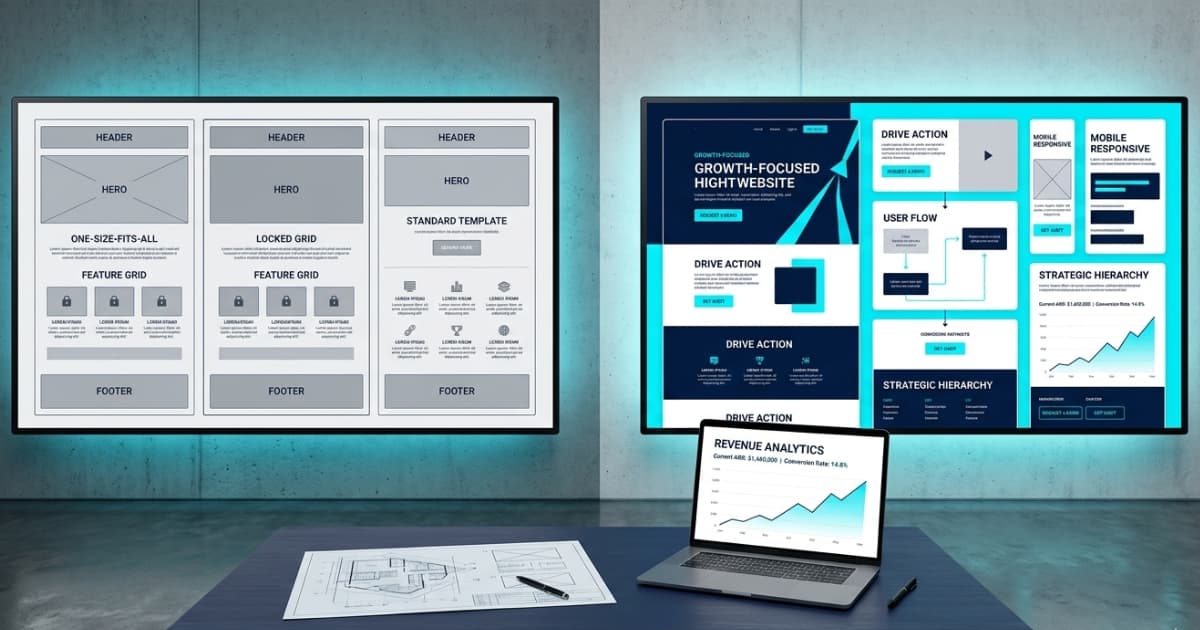
The big question on website templates vs custom design is always a hot one. Most businesses don’t lose money because their website looks bad. They lose money because the site’s structure can’t support how the business actually makes money once growth starts. That mismatch doesn’t show up on launch day. It shows up six months later, when traffic increases, when offers evolve, and when small limitations start slowing everything down. By then the team is already talking about a refresh, a redesign, or a rebuild. Money spent twice on a problem that was structural from the beginning. Custom Website Design vs Templates is treated as a design debate. It isn’t. It’s a structural revenue question. And the answer isn’t determined by budget , it’s determined by what the website is expected to carry, and whether the structure you chose can actually carry it. This article explains how both options behave over time, what breaks first, and how to know which decision is right for where your business actually is.
What this article covers:
-
- Why this is a revenue decision, not a design preference
-
- How templates and custom sites behave differently as the business grows
-
- The trigger-based break-even logic (not a timeline)
-
- Operational signals that tell you a structural ceiling has been reached
-
- When custom design is actually a bad investment
-
- Where website budget gets quietly wasted , before design even starts
The Question Nobody Is Actually Asking
The typical framing goes like this: templates are cheaper and faster, custom is better but expensive. Most articles give you a pros and cons list and let you decide. That framing is useless because it misidentifies the actual question. The real question is not “which option is better?” The real question is: “What does my website need to do, and which structure can actually do it without requiring a rebuild in twelve months?”
A website is not a one-time deliverable. It’s an operating asset. The structure you choose determines how easily you can test ideas, adjust offers, improve conversion, and adapt as the business changes. Choose the wrong structure for your stage and you don’t just lose the upfront cost , you lose the time and money spent working around limits that shouldn’t have existed. That is the decision this article is designed to help you make.
What “Structure” Actually Means, And Why It Drives Revenue
Structure is not how a website looks. Structure is how the site is organised to move a visitor toward a decision. It includes navigation logic, page hierarchy, content sequencing, how trust is built across pages, where friction appears, and whether the site’s data layer can tell you what’s working. Visual design sits on top of structure. If the structure is wrong, a better-looking design doesn’t fix the problem. It just makes the problem look better.
The Revenue Sequence Every Website Runs On
Every website that makes money runs the same sequence:
Traffic → Clarity → Trust → Action → Retention
Traffic arrives. The visitor needs immediate clarity about whether this is relevant to them. If it is, trust needs to build fast enough that they don’t leave. If trust builds, they take an action , a purchase, a form fill, a call booking. If the action was right, they return.
Design only matters where it reduces friction inside that sequence. Revenue problems happen when the sequence breaks — and it almost always breaks at the structural level, not the visual one. Traffic increases but the page doesn’t guide decisions. Content exists but doesn’t answer buying questions. Pages are present but poorly sequenced, so visitors lose orientation and leave.
That is why websites that look excellent can still underperform. The failure is structural.
Where Structure Fails and Revenue Leaks
Structural failure is rarely dramatic. It accumulates. The site works well enough at low traffic. Then the business grows, the offer changes, a new audience segment appears , and the existing structure can’t adapt cleanly. Small workarounds get added. Plugins patch gaps. Pages multiply without a navigation system that connects them. The site starts working against the business instead of for it.
Before committing to a redesign, it helps to understand exactly what that process involves and what decisions need to be made before any build starts. The website redesign checklist covers those decisions in sequence, so you’re not rebuilding blind.
How Templates Behave Over Time
This section isn’t a case against templates. Templates are the right structural choice in many situations. The problem is not using them, it’s staying on them after they’ve stopped supporting how the business operates.
What Templates Are Built to Do
Templates are pre-built site structures designed for speed and reuse. They assume most businesses can operate inside a standard pattern with minor edits. That assumption is often correct , especially early. Templates solve real problems: they launch fast, they cost less upfront, they require less strategic input before build, and they handle the basics of an informational or early-stage site cleanly. For a business that hasn’t yet proven its revenue model, a template is not a compromise. It’s the sensible choice.
Where templates are well-suited:
-
- Early-stage businesses with unproven revenue models
-
- Sites that are primarily informational , not conversion-dependent
-
- Businesses where the offer is still evolving frequently
-
- Situations where speed to market matters more than structural depth
Where Templates Start to Strain
The strain doesn’t appear suddenly. It’s a gradual tightening. Conversion rates flatten despite rising traffic. A change that should take a developer an hour takes three because the theme structure conflicts with what’s needed. A new landing page is added but doesn’t connect cleanly to the navigation logic. A plugin is installed to add functionality the theme doesn’t support. Then another. Then another. The site doesn’t collapse. It just becomes harder to improve. Every change takes longer. Every addition creates a new dependency. The site starts resisting the business instead of supporting it.
Where templates start to strain:
-
- Buying decisions are complex and require different content paths for different audiences
-
- Funnels need to differ by segment, location, or offer type
-
- Conversion rate optimisation requires clean testing without structural interference
-
- Content needs to expand without breaking navigation or load performance
-
- Integrations multiply and start conflicting with the theme structure
The Hidden Cost Structure of Template Websites
The upfront cost of a template is visible. The compounding costs are not. Over time, template-dependent sites accumulate costs through: recurring plugin subscriptions that patch functionality gaps, extra developer hours spent working around theme constraints rather than building clean solutions, partial rebuilds when a plugin stops working or conflicts with an update, and performance degradation as the plugin stack grows.
That last point matters more than most businesses realise. A plugin-heavy WordPress template can degrade load performance significantly over time , and site performance directly affects both search visibility and conversion rates. The cost shows up in lost traffic and lower conversion, not just in the developer’s invoice.
These costs don’t appear as one big bill. They show up as quiet, recurring friction. By the time the total is tallied, it often exceeds what a properly structured custom site would have cost, without the compound returns that a custom site would have generated.
Still Deciding Between Custom Website Design v Templates
That question usually means the structure decision hasn’t been made clearly yet , and building before that clarity is where most website budgets get wasted. Book a free 30-minute strategy call. We’ll map exactly which structure your business needs right now and why.
How Custom Websites Behave Over Time
Custom websites cost more upfront and take longer to launch. That is true and worth stating plainly. But the financial logic of custom design doesn’t live in the build cost , it lives in what happens in the eighteen months after launch.
What Custom Actually Changes (Not What You Think)
Custom website design is not primarily about how the site looks. It’s about how the site is built , and who it was built for. A custom site is designed after understanding how users make decisions on this specific site, what questions delay action, what content builds trust for this specific buyer, and where conversion friction appears in this specific journey. That understanding shapes information architecture, navigation logic, content hierarchy, and data structure , not just colour choices and layout preferences.
Operationally, custom changes:
-
- Faster edits — because structure was built to be changed, not worked around
-
- Cleaner analytics — because the tracking layer was set up intentionally, not patched in
-
- Fewer workarounds — because the architecture matched the use case from the start
-
- Easier testing — because pages can be adjusted without structural interference
-
- Clear ownership of structure — because every decision was made deliberately
Where Custom Starts to Compound
The compounding effect of custom design is what makes it financially interesting for businesses at the right stage. Because the structure was built around how users decide, every change you make builds on the last. A conversion improvement in month three doesn’t conflict with the navigation change from month one. A new audience segment can be served with a new content path without rebuilding the existing ones. Integrations connect cleanly rather than conflicting with a theme structure they weren’t designed for.
This compounding effect becomes most visible when the business serves more than one audience or operates across markets. When a site needs to serve more than one market or buyer type, template logic starts to fracture quickly , and the cost of maintaining parallel structures inside a theme constraint grows rapidly. Custom architecture is what allows that complexity to scale without the site becoming unmanageable. Instead of rebuilding, teams refine. Instead of patching, they iterate. That is where the long-term ROI of custom design actually comes from, not aesthetics, but the speed and cost of learning.
When Custom Is a Bad Investment
Custom is not always the right choice. It is a mistake when:
-
- The business model hasn’t been proven, the site’s structure should match a stable revenue logic, not guess at one
-
- Traffic is inconsistent , conversion optimisation only compounds when there’s enough traffic to test against
-
- The site is not tied to revenue generation , an informational or brand-presence site doesn’t need the architecture of a conversion engine
-
- Decisions are still exploratory , if the offer, audience, or funnel is changing every quarter, structural investment is premature
In these cases, custom design is spending money on structure before the business knows what structure it needs. The right sequence is: prove the model, stabilise the offer, then build the structure that supports it.
Learn how to create high converting Websites Today that bring results
The Break-Even Logic, Trigger-Based, Not Timeline-Based
There’s no universal point at which custom overtakes templates. The question is not “how long have I been on a template?” The question is “does my current structure support how my business actually makes money right now?” That is a trigger-based decision, not a timeline-based one.
When Templates Still Make Sense
A template continues to serve the business well when:
-
- Revenue is inconsistent or still being validated
-
- The site is informational, it supports the business without being the engine of it
-
- Offers change frequently enough that deep structural investment would need to be undone quickly
-
- Speed to launch still matters more than speed to improve
The mistake is not using a template. The mistake is staying on one after the business conditions above no longer apply.
When Custom Starts to Pay For Itself
Custom begins to generate returns when:
-
- The website directly drives leads or sales, not just awareness
-
- Marketing spend depends on conversion efficiency , where ad spend ROI is tied to landing page performance
-
- Decisions rely on data and testing, which requires a tracking and structure layer that can support controlled changes
-
- Content and offers evolve quarterly, not yearly , requiring a structure that adapts without rebuilding
It’s worth noting that this calculus is shifting. As AI changes how buyers find and evaluate options, the structural quality of a website, its clarity, its internal architecture, its ability to answer decision-stage questions , is becoming a direct competitive variable. Sites with weak structure are not just harder for users to navigate. They’re harder for AI systems to interpret and recommend. That changes the long-term return on structural investment significantly.
Operational Signals You Have Outgrown Your Template
Most business owners feel this before they can name it. The site starts to resist the business , small friction in every direction. Here are the operational signals that indicate a structural ceiling has been reached.
| Signal checklist: you have outgrown your template when…Small changes take disproportionately long, and the answer is always “it’s complicated with this theme” Conversion rates have plateaued despite increasing traffic Pages can’t adapt cleanly to different buyer types or audience segments You’re running more than five plugins to patch functionality the theme doesn’t support natively Analytics data is unreliable or incomplete because tracking was added after the fact Every improvement discussion ends in a rebuild conversation You’re planning a ‘refresh’ rather than a specific structural improvement Developers spend more time on workarounds than on actual development |
These are not design problems. They are structural ceilings. The template did its job , it helped the business launch. The ceiling is not a failure of the tool. It’s a sign that the business has grown past what the tool was designed to carry.
| Not sure which side you’re on? If the signals above sound familiar, the issue is almost never the tool, it’s that the structure was chosen before the business had enough clarity about how it makes money. That’s a strategy problem, not a design problem. The Website Strategy & Revenue Advisory gets you that clarity before you spend anything on design or build. |
Where Website Budget Gets Quietly Wasted
Most website budget waste happens before design starts. Not in the choice of custom versus template — in the absence of structural clarity before any money changes hands.
The most common patterns:
Paying for build before decisions are made.
The brief says ‘we need a new website.’ No one has mapped how the site makes money, what the conversion path looks like, or what success means in twelve months. The designer builds something. It looks right. It doesn’t perform. The redesign conversation starts nine months later.
Solving the wrong problem with design.
Conversion problems get treated as visual problems. A new design is commissioned when the issue is information architecture — the sequence in which content builds trust and guides decisions. A better-looking page with the same structural logic produces the same results.
Optimising a page that sits in the wrong position.
A landing page gets redesigned for conversion. But the traffic arriving at that page hasn’t been pre-qualified. The structural failure is upstream , in how traffic is routed and primed before it reaches the conversion point. Optimising the endpoint doesn’t fix the pipeline.
Tools don’t waste money. Unclear structure does. The most expensive website decision isn’t custom versus template. It’s spending money on either without first understanding what the site needs to do and whether the chosen structure can do it. That is what Website Strategy & Revenue Advisory is designed to resolve . before the build invoice arrives.
What to Do Before You Spend Anything on Website Design
The sequence matters more than the choice. Most businesses get into trouble not because they picked the wrong type of site , but because they made the structural decision too early, before they had the clarity needed to make it well.
Before committing to a custom build or a template, work through these four questions:
1. What is the site expected to do? Not in general terms, specifically. How many leads per month? What conversion rate on which pages? What does the business look like when the website is performing?
2. Is the revenue model stable enough to build structure around? If the offer, audience, or funnel is still shifting, structural investment is premature. Prove the model first.
3. What does the conversion path actually look like? Map the sequence from traffic arrival to action taken. Identify where trust breaks down, where questions go unanswered, where the site loses the visitor. That map determines what structure is needed , not the other way around.
4. Which structural choice supports iteration speed? Given how frequently offers and audiences will change in the next twelve months, which structure will make it cheaper and faster to adapt , not just today, but six months from now?
Strategy before design is not a luxury. It is the decision that determines whether the design spend works. Businesses that skip this step don’t just waste the design budget, they waste the time spent managing a site that was never structured to perform.
Next Article >>>>>>>>>>>>>>>>5 Reasons Small Business Owners Should Use Website Templates Now
Need A Clear Next Step?
Book your Advisory Session
In a relaxed 30‑minute call, we’ll:
- “Identify a clear structural direction”
- “Fewer unknowns”
- “Better use of Budget”
No sales pitch, just practical recommendations you can use right away.
FAQ: Website Templates vs. Custom Design
1. What is the difference between a website template and a custom website design? A website template is a pre-built layout that you populate with your own content — available on platforms like WordPress, Wix, or Squarespace. Custom website design starts from scratch, built specifically around your business’s structure, conversion goals, and audience. The real difference isn’t visual — it’s structural. A template assumes your business fits a standard pattern. A custom site is built around how your specific business actually makes money.
2. Is a website template good enough for a small business? Yes — in many cases. If your revenue model is still being validated, your offer changes frequently, or your site is primarily informational rather than a direct sales or lead-generation engine, a template is the sensible choice. The mistake isn’t using a template; it’s staying on one after your business has grown past what it was designed to carry.
3. How much does a custom website design cost compared to a template? Template-based websites are significantly cheaper upfront — often a few hundred dollars versus several thousand for custom design. However, the real cost comparison happens over time. Templates accumulate hidden costs through plugin subscriptions, developer workarounds, partial rebuilds, and performance degradation. A properly structured custom site often costs less in total over 18–24 months than a plugin-heavy template that constantly needs patching.
4. When should I upgrade from a template to a custom website? The trigger isn’t time-based — it’s performance-based. You’ve likely outgrown your template when: small changes take disproportionately long because of theme constraints, conversion rates have plateaued despite growing traffic, you’re running five or more plugins to patch functionality gaps, or every improvement discussion ends in a rebuild conversation. These are structural ceilings, not design problems.
5. Does a custom website rank better on Google than a template? Not automatically — but structurally, custom websites have an advantage. They can be built with clean information architecture, intentional internal linking, and optimised performance from the ground up. Template sites with large plugin stacks often suffer from slower load times and bloated code, both of which negatively impact search rankings. SEO performance is a byproduct of structural quality, not template vs. custom alone.
6. Can I customise a website template to make it look unique? To a degree, yes. You can change colours, fonts, images, and some layouts. But the underlying structure — how pages are connected, how content is sequenced, how users move toward a decision — is determined by the template’s logic, not yours. If your conversion path or audience journey differs from what the template assumes, you’ll hit limits that visual customisation can’t solve.
7. Is custom website design worth it for a startup? Usually not at the start. Custom design requires a stable revenue model to build structure around. If your offer, audience, or funnel is still shifting, spending on deep structural investment is premature — you’d be building architecture around a business that hasn’t yet found its footing. Prove the model first, then invest in the structure that supports it.
8. How long does it take to build a custom website vs. using a template? A template-based site can launch in days. A custom website typically takes weeks to months depending on complexity. That speed difference is real — but it only matters if speed to market is more valuable to you right now than speed to improve. Once live, custom sites are generally faster to update and test because they were built to be changed, not worked around.
9. What are the hidden costs of using a website template? The upfront savings are visible; the compounding costs are not. These include recurring plugin subscription fees to patch functionality the theme doesn’t support, extra developer hours working around theme constraints, partial rebuilds when plugins conflict or break after updates, and performance degradation as the plugin stack grows — which directly affects both SEO and conversion rates.
10. Does my website structure affect my conversion rate? Yes — more than most businesses realise. Conversion problems are almost always structural, not visual. The sequence of how your site builds trust, answers buyer questions, and guides decisions determines whether visitors take action. A better-looking page with the same structural logic produces the same results. That’s why high-traffic sites with polished designs can still underperform.
11. Can I use a page builder like Elementor or Divi to get the benefits of custom design? Page builders give you more flexibility than rigid templates, but they don’t replace strategic structure. You can build a visually unique site with Elementor — but if the information architecture, content hierarchy, and conversion logic weren’t deliberately planned, you still have a structural problem. The tool is not the strategy. Custom design is about intentional decision-making before and during the build, not just the software used.
12. How do I know if my website is holding back my business growth? Watch for these signals: traffic is increasing but leads or sales are flat; your team regularly proposes a “refresh” without identifying a specific structural problem; developers spend more time on workarounds than improvements; analytics are incomplete or unreliable because tracking was added as an afterthought; and new offers or audience segments can’t be added cleanly without a partial rebuild. These aren’t design issues — they’re signs the structure was chosen before the business had enough clarity about how it makes money.