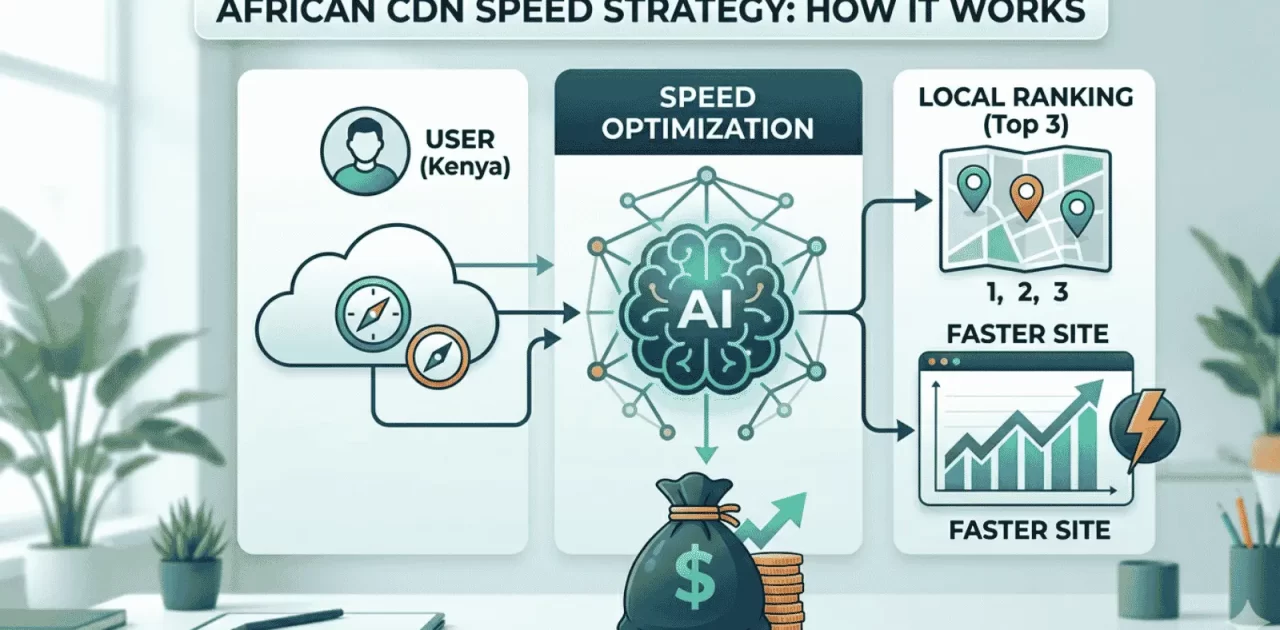
Your website is your business’s first impression. And in East Africa, that impression is happening on a mobile phone, on a mixed 3G and 4G signal, in the middle of someone’s busy day. If your pages take more than three seconds to load, the person on the other end has already moved on and found someone else. This is the reality most small business owners here do not talk about enough. You pay for a decent hosting plan, you build a good-looking site, and then you sit back wondering why visitors are not converting. Meanwhile the problem is not your design. It is the distance your content is traveling. Most website hosting servers sit in Europe or North America. When someone in Nairobi opens your site, that request travels from their phone, across the Indian Ocean via undersea cables, to a server in Frankfurt or Virginia, and all the way back. According to Cloudflare’s network documentation, this round-trip latency alone adds 200 to 400 milliseconds to every single request before a byte of your content moves. Stack that across the 50 to 80 resource files that make up a typical business website and you quickly understand why African users routinely experience load times of five to eight seconds on sites that feel instant to someone in London.
A Content Delivery Network, or CDN, solves this problem by storing copies of your website’s assets on servers located physically close to your users. Cloudflare defines a CDN as a geographically distributed group of servers that work together to provide fast delivery of internet content. Cloudflare currently operates an edge node right inside Nairobi and another in Johannesburg. When your visitor in Karen or Westlands opens your site, they are no longer waiting for content from Frankfurt. They are getting it from a server that is practically around the corner. This guide is part of Marginseye Digital’s Website Design for Business Growth series, which covers every tool and strategy you need to build a website that works for your East African audience. What is the best CDN for African users? Cloudflare CDN for African users is currently the most accessible and cost-effective option for East African businesses because it offers a genuinely free plan with no time limit, has edge nodes in Nairobi and Johannesburg, and takes under an hour to set up even without technical experience.
→ Start with Marginseye Digital’s free Website Audit to see your current speed situation
This guide is reviewed and updated monthly. Last verified: May 2026. Next update: June 2026.
Key Takeaways
- Cloudflare CDN for African users reduces page load times by serving content from nearby edge nodes in Nairobi and Johannesburg, cutting latency by up to 80 percent for East African visitors.
- The Cloudflare Free plan covers the CDN, DDoS protection, and SSL certificate at zero cost, making it accessible for East African startups and small businesses operating on tight budgets.
- Websites using Cloudflare CDN for African users typically see load times drop from five to eight seconds down to under two seconds on local mobile networks.
- A faster website directly improves your Google Core Web Vitals scores, which affects how prominently your site appears in Kenyan and East African search results.
- Cloudflare CDN works alongside WhatsApp Business and M-Pesa integrations without disrupting your lead capture or payment flows when configured correctly.
- Setting up Cloudflare CDN for your African business website takes less than one hour and does not require a developer for a standard WordPress or Elementor site.
Why Are Business Websites in East Africa So Frustratingly Slow for Local Users?
The most common reason East African business websites underperform is geography. Your hosting provider almost certainly has its servers in Europe or the United States. This works reasonably well for companies targeting Western markets, but it creates a fundamental bottleneck for every single user on your side of the world. According to the Speedtest Global Index, the average mobile download speed in Kenya is around 22 Mbps. That is a respectable number. But download speed tells only part of the story.
Latency, which is the time it takes for a signal to travel between your user’s device and your server and return, is the real culprit. Latency between Nairobi and a European data center sits at 150 to 300 milliseconds per round trip under normal conditions. For a web page that makes 60 separate server requests, that means roughly 9 to 18 seconds of added latency before a single line of visible content has loaded. Most users in Kenya will not wait that long.
Another problem is that every page request hitting your origin server directly means traffic spikes can bring a standard shared hosting plan to its knees. A single Instagram post driving 200 people to your website at the same time creates a load your cheap hosting plan was never designed to handle. Research from Google and Deloitte found that just a 0.1-second improvement in page load time increases conversions by 8 percent on retail sites. For East African businesses competing for the same mobile-first customer, the speed gap between you and a well-optimised competitor is costing you real money every single day.
Additionally, most business owners here do not discover their website is slow until a customer mentions it, by which time the lost sales are already gone. The businesses that fix this problem proactively are the ones that capture the customers everyone else is losing.
→ See exactly how your website is performing right now with Marginseye Digital’s free Website Audit
How Does Cloudflare CDN for African Users Actually Solve the Speed and Latency Problem?
Fortunately, the solution to the latency problem does not require moving your entire hosting setup or spending money on a local African server. Cloudflare CDN for African users sits in front of your existing host and handles content delivery from the server closest to each visitor, without touching your origin hosting arrangement.
When a user in Nairobi requests your home page, Cloudflare intercepts that request at its Nairobi edge node before it ever reaches your hosting server in Europe. If Cloudflare already has a cached copy of that page, it delivers it instantly from Nairobi. If the content has not been cached yet, Cloudflare fetches it from your origin server once, stores it at the Nairobi edge, and serves it quickly to that user and to every subsequent visitor in the same region.
To address the server load problem, Cloudflare absorbs the bulk of your traffic before it reaches your origin server. During traffic spikes, your hosting plan stays stable because Cloudflare is handling the load at the edge. According to Cloudflare’s network documentation, their global network processes over 5 trillion requests per month and blocks billions of threats daily, including the kind of bot traffic and DDoS attacks that can slow or take down small business hosting plans.
Additionally, Cloudflare handles your SSL certificate automatically on the free plan. Your site is served over HTTPS without any extra configuration on your part. This matters because Google has used HTTPS as a ranking signal since 2014, and customers in East Africa are increasingly suspicious of sites that show a “not secure” warning in their browser.
What Marginseye Digital Has Found Configuring Cloudflare Across East African Business Websites
At Marginseye Digital, we have configured Cloudflare for business websites across Kenya, Uganda, Tanzania, and Rwanda, and the pattern we see most consistently is this: the largest speed gains come not just from enabling the CDN but from getting the caching rules right. Most small business websites using WordPress or similar platforms have their Cloudflare cache configured too conservatively, which means the CDN is not doing the heavy lifting it should be doing.
The Cloudflare CDN for African users setup we recommend for most East African businesses involves setting browser cache TTL to at least four days for static assets and creating specific bypass rules for dynamic elements like WooCommerce cart pages and M-Pesa callback URLs. This keeps the fast content fast while ensuring transactional pages always pull fresh data from your origin server.
We have also found that many East African business owners enable Cloudflare and then forget about it, assuming the work is done. The dashboard analytics tell a different story. Monitoring your cache hit ratio and adjusting your rules based on what you find is what separates a site with a genuine speed advantage from one that enabled Cloudflare and got a 20 percent improvement when it could have gotten 70 percent.
What Are the Real Business Benefits of Cloudflare CDN for African Users Beyond Just Speed?
When you implement Cloudflare CDN for African users correctly, the benefits go beyond raw load time. The most immediate improvement you will notice is in your Google Core Web Vitals scores. Largest Contentful Paint, which measures how quickly your main content loads for a visitor, typically drops from the five to seven second range to under two seconds after Cloudflare is configured correctly. This moves a site from Google’s Poor category into the Good category.
Consequently, better Core Web Vitals contribute to stronger search rankings in Kenyan and East African Google results. For local businesses trying to rank for terms like “plumber Nairobi” or “hotel Mombasa,” every ranking position matters and page speed is now a measurable part of how Google evaluates your site against your competitors.
Additionally, the reduction in bounce rate is one of the most consistent results we see after enabling Cloudflare CDN for African users. A visitor who finds your site loading in 1.8 seconds is three times more likely to stay and engage than one who waits six seconds, based on Google’s published research on the relationship between page speed and user behaviour. For East African business websites where mobile is the primary access device and data costs make users even less patient, this difference compounds quickly.
Therefore, the cumulative effect is that you get more visitors staying on your site, Google ranking your pages higher in local searches, and more of those visitors completing their intended action, whether that is sending a WhatsApp message, completing an M-Pesa payment, or filling in your contact form.
How East African Businesses Are Using Cloudflare CDN to Stop Losing Customers to Slow Pages
Case Study 1 – A Nairobi Fashion Retail Business
A women’s fashion retailer based in Westlands was running a WooCommerce store built on a shared hosting plan based in Germany. Their homepage was taking an average of 7.4 seconds to load for users on Safaricom 4G, and their product pages were worse. The owner had been attributing low sales to pricing competition from social media sellers and had recently considered discounting to compete.
After Marginseye Digital configured Cloudflare CDN for their site with appropriate caching rules and image optimization settings, homepage load time dropped to 1.9 seconds. Checkout completion rates improved by 23 percent in the first month, primarily because the M-Pesa payment redirect page was no longer timing out on slower connections. The pricing was fine all along. The product was fine. The website was simply too slow to let the business show what it could do.
→ See how Marginseye Digital can improve your e-commerce website’s performance across East Africa
Case Study 2 – A Mombasa Coastal Tourism and Hospitality Website
A boutique beach property in Diani was running a booking site that took between eight and twelve seconds to fully load for visitors coming from inland Kenya on mobile. The site had high-quality photography, which was the right call for a hospitality business, but those images were being served directly from a European server without compression or edge caching. Potential guests were arriving on the site and leaving before the images had fully rendered.
After enabling Cloudflare CDN for African users and activating Cloudflare’s image optimization settings, total page size dropped by 62 percent and load time fell to 2.3 seconds even on pages with large gallery images. The property began seeing stronger direct booking traffic from Kenyan visitors in the following quarter. The improvement was entirely technical, and it cost nothing beyond the time it took to configure Cloudflare correctly.
How to Set Up Cloudflare CDN for Your African Business Website: Marginseye Digital’s 7-Step Framework
Setting up Cloudflare CDN for African users is more straightforward than most people expect. Before you start, gather your domain registrar login credentials and make a note of your existing DNS records. You will need both during the process.
Step 1 – Create Your Free Cloudflare Account
Go to cloudflare.com and sign up for a free account using your business email. The free plan is what Marginseye Digital recommends for most East African small businesses starting out. It includes the CDN, DDoS protection, SSL certificate, and basic analytics at no cost. Once logged in, click “Add a Site” and enter your domain name.
Step 2 – Let Cloudflare Scan Your Existing DNS Records
After entering your domain, Cloudflare automatically scans and imports your existing DNS records. This takes about 60 seconds. Review the imported records carefully before proceeding. You are looking for your A records, CNAME records, and MX records. Ensure that any records related to your business email, particularly MX records and associated TXT records, are set to DNS Only using the grey cloud icon, not the orange proxied cloud. Proxying email records through Cloudflare will break your business email delivery.
Step 3 – Select the Free Plan and Continue
Cloudflare shows you the plan options at this point. Select Free and confirm. For most East African small business websites, the free plan covers everything you need to solve the speed problem. Then proceed to the nameserver update screen.
Step 4 – Update Your Domain’s Nameservers at Your Registrar
Cloudflare provides two custom nameservers specific to your account. Log in to wherever you registered your domain. For many Kenyan businesses this is a local registrar or an international provider like GoDaddy, Namecheap, or Afriregister. Find the nameserver settings for your domain and replace the existing nameservers with the two Cloudflare provides. Consequently, this change can take 24 to 48 hours to propagate globally, though in practice most sites switch within a few hours.
Step 5 – Set SSL/TLS to Full Strict Mode
Once your nameservers have propagated, go to the SSL/TLS section of your Cloudflare dashboard. Set the mode to Full (Strict). This ensures the connection is encrypted all the way from the visitor to Cloudflare and from Cloudflare to your origin server. If your hosting plan already includes an SSL certificate, which most do, this works without any issues. Flexible mode, which is sometimes the default, leaves your origin connection unencrypted and can cause redirect loops.
Step 6 – Configure Performance and Caching Settings
In the Speed section of your dashboard, turn on Auto Minify for JavaScript, CSS, and HTML. Enable Brotli compression, which is generally more efficient than Gzip for text-based content. Additionally, in the Caching section, set the Browser Cache TTL to at least one week for static assets. Then create Cache Rules or Page Rules to exclude your M-Pesa callback URLs, Pesapal redirect pages, and any WooCommerce cart or checkout pages from caching. These dynamic transactional pages must always pull fresh data from your server.
Step 7 – Test and Verify Your Improvement
Go to Google PageSpeed Insights and run a test on your homepage using the mobile setting. Record the current scores. Then go to your Cloudflare dashboard, purge your entire cache, and run the test again after waiting a few minutes for the CDN to warm up. You should see your Largest Contentful Paint score improve significantly. After that, check the Cache analytics section in your Cloudflare dashboard to confirm that a strong percentage of requests are being served from the CDN cache rather than hitting your origin server. A healthy ratio is typically 60 percent or higher from cache.
Which CDN Options Work Best for African Users? An Honest Comparison
Choosing the right CDN for your East African business website comes down to four things: whether that CDN has actual server locations on the continent, what it costs, how easy it is to configure without a developer, and whether it integrates cleanly with the tools East African businesses actually use. The table below compares the main CDN options available for African business users based on these criteria.
Cloudflare CDN for African users consistently leads this comparison on accessibility and coverage because of its Nairobi and Johannesburg edge nodes, its extensive free plan, and the fact that it requires no developer to set up. The alternatives are viable in specific circumstances but carry trade-offs that matter for East African small businesses operating without dedicated technical teams.
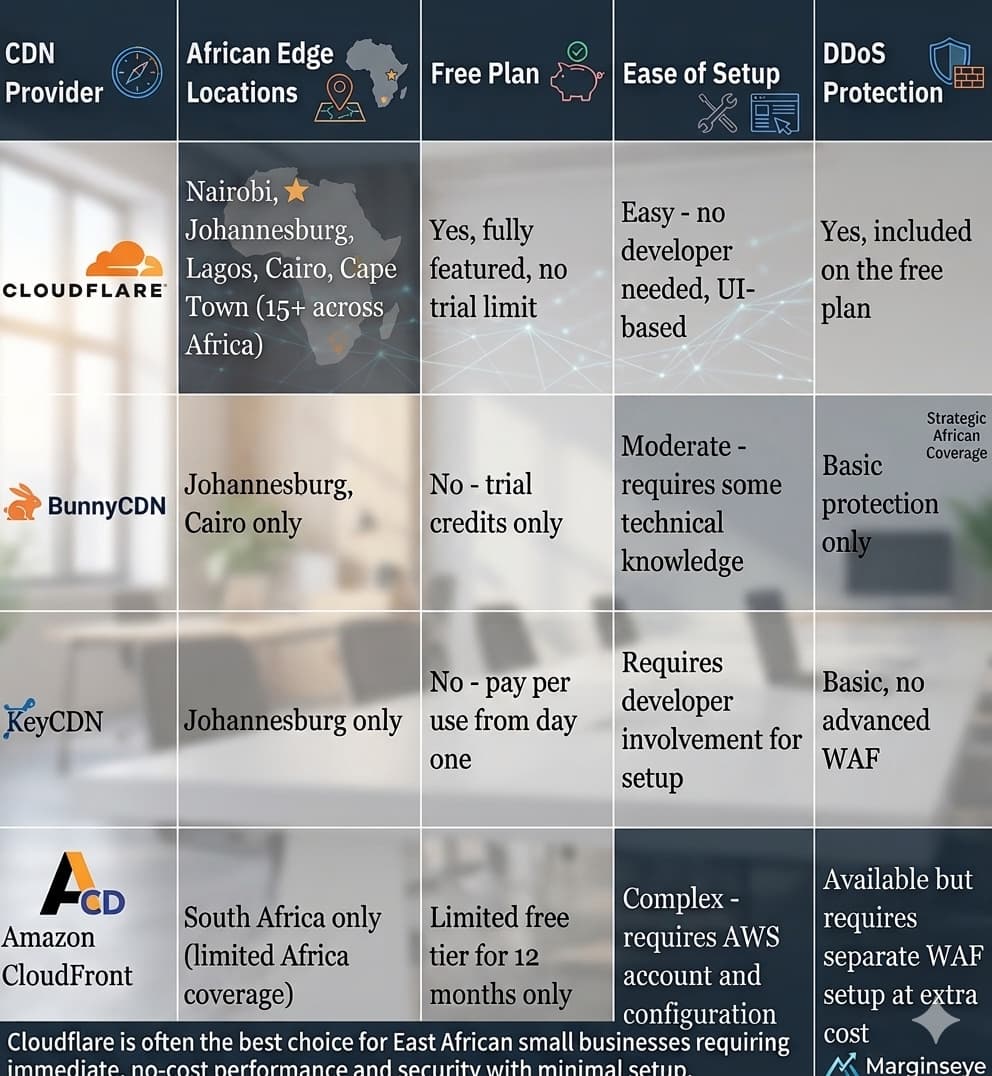
Independently verified: CDN edge locations above were confirmed against each provider’s publicly available network documentation. Last checked May 2026.
After reviewing all available CDN options for East African business websites, Marginseye Digital recommends Cloudflare for most small and medium businesses because it combines the widest African edge network, a fully functional free tier, and the simplest setup process of any CDN available at zero cost.
What Are the Pros and Cons of Cloudflare CDN for East African Business Websites? Full Transparency
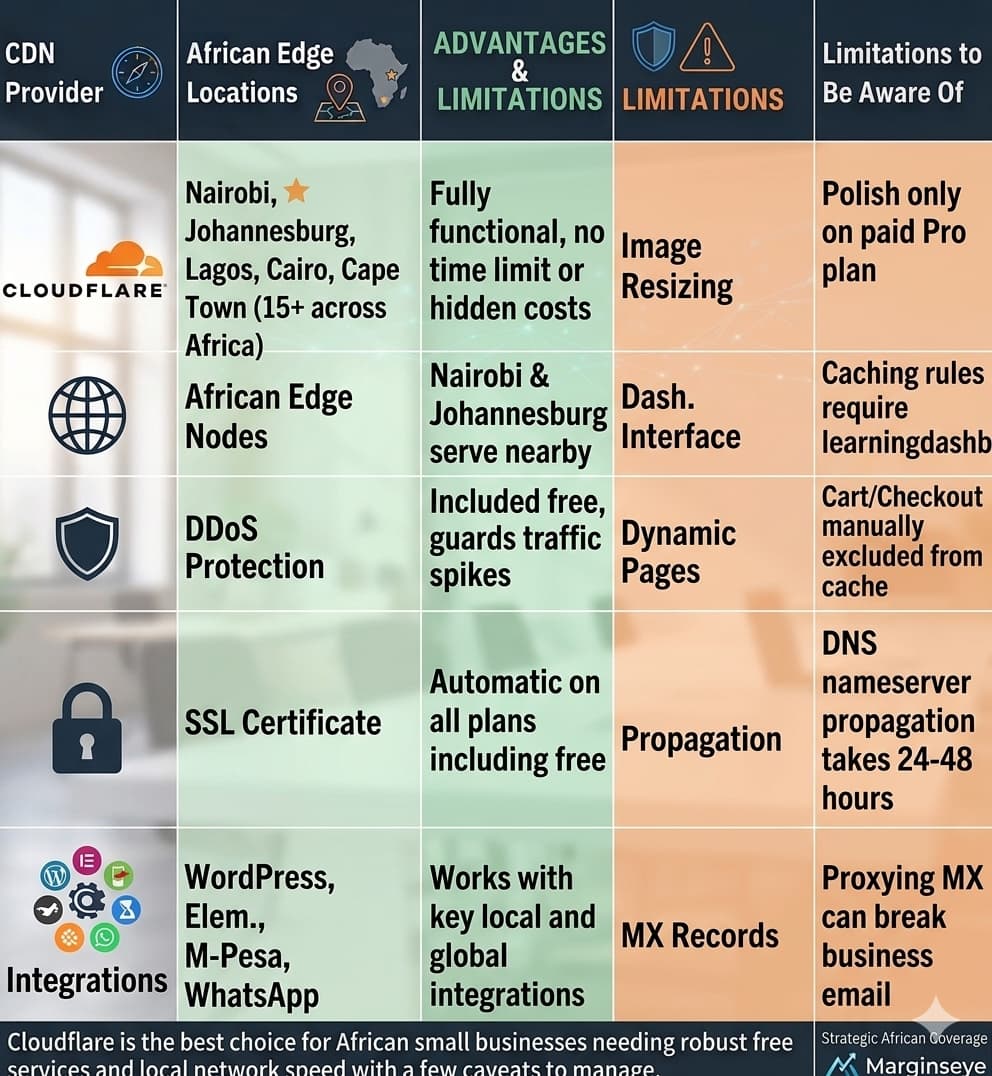
Every tool has trade-offs. Cloudflare CDN for African users delivers meaningful speed and security benefits, but there are a few practical limitations worth knowing before you commit. The table below gives you the complete picture so you can decide with your eyes open and configure accordingly.
The pros carry the weight here, particularly for East African businesses that need speed gains without upfront investment. The cons are real but all manageable with the right configuration approach, which is exactly what the Marginseye Digital setup checklist addresses.
What Mistakes Should You Avoid When Setting Up Cloudflare CDN for Your African Business Website?
- Proxying your email records through Cloudflare. When you first add your domain to Cloudflare, the platform sometimes defaults to proxying everything including your MX records. This breaks your business email delivery entirely because email cannot route through Cloudflare’s HTTP proxy. Always verify that all email-related DNS records are set to DNS Only, with the grey cloud icon, before finalising your setup.
- Setting browser cache TTL too low. Many East African website owners leave the cache time-to-live at the Cloudflare default setting, which is often as low as two hours. For static assets like logos, fonts, and background images that rarely change, setting cache TTL to at least one week or one month significantly reduces repeated loading time for returning visitors and reduces unnecessary hits on your origin server.
- Forgetting to purge the cache after making site updates. Once Cloudflare is serving cached versions of your pages, updating your website content does not automatically update what visitors see. After any significant content change, go to your Cloudflare dashboard and purge the cache for affected pages, or purge everything if the update is site-wide. The Cloudflare WordPress plugin handles this automatically for post and page updates if you install it.
- Using Cloudflare Development Mode as a permanent setting. Development Mode bypasses the CDN cache entirely and is designed for testing while you work on your site. Leaving it permanently enabled removes all the speed benefits of Cloudflare CDN for African users and adds unnecessary latency instead. It also disables automatically after three hours, which means visitors will experience inconsistent performance if you forget to turn it off manually.
- Not excluding M-Pesa and payment callback URLs from caching. Dynamic transactional pages, including Pesapal redirect URLs and M-Pesa callback endpoints, must be excluded from Cloudflare’s cache using Cache Rules. Caching these pages can result in stale checkout sessions and failed payment confirmations, which is one of the most damaging user experience problems an East African e-commerce site can face. See the Marginseye Digital website redesign checklist for a full list of pages that should always be excluded.
- Skipping the SSL/TLS Full Strict configuration. Leaving SSL on Flexible mode means the connection between Cloudflare and your origin server is unencrypted, which is a security vulnerability and can cause browser redirect loops on some hosting setups. Always set SSL to Full (Strict) once your origin server has a valid certificate installed.
- Never checking your Cloudflare analytics after setup. The Cache analytics section of your Cloudflare dashboard shows what percentage of requests are being served from the CDN versus hitting your origin server. If that ratio is below 60 percent, your caching rules need adjustment. Most East African business owners enable Cloudflare and walk away, missing the opportunity to fine-tune their setup based on real traffic data.
Get the Free Cloudflare Setup Checklist for East African Business Websites
Get the Cloudflare CDN setup checklist for East African businesses sent to your inbox (PDF, includes exact configuration steps for M-Pesa callback exclusions, WhatsApp Business integrations, and WordPress-specific cache rules). Only 50 downloads available this month.
Checklist includes:
- Nameserver update confirmed and propagation verified
- Email MX records confirmed as DNS Only (not proxied)
- SSL/TLS set to Full Strict mode
- M-Pesa callback and Pesapal redirect URLs excluded from cache via Cache Rules
- Browser cache TTL set to minimum one week for static assets
- WordPress Cloudflare plugin installed and cache purge configured
→ Send me the free Cloudflare CDN setup checklist for East African websites
Where Can East African Businesses Access Cloudflare CDN Setup Support? Your Options Compared
The table below outlines the main paths for East African business owners looking to implement Cloudflare CDN, from doing it yourself using Cloudflare’s free plan all the way to working with a digital strategy partner who will configure everything correctly the first time. Each option has different trade-offs around time investment, cost, and confidence in the result.
For most East African small business owners, the free self-setup route delivers excellent results when paired with the right checklist. If you want a professional review of your existing setup, or want someone to handle the configuration as part of a broader website strategy, the Marginseye Digital audit is the logical starting point.
| Option | Monthly Cost | Your Time Required | What You Get | Get Started |
| Cloudflare Free Plan (self-setup) | Free | 1 to 3 hours | CDN, DDoS protection, SSL, basic analytics | Start on Cloudflare free |
| Cloudflare Pro Plan (self-setup) | USD 20/month (approx. KES 2,600) | 1 to 3 hours | Everything in Free plus image resizing, advanced analytics, priority support | Upgrade to Cloudflare Pro |
| Marginseye Digital Website Audit | Free | 30 minutes of your time | Full audit including CDN review, speed diagnosis, personalised configuration recommendations | Book your free Website Audit |
| Marginseye Digital Full Website Setup | Custom quote | Handled entirely for you | Complete strategy, hosting, CDN, and conversion optimization from our team | Request a project quote |
→ Compare live website service options for your East African business at Marginseye Digital
How Does Cloudflare CDN Pricing Compare Across East African Markets?
Cloudflare’s free plan costs nothing regardless of where you are in the world, which makes it uniquely accessible for East African businesses operating in markets where USD-denominated software subscriptions can be a significant barrier. The table below compares the cost of Cloudflare’s Pro plan upgrade across the main East African markets so you can evaluate it in your local currency context.
Prices below are approximate based on the Cloudflare Pro rate of USD 20 per month and current exchange rates as of May 2026. Use the links to check current live pricing directly on the Cloudflare website before committing to any paid plan.
| Country | Currency | Cloudflare Free Plan | Cloudflare Pro (per month) | Key Note for Local Context |
| Kenya | KES | KES 0 | Approx. KES 2,600 | Pro adds image resizing, which is valuable for product-heavy e-commerce sites in Kenya |
| Uganda | UGX | UGX 0 | Approx. UGX 75,000 | Free plan covers most Ugandan SME needs without requiring an upgrade |
| Tanzania | TZS | TZS 0 | Approx. TZS 52,000 | Tanzanian users benefit from the Nairobi edge node which serves them with low latency |
| Rwanda | RWF | RWF 0 | Approx. RWF 23,000 | Kigali users are well served by the Nairobi node making the free plan very effective |
| Nigeria | NGN | NGN 0 | Approx. NGN 32,000 | Lagos edge node serves Nigerian users directly, free plan delivers strong results |
Prices are estimates as of May 2026. Check live pricing at cloudflare.com/plans before making a decision.
Community Questions from Marginseye Digital Readers Across East Africa
From James Otieno, Westlands, Nairobi
James asked: “I am on a budget shared hosting plan with a Kenyan provider. Will Cloudflare CDN for African users actually make a difference for me, or do I need to upgrade my hosting first?”
Answer from Marginseye Digital: In most cases, Cloudflare CDN will make a bigger difference than upgrading your hosting, and it will do so at zero cost. The reason is that the performance problem on most Kenyan shared hosting plans is not the server’s processing power, it is the distance that data has to travel. If your host is in Germany or the US, Cloudflare intercepts requests in Nairobi before they ever reach that server, which removes the latency problem entirely for static content. The one caveat is that if your site is generating PHP errors or your database is genuinely overloaded from high concurrent traffic, a CDN alone will not fix that, and that is a hosting issue worth investigating separately. See what our free Website Audit reveals about your specific situation.
From Aisha Mwangi, Mombasa
Aisha asked: “My M-Pesa payment page sometimes has issues after I try to optimise my site. Will adding Cloudflare CDN make things worse for my checkout?”
Answer from Marginseye Digital: Cloudflare CDN for African users is actually safer for M-Pesa integrations than most optimisation plugins because it gives you explicit control over which URLs are cached and which are not. Your M-Pesa callback URL and any dynamic checkout pages should be added to a Cache Rule that sets Bypass as the cache status. When this is set up correctly, Cloudflare accelerates every other page on your site while leaving your transactional flow completely untouched. We include the exact M-Pesa bypass configuration in our setup checklist. Download the checklist from Marginseye Digital.
From David Kipchoge, Eldoret
David asked: “My web developer told me the free Cloudflare plan is not enough for a business website and I need to pay for the Pro plan. Is that actually true?”
Answer from Marginseye Digital: For most East African small business websites, the free Cloudflare plan is more than adequate and the Pro plan is optional rather than essential. The main features the Pro plan adds are Cloudflare Polish for image resizing at the edge, advanced Web Application Firewall rules, and priority support. If your site has a large number of product images and you do not want to manage image compression separately, Pro can be worth the approximate KES 2,600 per month. For a standard brochure site, a services portfolio, or a basic WooCommerce store, the free plan handles everything you need. Talk to the Marginseye Digital team in your free Website Audit if you are unsure which plan makes sense for your business.
Have a different question about Cloudflare CDN for African users or website speed in East Africa?
→ Ask the Marginseye Digital team directly through our Website Audit consultation
What Your East African Business Website Gains When You Solve the Speed Problem
Cloudflare CDN for African users is one of the most impactful and immediately actionable improvements you can make to your East African business website, and it starts at zero cost. The combination of edge nodes in Nairobi and Johannesburg, a fully functional free plan, and a setup process that takes less than an hour makes Cloudflare the clearest answer to the latency problem that has held back East African business websites for years.
The businesses getting ahead in Kenya, Uganda, Tanzania, and across the region right now are the ones who have stopped accepting slow websites as an unavoidable fact of operating in this market. Speed is a business decision, not a technical luxury. When your site loads in under two seconds on a Safaricom connection, you earn the right to keep a visitor long enough to turn them into a customer.
If you are not sure where your website stands today, start with Marginseye Digital’s free Website Audit. We show you your current load time, where the bottlenecks are, and what Cloudflare CDN configuration would make the most impact for your specific site and your specific audience.
For your next step in building a website that works for East African customers, read Marginseye Digital’s guide to recommended tools and integrations for East African business websites.
Next Read >>>>>>> How To structure Your Website For multiple Markets
Frequently Asked Questions About Cloudflare CDN for African Users
1. Does Cloudflare CDN have actual server locations in Africa?
Yes, Cloudflare currently operates over 15 edge locations across Africa, including nodes in Nairobi, Johannesburg, Lagos, Cairo, and Cape Town. For East African business websites, the Nairobi node is especially significant because it means content is served from within or immediately adjacent to the same region as your Kenyan, Ugandan, and Tanzanian users, cutting latency dramatically compared to a European origin server. You can verify the full current list of locations on the Cloudflare network page.
2. Is Cloudflare CDN genuinely free for African business websites?
Cloudflare’s free plan is fully free with no trial period and no credit card required. It includes the global CDN, DDoS protection, automatic SSL, and basic analytics at no cost with no time limit. The paid Pro plan at approximately USD 20 per month adds image resizing and advanced firewall features, but the overwhelming majority of East African small and medium businesses operate effectively on the free tier without needing to upgrade. Explore how Marginseye Digital configures Cloudflare on the free plan for East African businesses.
3. How much faster will Cloudflare CDN actually make my website for African users?
The speed improvement depends on your current hosting location and website setup, but for websites hosted in Europe or North America, East African users typically see load times drop by 60 to 80 percent after Cloudflare CDN is correctly configured. A website loading in six seconds for Nairobi users often loads in 1.5 to 2 seconds after Cloudflare. The biggest gains come from static content like images, fonts, and scripts being served from Cloudflare’s Nairobi edge node instead of traveling across continents. Check your current speed and see your potential improvement with Marginseye Digital’s free Website Audit.
4. Does Cloudflare CDN for African users work with WordPress websites?
Yes, Cloudflare works seamlessly with WordPress. Cloudflare also provides an official WordPress plugin that manages cache purging automatically when you publish or update content, so you do not need to manually clear the cache after every change. Cloudflare is compatible with all major WordPress page builders including Elementor, which is widely used by East African web designers. See how Marginseye Digital integrates Cloudflare with WordPress for East African business websites.
5. Will Cloudflare CDN interfere with my M-Pesa payment integration?
Cloudflare CDN does not interfere with M-Pesa integrations when configured correctly. The key is creating Cache Rules in your Cloudflare dashboard that exclude your payment and checkout URLs from caching. This ensures Cloudflare never serves a cached version of your M-Pesa redirect or callback page, where stale data would cause transaction failures. The same exclusion rule applies to Pesapal, Flutterwave, and any other payment gateway handling live transaction data. Download Marginseye Digital’s Cloudflare setup checklist that includes the exact M-Pesa bypass configuration.
6. How does Cloudflare CDN for African users affect Google Core Web Vitals?
Cloudflare CDN for African users directly improves three Core Web Vitals metrics. Largest Contentful Paint improves because your main content loads from a nearby edge node instead of a distant origin server. First Input Delay improves because JavaScript files cached at the edge load faster. Cumulative Layout Shift can also improve when fonts and stylesheets are delivered consistently and quickly. According to web.dev, LCP under 2.5 seconds is classified as Good. Most East African sites move from Poor into Good after Cloudflare is set up correctly. Learn how Marginseye Digital optimizes Core Web Vitals for East African business websites.
7. Which Cloudflare CDN plan should East African small businesses choose?
The free Cloudflare plan is the right starting point for the overwhelming majority of East African small and medium businesses. It includes everything you need to solve the latency and speed problem at no cost. The Pro plan at approximately USD 20 per month, which is around KES 2,600, is worth considering if your website carries a large volume of product images and you want Cloudflare to handle image resizing automatically at the edge. The Business and Enterprise plans are designed for high-traffic operations and large organizations and are not relevant for most SMEs in East Africa. Talk to Marginseye Digital about which plan makes sense for your traffic volume and website type.
8. How do I set up Cloudflare CDN for my African business website if I am not technical?
Setting up Cloudflare CDN for African users involves creating a free account at cloudflare.com, adding your domain, reviewing the automatically imported DNS records, updating your domain’s nameservers to the two Cloudflare provides, configuring SSL to Full Strict mode, and enabling performance settings. The full process takes 45 minutes to 90 minutes for someone doing it for the first time. The step-by-step framework in this article above walks you through each stage. If you want someone to do it for you and verify the configuration, book Marginseye Digital’s free Website Audit as your starting point.
9. Can Cloudflare CDN for African users reduce my website’s bounce rate?
Yes, and the relationship between page speed and bounce rate is well documented. According to Google’s research on mobile speed, pages that load in one second have a bounce rate three times lower than pages that load in five seconds. For East African business websites where mobile is the primary access device and data costs make users less patient with slow pages, the bounce rate improvement after enabling Cloudflare CDN for African users is typically one of the most visible gains you will see in your analytics within the first 30 days. See how Marginseye Digital helps East African businesses reduce bounce rates and turn visitors into leads.
10. Does Cloudflare CDN work with WhatsApp Business integrations on my website?
Cloudflare CDN works fully alongside WhatsApp Business chat integrations. WhatsApp Business chat widgets load externally from Meta’s servers, not your origin server, so they are not affected by your CDN configuration in either direction. Where Cloudflare helps is in making the rest of your page load fast enough that the WhatsApp widget appears to a visitor who is still engaged with your content rather than to one who has already bounced because the page was slow. Learn how Marginseye Digital structures WhatsApp Business integrations for East African lead capture.
11. How will I know if Cloudflare CDN is actually working for my African website visitors?
The most direct way to verify that Cloudflare CDN for African users is working is to check your page response headers. When Cloudflare serves content from its cache, the response includes a CF-Cache-Status header set to HIT. You can check this using your browser’s developer tools under the Network tab. Additionally, your Cloudflare analytics dashboard shows the percentage of requests being served from cache versus your origin server. Running a speed test on Google PageSpeed Insights before and after setup gives you a clear comparison of your Largest Contentful Paint and other Core Web Vitals improvements. Marginseye Digital includes a Cloudflare performance verification check in our free Website Audit.
12. What makes Cloudflare CDN for African users different from simply paying for better hosting?
Upgrading your hosting plan improves the processing power and storage of your origin server, which helps with database-heavy sites and high concurrent traffic loads. Cloudflare CDN for African users solves a fundamentally different problem, which is the geographic distance between your server and your East African users. Even the fastest server in Frankfurt is still 6,000 kilometers from Nairobi, and no amount of RAM or CPU upgrades changes that physical reality. Cloudflare puts a copy of your content in Nairobi and across Africa so that distance is no longer a factor for the majority of your page requests. In most cases, you will see more improvement from correctly configuring Cloudflare than from spending money on a hosting upgrade, and Cloudflare starts at zero cost. If you are unsure whether your website needs better hosting, a CDN, or both, Marginseye Digital’s free Website Audit gives you a clear answer based on your specific site.
More Website Strategy Guides from Marginseye Digital for East African Businesses
Every guide below is part of Marginseye Digital’s website strategy resource cluster for East African entrepreneurs and small business owners. Use them together for the strongest results.
- Website Design for Business Growth: The Complete Strategy for East African Businesses
- How to Convert Website Visitors into Leads: A Practical Guide for East African Small Businesses
- The Complete Website Redesign Checklist for East African Business Owners
- High-Converting Website Design: What Actually Works for Kenyan Businesses
- The CTA Guide for Small Businesses in East Africa: How to Get Visitors to Take Action
Affiliate Disclosure
This article may include affiliate partnerships with technology vendors and software providers. If readers access recommended products or services through the provided pathways, a small commission may be earned at no additional cost. These partnerships help support independent research and high-quality digital strategy guides. Marginseye Digital is a participant in the Amazon Services LLC Associates Program.
Disclaimer
This article is for informational purposes only. All product names, logos, and brands are property of their respective owners. The information provided does not constitute professional advice; readers should consult with qualified experts before making any procurement or deployment decisions. Links to third-party websites are provided for convenience; Marginseye Digital does not endorse or guarantee the accuracy of external content. Prices and offers are subject to change without notice.
This guide is part of Marginseye Digital’s Website Strategy for East African Businesses series. Last verified: May 2026. Next update: June 2026.