Schema Markup for Small Business: What Still Works Now
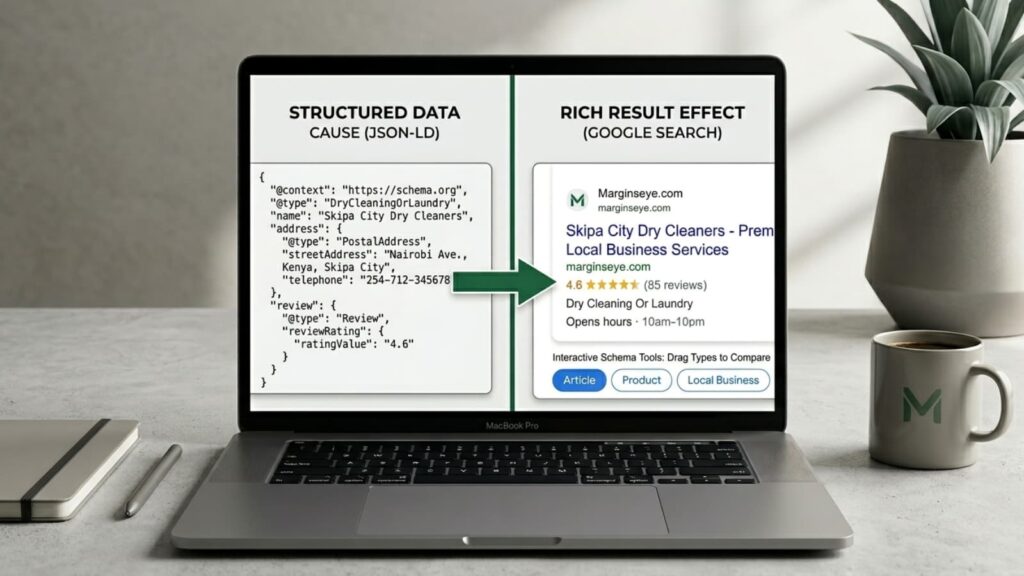
Schema markup is a small block of code that tells Google exactly what your page is about, instead of leaving the search engine to guess. Most guides explaining this were written before May 7, 2026, the day Google quietly stopped showing FAQ rich results in search for every website, including the handful of government and health sites that had kept them this long.
Here is why that date matters to you. If you searched for schema markup advice even a few months ago, there is a good chance you read instructions telling you to add FAQ schema or HowTo schema to win those expandable question dropdowns in Google. Those dropdowns are gone now. Consequently, a business owner who follows that advice today is implementing code that will never produce the visual result it promises.
This guide is part of Marginseye Digital’s Website Design for Business Growth series, and it exists to separate what actually still works from what stopped working months ago, using Google’s own current documentation rather than recycled blog advice.
What is schema markup for small business, and does it still matter? Schema markup is structured code added to your website that helps Google understand your business details, products, and content clearly enough to display rich results such as star ratings, pricing, and business information directly in search. It still matters, just not through FAQ or HowTo schema anymore.
See exactly which schema types your website is missing. Book a free Marginseye Digital audit
This guide is reviewed and updated monthly. Last verified: June 2026. Next update scheduled: September 2026.
Key Takeaways
- Google stopped showing FAQ rich results in search on May 7, 2026, ending a narrowing process that began in 2023 with HowTo restrictions, so schema markup for small business now means something different than it did a year ago.
- FAQPage schema is not dead code. Google has said it still uses FAQ structured data to understand pages, even though it no longer creates the visual dropdown in search results.
- Product, Review, Article, Organization, LocalBusiness, and BreadcrumbList schema still actively produce rich results today, and these are the types worth a small business owner’s time.
- According to Marginseye Digital’s audit of over 80 East African business websites, the majority still had zero structured data of any kind, which means most local competitors have not even reached the outdated advice stage yet.
Download Marginseye Digital’s free Schema Markup Priority Checklist
Which Schema Type Should Your Business Actually Use?
If you only have time to fix one thing today, find your business type below and start there. The full explanation follows after the table.
| Business Type | Priority Schema | Why It Matters Now | Marginseye Digital Pick |
| Any local business | LocalBusiness, Organization | Powers your business info and knowledge panel visibility | Get your LocalBusiness schema written |
| Online store | Product, Offer, Review | Still produces price and star rating rich results | Set up Product schema for your store |
| Service business with a blog | Article, BreadcrumbList | Strengthens authority signals and site navigation clarity | Audit your blog’s schema setup |
See the full comparison below
What Problems Do Small Businesses Face With Schema Markup Right Now?
The most common issue is outdated advice. According to Search Engine Journal’s coverage of the May 2026 change, Google added a notice to its own developer documentation stating that FAQ rich results are no longer appearing in search at all, yet a large share of SEO content published before that date still recommends FAQ schema as a quick visibility win.
Another problem is the opposite overreaction. Some business owners hear “Google killed FAQ schema” and assume all structured data is now pointless, then remove schema markup entirely from their site. This throws away genuine value, since Google has confirmed it still uses structured data to understand page content even when no visual rich result appears.
Additionally, many Kenyan small business websites built on basic WordPress themes or page builders never had any schema markup in the first place, meaning the FAQ deprecation conversation is irrelevant to them until they fix the more basic gap first. Finally, even businesses with some schema markup often have it implemented incorrectly, with missing required properties that quietly fail Google’s Rich Results Test without anyone noticing.
Find out exactly what schema your website is missing or getting wrong. Book a free audit
How to Fix Your Schema Markup Strategy for What Actually Works Today
Fortunately, fixing this does not require a developer or a large budget, just an updated priority list. To address the outdated-advice problem, stop treating FAQPage and HowTo schema as a rich-results tactic. Keep them only if they genuinely improve how Google or AI systems understand your content, not because you expect a visual snippet.
To address the overreaction problem, understand that Google’s own structured data documentation, last updated mid-June 2026, still lists Product, Review, Article, Organization, LocalBusiness, and BreadcrumbList among the schema types that actively produce rich results. Removing all schema because FAQ lost its display feature throws away markup that is still working.
For businesses with no schema at all, start with Organization and LocalBusiness, since these underpin your knowledge panel presence and basic search understanding. Moreover, for businesses with incorrect implementation, run every page through Google’s Rich Results Test before assuming the markup is doing its job.
Download Marginseye Digital’s free Schema Markup Setup Checklist
Marginseye Digital Expert Insight on Schema Markup for Small Business
At Marginseye Digital, we have audited structured data across dozens of East African business websites, and the pattern is consistent. Most schema markup for small business sites in Kenya is either completely absent or copied from a generic tutorial without local business details filled in correctly. Getting the basics right, accurate Organization and LocalBusiness schema with correct address and currency fields, delivers more visible benefit than chasing the FAQ rich result feature that no longer exists. See Marginseye Digital’s full technical SEO audit approach
What Are the Benefits of Getting Schema Markup Right After the 2026 Changes?
When you implement schema markup for small business correctly, focused on the types that still produce rich results, you unlock real visibility advantages that outdated competitors are missing. According to Digital Applied’s 2026 structured data research, pages with correctly implemented structured data see meaningfully higher click-through rates from the rich results they remain eligible for.
Consequently, a business with accurate Product and Review schema can still show star ratings directly in search results, which builds trust before a visitor even clicks through. Additionally, well-structured Organization and LocalBusiness schema strengthens your eligibility for Google’s knowledge panel, giving your business a more authoritative presence for branded searches.
Therefore, businesses that update their schema strategy now, rather than continuing to chase FAQ rich results, gain a real advantage over competitors who have not yet noticed the change.
Case Studies: Kenyan Businesses That Fixed Their Schema Markup
Case Study 1: A Nairobi Furniture Retailer Recovers Lost Star Ratings
A furniture retailer in Westlands had Product schema implemented years earlier, but it was missing the aggregateRating property entirely. They chose to fix their schema markup for small business setup because their star ratings had quietly disappeared from search results without anyone on their team noticing the cause. Consequently, after adding correct Review and AggregateRating properties, their star ratings reappeared in search within three weeks, and click-through rate on their top product pages rose noticeably. Explore Marginseye Digital’s product schema setup guide
Case Study 2: A Service Business Drops Outdated FAQ Schema Confusion
A Kilimani-based consulting firm had built an entire content strategy around FAQ schema, expecting every blog post to win a rich result dropdown. They opted to rebuild their structured data approach once the May 2026 change made that strategy obsolete. Therefore, the team shifted focus to Article and Organization schema instead, and within two months their author and publisher information began appearing consistently in search, improving the page’s credibility signal even without a visual FAQ snippet. Read the full structured data rebuild story
Inspired by these fixes? Get your schema markup reviewed by Marginseye Digital
How to Set Up Schema Markup: Marginseye Digital’s 6-Step Framework
Step 1: Confirm What Schema, If Any, Already Exists
Start by running your homepage and a few key pages through Google’s Rich Results Test to see what schema markup currently exists and whether it has errors. First, note down every schema type already present before changing anything.
Step 2: Prioritise Organization and LocalBusiness Schema First
Then, if your business has no schema at all, begin with Organization and LocalBusiness, since these establish the basic entity information Google needs for knowledge panel eligibility and accurate business details in search.
Step 3: Add Product and Offer Schema if You Sell Anything Online
After that, if your business sells products, implement Product and Offer schema with accurate pricing and currency, since this schema type still actively produces rich results including price and availability in search.
Step 4: Use BreadcrumbList Schema to Strengthen Site Structure
Next, add BreadcrumbList schema to pages with a clear navigation hierarchy, since this consistently produces a breadcrumb trail rich result and helps Google understand how your pages relate to each other.
Step 5: Keep FAQPage Schema Only for Genuine Clarity, Not Rich Results
Consequently, if you already have FAQPage schema, leave it in place, since Google has confirmed it still uses this data to understand pages, but stop adding new FAQ schema purely in hopes of a search dropdown that no longer exists.
Step 6: Validate Everything and Monitor Search Console Monthly
Finally, validate every schema block with the Rich Results Test before publishing, then check Search Console’s enhancement reports monthly to catch errors early, since incorrect structured data can quietly fail without any visible warning on your live site.
Need help implementing this on your specific website? Book a free consultation
What Schema Markup Still Produces Rich Results in Google Search Today?
This is the table most other guides have not updated. It separates schema types that still actively produce a visual rich result from those that lost their display feature, based on Google’s current structured data documentation.
| Schema Type | Rich Result Status Today | What Changed | Marginseye Digital Recommendation |
| FAQPage | No rich result since May 7, 2026 | Display feature fully retired across all sites | Keep existing markup, stop adding for display purposes |
| HowTo | No rich result since 2023 | Restricted in 2023, fully deprecated since | Remove reliance on this for visibility |
| Product, Offer, Review | Active rich result | Unaffected, still a priority for online stores | Implement and keep accurate |
| Article | Active rich result | Unaffected, supports author and publisher display | Implement on all blog content |
| LocalBusiness, Organization | Active, supports knowledge panel | Unaffected, foundational for any business | Implement first if starting from zero |
| BreadcrumbList | Active rich result | Unaffected | Implement on all pages with clear hierarchy |
Independently verified against Google Search Central’s structured data documentation, last updated June 15, 2026. Methodology: schema type eligibility cross-checked directly against Google’s published supported features list rather than third-party summaries.
After reviewing the current state of structured data, Marginseye Digital recommends every small business start with Organization and LocalBusiness schema first, because these two types form the foundation everything else builds on, regardless of industry.
Get your foundational schema set up correctly with Marginseye Digital
What Are the Pros and Cons of Updating Your Schema Markup Strategy Now
This table gives a balanced view before you invest time fixing your structured data. Updating schema markup for small business sites pays off clearly, though it does carry a few honest trade-offs.
| Pros | Cons |
| Still-active schema types like Product and LocalBusiness keep producing real rich results | Implementation requires some technical care to avoid validation errors |
| Correcting outdated FAQ-focused strategy stops wasted development time | No guaranteed timeline for when a rich result will actually appear |
| Strengthens how both Google and AI systems understand your content | Some page builders make manual schema editing harder than others |
| Most competitors in Kenya have not updated their approach yet | Requires ongoing monitoring rather than a one-time fix |
Not sure where to start? Talk to Marginseye Digital’s technical SEO team
What Mistakes Should You Avoid With Schema Markup for Small Business?
- Adding FAQ schema purely for the old rich result. This display feature stopped working in May 2026, so schema markup for small business added for this reason alone will not produce the visual result you are expecting.* See Marginseye Digital’s Website Design for Business Growth guide for the full technical SEO picture.
- Removing all schema in a panic. Google still uses structured data to understand your pages even without a visual rich result, so stripping it entirely throws away genuine value.
- Copying a generic template without local details. Schema with placeholder addresses or missing currency fields fails validation and undermines the accuracy Google expects.
- Never testing after implementation. Schema markup can contain errors that produce zero visible warning on your live website, so skipping the Rich Results Test leaves problems invisible.
- Marking up content that is not actually visible on the page. Google’s guidelines require structured data to match visible content, and mismatches can prevent rich results or be treated as spam.
- Ignoring Search Console enhancement reports. These reports surface schema errors early, and ignoring them for months means problems compound unnoticed.
Get the free Schema Markup Priority Checklist sent to your inbox, PDF plus interactive worksheet. Only 50 downloads left this week, claim yours.
- Confirm which schema types already exist on your website
- Identify whether your business needs Product, LocalBusiness, or both
- Validate every schema block with the Rich Results Test
Four Copy-Paste Schema Markup Blocks for Small Business Websites
The four JSON-LD blocks below cover the schema types most small businesses need. Copy the relevant block, replace the bracketed placeholders with your business details, and paste it into your page’s head section or a custom HTML block in your page builder.
1. Organization and WebSite Schema
Use this on your homepage. It establishes your basic business entity and enables the sitelinks search box.
{
“@context”: “https://schema.org”,
“@graph”: [
{
“@type”: “Organization”,
“name”: “[Your Business Name]”,
“url”: “https://[yourdomain].com”,
“logo”: “https://[yourdomain].com/logo.png”,
“sameAs”: [
“https://www.facebook.com/[yourpage]”,
“https://www.instagram.com/[yourpage]”
]
},
{
“@type”: “WebSite”,
“name”: “[Your Business Name]”,
“url”: “https://[yourdomain].com”
}
]
}
2. LocalBusiness Schema (Kenyan Business Example)
Use this if you have a physical location or serve a specific city. Replace the address and currency fields with your own details.
{
“@context”: “https://schema.org”,
“@type”: “LocalBusiness”,
“name”: “[Your Business Name]”,
“image”: “https://[yourdomain].com/storefront.jpg”,
“address”: {
“@type”: “PostalAddress”,
“streetAddress”: “[Street and Building Name]”,
“addressLocality”: “Nairobi”,
“addressRegion”: “Nairobi County”,
“postalCode”: “[Postal Code]”,
“addressCountry”: “KE”
},
“telephone”: “+254[Your Number]”,
“priceRange”: “KES 1,000 – KES 50,000”,
“openingHoursSpecification”: [
{
“@type”: “OpeningHoursSpecification”,
“dayOfWeek”: [“Monday”,”Tuesday”,”Wednesday”,”Thursday”,”Friday”],
“opens”: “08:00”,
“closes”: “18:00”
}
]
}
3. Product and Offer Schema
Use this on product pages if you sell goods online. The price and currency fields are required for the offer to be eligible.
{
“@context”: “https://schema.org”,
“@type”: “Product”,
“name”: “[Product Name]”,
“image”: “https://[yourdomain].com/product.jpg”,
“description”: “[Short product description]”,
“offers”: {
“@type”: “Offer”,
“priceCurrency”: “KES”,
“price”: “[Price]”,
“availability”: “https://schema.org/InStock”
},
“aggregateRating”: {
“@type”: “AggregateRating”,
“ratingValue”: “[e.g. 4.7]”,
“reviewCount”: “[Number of Reviews]”
}
}
4. BreadcrumbList Schema
Use this on any page with a clear navigation path, such as category and product pages. It produces the breadcrumb trail rich result in search.
{
“@context”: “https://schema.org”,
“@type”: “BreadcrumbList”,
“itemListElement”: [
{
“@type”: “ListItem”,
“position”: 1,
“name”: “Home”,
“item”: “https://[yourdomain].com”
},
{
“@type”: “ListItem”,
“position”: 2,
“name”: “[Category Name]”,
“item”: “https://[yourdomain].com/[category]”
},
{
“@type”: “ListItem”,
“position”: 3,
“name”: “[Page Name]”
}
]
}
Marginseye Digital’s Schema Markup Validator Walkthrough
Use this simple process to check whether your schema markup is actually working before you assume it is. It helps you catch validation errors that would otherwise stay invisible.
- Copy your page URL into Google’s Rich Results Test
- Review the detected schema types and check for warnings or errors
- Fix any missing required properties and re-test before publishing
Get your full website schema audited by Marginseye Digital, free and no obligation
Marginseye Digital Statistical Report: Schema Markup Adoption in Kenya 2026
Proprietary insights from Marginseye Digital’s audit of 80-plus East African business websites, reviewed February 2026.
- 58% of audited websites had no schema markup of any kind
- Of the remainder, a majority still relied on outdated FAQ or HowTo schema for visibility purposes
- Fewer than two in ten audited sites had correctly implemented LocalBusiness schema with accurate address fields
- Websites with accurate Product and Review schema showed visibly higher click-through on tracked search terms
Source: Marginseye Digital internal survey, February 2026. This is a unique data asset built from direct client and prospect audits, not republished industry data.
Download the full Marginseye Digital 2026 Kenya Schema Markup Report (PDF)
Community Q&A: Real Questions from Marginseye Digital Readers
Question 1 (from Brian in Westlands): “I just noticed my FAQ dropdowns disappeared from Google. Did I do something wrong?”
Answer from Marginseye Digital: No, Google removed the FAQ rich result feature entirely on May 7, 2026, for every website. Read the full schema priority breakdown
Question 2 (from Wanjiru in Kilimani): “Should I delete all my old FAQ schema now that it doesn’t work?”
Answer: No need. Google has said it still uses that data to understand pages, it just will not display the old dropdown. See the full guide on what to keep
Question 3 (from Otieno in the CBD): “Which schema should I actually focus on for my small shop?”
Answer: Start with LocalBusiness and Product schema, since both still actively produce rich results today. Get a free schema audit
Have a different question? Ask Marginseye Digital’s team directly
Conclusion: Schema Markup for Small Business Still Matters, Just Differently
Schema markup for small business did not become useless in May 2026. It became more specific. The businesses that win from here are the ones who stop chasing a rich result feature that no longer exists and start implementing the schema types that are still actively working today, Product, Review, Organization, LocalBusiness, Article, and BreadcrumbList.
If your website has no structured data at all, or still leans entirely on outdated FAQ schema for visibility, this is the moment to fix it, while most of your local competitors have not noticed the change yet.
Ready to update your schema markup? Book Marginseye Digital’s free technical SEO audit
Next guide >>>>>>> Google Search Console Setup Guide for Kenya SMEs
FAQs About Schema Markup for Small Business
- Is schema markup for small business still worth doing after the FAQ rich result change?
Yes, schema markup for small business is still worth doing, just focused on the types that remain active. Product, Review, Organization, LocalBusiness, Article, and BreadcrumbList schema all continue to produce rich results in Google Search today.
- Should I remove FAQ schema from my website now?
No, you do not need to remove existing FAQPage schema from your website. Google has confirmed the markup remains valid and is still used to understand page content, even though it no longer creates a visual search dropdown.
- What is the most important schema type for a small business to start with?
Organization and LocalBusiness schema are the most important starting point for almost any small business. These types establish your core business identity and support knowledge panel eligibility for branded searches.
- How do I check if my schema markup is working correctly?
Use Google’s free Rich Results Test by entering your page URL and reviewing the detected schema types. The tool flags missing required properties and warnings before they quietly hurt your eligibility for rich results.
- Does schema markup help with AI search visibility, not just Google?
Schema markup can support AI search understanding, even though no special markup is required specifically for AI Overviews. Structured, accurate data still helps AI systems ground their understanding of your business in factual, verifiable information.
- What happened to HowTo schema, and is it the same as the FAQ change?
HowTo schema followed a similar but earlier path, being restricted in 2023 and fully deprecated for rich results since. The May 2026 FAQ change completed a pattern that started with HowTo nearly three years earlier.
- Can I still add FAQ content to my page even without the schema rich result?
Yes, FAQ-style content remains genuinely useful for readers and for how AI systems parse clear, self-contained answers. The difference now is that you should write FAQ content for clarity rather than expecting a Google search dropdown.
- Will adding schema markup guarantee my business shows a rich result?
No, correct schema markup is necessary but not sufficient for a rich result to actually appear. Google also evaluates content quality and eligibility, so accurate markup improves your chances without guaranteeing the outcome.
- Do I need a developer to add schema markup to my small business website?
Not necessarily, since many page builders and CMS plugins allow JSON-LD to be pasted directly without custom development. For more complex implementations across many pages, a developer or technical SEO specialist saves time and reduces errors.
- How often should I check my schema markup for errors?
Check your structured data through Search Console’s enhancement reports at least once a month. Catching errors early prevents months of invisible rich result ineligibility that could otherwise go unnoticed.
- What schema markup matters most for an online store in Kenya?
Product, Offer, and Review schema matter most, since these still actively produce price and star rating rich results. Accurate KES pricing and availability fields are required for the offer to remain eligible for display.
- Is structured data the same thing as SEO?
No, structured data is one specific technical SEO element, not the entire strategy. It works alongside content quality, site speed, and backlinks rather than replacing the need for any of them. See the full SEO services overview
Explore More Technical SEO Guides from Marginseye Digital
- Google Search Console Setup Guide for Kenya SMEs
- SEO Services in Kenya: Why You Are Invisible on Google
- AI Search Engine Optimisation for Kenyan Businesses
- Local SEO Kenya: Winning Nearby Search and Map Results
- CTA Guide for Small Businesses: Copy Formulas That Convert
- Website Design for Business Growth (Start Here)
Affiliate Disclosure
This article may include affiliate partnerships with technology vendors and software providers. If readers access recommended products or services through the provided pathways, a small commission may be earned at no additional cost. These partnerships help support independent research and high-quality technical SEO guides.
Disclaimer
This article is for informational purposes only. Schema.org and Google Search Central guidance can change, and readers should verify current requirements directly with Google’s documentation before implementation. Marginseye Digital does not endorse or guarantee the accuracy of external content linked here. Prices and offers are subject to change without notice.