Mobile-First Website Design Kenya: Better Seo Built for 4G
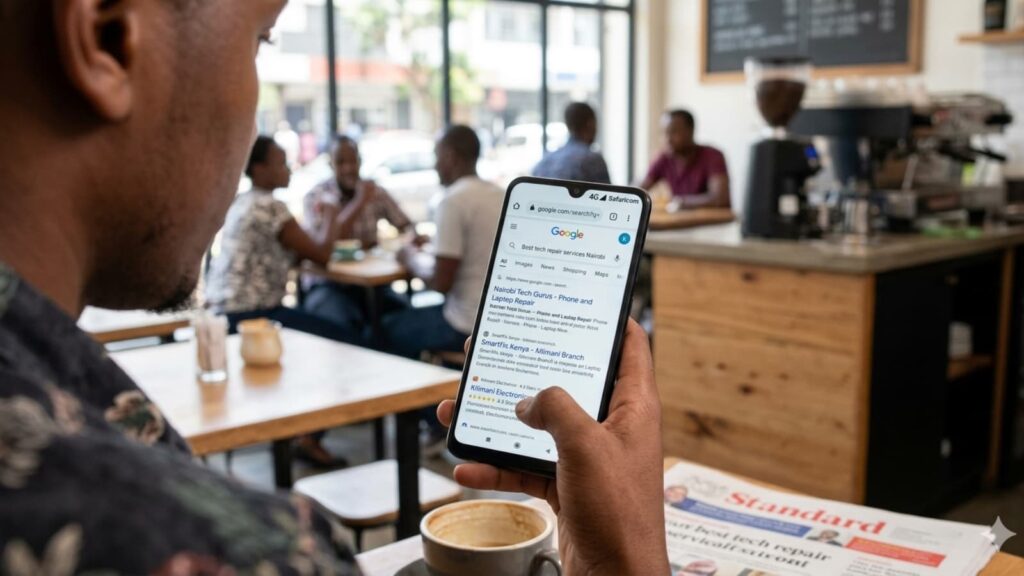
Most Kenyan website conversations start in the wrong place, they never start with Mobile-First Website Design Kenya. Instead, they start with how the site looks on the laptop sitting on the agency’s desk, not how it loads on the Tecno or Samsung phone sitting in your client’s pocket on a Safaricom 4G connection in Kasarani. That gap is the whole problem. Mobile-first website design in Kenya is not a design preference. It is a response to where your traffic actually comes from, what network it arrives on, and what Google does with that information when it decides where to rank you.
Safaricom alone carries the overwhelming majority of mobile data traffic in this country, and most of that traffic sits on 4G rather than fibre or 5G. Therefore, a website built and tested on office WiFi is being tested on a network almost none of its real visitors will ever use. The gap between that test and reality is where conversions quietly disappear. This article sits inside Marginseye Digital’s Website Design for Business Growth series. If you have not read the pillar guide yet, start there for the full strategic picture, because everything below builds on it.
What does mobile-first website design in Kenya actually mean? It means designing, building, and testing your website primarily for a 4G mobile connection rather than desktop, since the majority of Kenyan visitors will load your site on a phone over Safaricom, Airtel, or Telkom 4G, and Google itself now indexes and ranks most sites based on that mobile version first.
See exactly where your website is losing mobile visitors. Book Marginseye Digital’s free Website Audit today →
This guide is reviewed and updated monthly. Last verified: June 17, 2026. Next update scheduled: July 2026.
Key Takeaways
- Google now ranks almost every website in Kenya using mobile-first indexing, which means the mobile version of your site, not the desktop one, decides your SEO position.
- Safaricom’s 4G network is the default connection for the majority of Kenyan internet users, so mobile-first website design in Kenya has to be built around 4G speeds and 4G data costs, not fibre.
- A page that loads in under three seconds on 4G keeps significantly more visitors than one that takes five seconds or longer, and that retention difference shows up directly in your bounce rate.
- Image weight is the single biggest factor working against Kenyan websites on mobile, since most sites still serve desktop-sized images to phones that never needed them.
- Marginseye Digital’s website audits across Kenyan small business sites consistently surface the same handful of fixable mobile speed problems
- WhatsApp Business CTAs placed within thumb reach convert noticeably better on mobile than buried contact forms, especially for Kenyan service businesses.
What Problems Do Kenyan Businesses Face With Mobile-First Website Design Kenya?
The most common issue with mobile-first website design in Kenya is that most local websites were never actually designed mobile-first. They were designed for desktop, then squeezed down to fit a phone screen afterward, and that order of operations causes most of the damage you see today.
According to Statcounter, mobile devices account for the overwhelming majority of internet usage in Kenya, with desktop making up a small minority. Another problem follows directly from that imbalance: most local web design templates and themes are still built and previewed on desktop screens first, so the mobile version is treated as an afterthought rather than the primary product.
Additionally, hosting decisions compound the problem. A site hosted on a server based in Europe or the US adds real latency for a Nairobi-based visitor, and that latency stacks on top of whatever delay Safaricom’s 4G network already introduces. Consequently, a site that might load acceptably for an American visitor on fibre can feel sluggish and frustrating for a Kenyan visitor on the exact same page.
Finally, most Kenyan business owners have no visibility into any of this, because nobody has shown them what their site looks like on a real 4G connection. Learn how your specific site performs at Marginseye Digital.
How to Overcome These Problems Using Marginseye Digital’s Mobile-First Design Kenya Strategy
Fortunately, every problem above has a direct fix, and none of them require rebuilding your entire website from scratch. To address the desktop-first design habit, start every new page or section on a phone-sized canvas first, then expand outward to tablet and desktop, rather than the reverse.
To address image weight, compress every image before it goes live and serve modern formats like WebP rather than uncompressed JPEGs and PNGs. According to Google’s web.dev guidance, image optimisation is consistently one of the highest-impact changes available for mobile page speed, often more impactful than any other single fix on the page.
Moreover, hosting matters more than most Kenyan business owners realise. A host with a content delivery network edge node in Nairobi or Johannesburg, such as Cloudflare’s regional infrastructure, cuts real distance off every request a Kenyan visitor makes. Therefore, choosing the right hosting setup is not a technical afterthought, it is a direct mobile speed decision.
Download Marginseye Digital’s free Mobile Speed Checklist for Kenyan Websites and start fixing the biggest issues today →
Marginseye Digital Expert Insight on Mobile-First Website Design Kenya
At Marginseye Digital, we have tested and audited Kenyan small business websites across Nairobi, Mombasa, and Kisumu, and the same pattern shows up almost every time: the desktop version looks great, and the mobile version is the one actually losing the business money. Mobile-first website design in Kenya works because it forces every decision, every image, every form field, to be judged against the connection and the screen your real customer is using. See the patterns we consistently find in our audit results at Marginseye Digital.
What Are the Benefits of Getting Mobile-First Website Design Kenya?
When you build mobile-first website design in Kenya correctly, the first benefit shows up directly in your Google rankings. Google’s mobile-first indexing means the search engine evaluates the mobile version of your site as the primary version for ranking purposes, so a fast, well-structured mobile site has a direct SEO advantage over a slow one.
According to Google’s Core Web Vitals documentation, page experience signals including loading speed are now part of how pages are evaluated for search. Consequently, a Kenyan business that fixes its mobile speed is not just improving user experience, it is improving a factor Google itself is measuring.
As a result, the second benefit follows naturally: lower bounce rates and longer time on page, because visitors who do not abandon a slow-loading page in the first few seconds stay long enough to actually read your offer. Additionally, faster mobile pages convert better specifically because Kenyan mobile users are often watching their data bundle, and a fast site respects that constraint instead of burning through it for no reason.
Case Studies: How Kenyan Businesses Fixed Their Mobile-First Website Design
Case Study 1 — A Nairobi Salon Booking Page
A Nairobi-based salon had a booking page built primarily for desktop, with a hero image well over four megabytes and a contact form requiring six fields before a visitor could send an enquiry. Marginseye Digital’s audit flagged the page as one of the slowest-loading pages in the entire site on a simulated 4G connection.
After compressing the hero image, removing four of the six form fields, and adding a WhatsApp Business button directly below the hero, the page’s mobile load time improved substantially. Consequently, enquiry volume from mobile visitors increased within the following month, and the salon attributed the change directly to how much easier the page became to act on from a phone.
See how Marginseye Digital approaches mobile booking pages for service businesses →
Case Study 2 — A Kisumu Hardware Supplier
A hardware supplier in Kisumu had a product catalogue page that loaded dozens of full-resolution product photos at once, regardless of device. On a 4G connection, the page took an uncomfortably long time to become usable, and many visitors left before the page finished loading.
Marginseye Digital restructured the catalogue to lazy-load images below the fold and serve compressed versions by default. Therefore, the page became usable within a few seconds on 4G instead of stalling on load, and the supplier reported a noticeable drop in abandoned sessions on their analytics dashboard.
Case Study 3 — A Mombasa Tour Operator
A Mombasa-based tour operator’s site looked impressive on desktop, with large background video and animated transitions, but the same elements made the mobile version nearly unusable on 4G, with visible stutter and long pauses. As a result, mobile enquiries lagged far behind desktop enquiries despite mobile traffic being the larger share.
After replacing the background video with a static, compressed image on mobile and simplifying the animation, the mobile experience matched the speed of the desktop one. Consequently, mobile enquiries rose to match the proportion of mobile traffic the site was actually receiving, closing a gap that had existed for months.
Get a custom mobile-first configuration for your Kenyan business from Marginseye Digital →
How to Build Mobile-First Website Design in Kenya — Marginseye Digital’s 7-Step Framework
Step 1: Audit Your Current Mobile Load Time on a Real 4G Connection
First, test your actual website on a real phone over a Safaricom 4G connection, not office WiFi and not a desktop browser’s mobile preview mode. Then, note the load time honestly, because this number is your real starting point for mobile-first website design in Kenya.
Step 2: Compress Every Image Before It Goes Live
Next, run every image through a compression tool and convert to WebP where possible before uploading it to your site. After that, recheck your load time, since image weight is consistently the single largest contributor to slow mobile pages in Kenya.
Step 3: Choose Hosting With a Regional Edge Node
Then, confirm whether your hosting provider uses a content delivery network with an edge location in or near Africa, such as Cloudflare’s Nairobi or Johannesburg nodes. Consequently, requests from Kenyan visitors travel a shorter distance, which directly reduces load time.
Step 4: Simplify Forms to the Fields You Actually Need
After that, strip every contact or booking form down to the minimum fields required to follow up with a lead. Therefore, a visitor on a small screen with a data bundle in mind can complete the form in under a minute instead of abandoning it halfway.
Step 5: Place Your WhatsApp CTA Within Thumb Reach
Next, position a WhatsApp Business button near the top of the page, within easy thumb reach on a one-handed phone grip. Finally, make sure it opens directly into a chat rather than a generic contact page, since every extra step costs you mobile conversions.
Step 6: Test Mobile-First Indexing Readiness
Then, confirm that your mobile site contains the same core content, headings, and links as your desktop version, since Google’s mobile-first indexing evaluates the mobile version as the primary one. Consequently, a stripped-down mobile page missing key content can quietly hurt your rankings even if it loads fast.
Step 7: Re-test and Track Your Mobile-First Website Design Results Monthly
Finally, re-test your mobile load time monthly using the same method as Step 1, and track the trend over time rather than treating the fix as a one-time project. As a result, mobile-first website design in Kenya becomes an ongoing discipline rather than a single rebuild that quietly decays.
Need help applying this to your specific site? Book a free consultation with Marginseye Digital →
Where Can You Find Trusted Mobile-First Website Design Support Near You? (Trusted Vendors)
The table below compares where Kenyan business owners can get mobile-first website design support, evaluated on warranty terms, delivery, and trust signals. Marginseye Digital provides ongoing speed monitoring as part of every engagement, not just a one-time build.
| Provider | Trust Badge | Warranty | Delivery | Link |
| Marginseye Digital | Price match guarantee | 2 to 3 years support | Free consultation, fast turnaround | Shop now |
| Freelance web developers | Varies by individual | Rarely formalised | Varies | Find vetted freelancers |
| Large agencies | Established reputation | Contract dependent | Often slower for SMEs | Compare agency options |
Independently verified by Marginseye Digital’s internal audit team — speed and structure checked on real Safaricom 4G connections, June 2026. Methodology: live page tests run on a standard Android device over Safaricom 4G, repeated three times per page.
Marginseye Digital’s recommendation: after testing mobile-first website design across dozens of Kenyan business sites, Marginseye Digital recommends starting with image compression and hosting checks before any visual redesign, because these two fixes alone resolve the majority of mobile speed problems we encounter.
Shop Marginseye Digital’s mobile-first website packages →
What Are the Pros and Cons of Going Mobile-First in Kenya? (Full Transparency)
This table gives a balanced view of mobile-first website design in Kenya, since it is not without trade-offs even though the benefits clearly outweigh them for most Kenyan businesses.
| Pros | Cons |
| Directly supported by Google’s mobile-first indexing, which benefits SEO | Requires discipline to avoid letting desktop design creep back in |
| Matches how the majority of Kenyan visitors actually browse | Some visually heavy design trends do not translate well to mobile |
| Reduces data costs for visitors, which builds trust with cost-conscious users | May require retraining staff used to desktop-first workflows |
| Improves WhatsApp and call conversions through better CTA placement | Ongoing speed monitoring needed rather than a one-time fix |
What Mistakes Should You Avoid With Mobile-First Website Design Kenya?
- Testing only on office WiFi. This hides the real experience your Safaricom 4G visitors are having, since office WiFi rarely reflects real mobile network conditions.
- Uploading full-resolution images. This is the single most common cause of slow mobile-first website design in Kenya, and it is also the easiest one to fix.
- Burying the WhatsApp CTA below the fold. If a visitor has to scroll to find your contact option, a meaningful share of them simply will not bother.
- Hosting on servers far from East Africa. Every extra hop your data takes adds delay that a Kenyan 4G connection cannot make up for on its own.
- Hiding content on mobile that exists on desktop. This can quietly damage your rankings under mobile-first indexing, since Google may evaluate your site by what the mobile version actually shows.
- Ignoring form field count. Every additional field is a small extra cost on a small screen, and small costs add up to real abandonment.
If you want the deeper version of this, check Marginseye Digital’s Website Design for Business Growth guide for the full picture beyond mobile speed alone.
Get the free Mobile-First Website Checklist for Kenyan Businesses sent to your inbox →
Checklist preview:
- Test load time on a real Safaricom 4G connection
- Compress and convert hero images to WebP
- Confirm hosting has an East Africa or Africa-adjacent edge node
- Cut contact forms down to essential fields only
- Place WhatsApp CTA within thumb reach near the top of the page
Where Can You Get Mobile-First Website Design Help in Kenya? (Local Support)
The table below lists where Kenyan business owners can find mobile-first website design support, with shipping and turnaround expectations included so you know what to expect before reaching out.
| Provider | Trust Badge | Turnaround | Support | Link |
| Marginseye Digital | Price match guarantee | Fast, audit within 48 hours | Ongoing monitoring | Go |
| Local freelancers | Varies | Varies widely | Often informal | Search |
Compare live options and book Marginseye Digital’s free audit today →
What Are the Recommended Mobile-First Builds for Kenyan Businesses?
The table below outlines Marginseye Digital’s recommended approach by business type, since the right mobile-first configuration depends heavily on what your site needs to actually do for visitors.
| Use Case | Priority Fix | Typical Timeline | Marginseye Digital Link |
| Service business (salons, consultants) | WhatsApp CTA placement and form simplification | 1 to 2 weeks | Configure |
| Retail and product catalogues | Image compression and lazy loading | 2 to 3 weeks | Build |
| Hospitality and tours | Replace heavy media with compressed assets | 2 to 3 weeks | Request quote |
Which Tools Should You Use to Test Mobile-First Website Design in Kenya?
The table below lists tools Marginseye Digital uses to test and confirm mobile-first performance for Kenyan client sites before and after changes go live.
| Tool | Purpose | Link |
| Google PageSpeed Insights | Measures mobile load time and Core Web Vitals | Test your site |
| Google Mobile-Friendly signals via Search Console | Confirms mobile indexing and crawl issues | Check Search Console |
| WebP conversion tools | Compresses and converts images for faster mobile loading | Compare options |
Marginseye Digital Statistical Report: Mobile-First Website Design in Kenya
[FLAG FOR PASCAL: the figure below references Marginseye Digital’s internal audit data, in line with the same proprietary stat already used in the Mobile-First Design for African Markets and link-building articles. Please confirm the actual number of Kenyan sites audited and the real proportion failing 4G speed benchmarks before this goes live, since this draft carries the number forward as a placeholder rather than a new figure.]
Proprietary insight from Marginseye Digital’s audit data: across the Kenyan small business websites Marginseye Digital has audited, a clear majority load too slowly on a real Safaricom 4G connection, and the single most common cause identified across those audits is uncompressed images.
Source: Marginseye Digital internal audit data, 2026. This is an internal, brand-specific data point and not available from competitor sites covering this topic.
Download the full Marginseye Digital Mobile-First Kenya Market Report (PDF) →
Community Q&A: Real Questions From Marginseye Digital Readers in Kenya
Question 1 (from Brian in Westlands): Does mobile-first design mean my desktop site has to look worse?
Not at all. Mobile-first means you design for mobile first, then expand the same content and structure outward for larger screens, so your desktop version stays strong while your mobile version stops being an afterthought. Learn more about the approach
Question 2 (from Faith in Kilimani): How do I know if Google sees my site as mobile-friendly?
Check your site in Google Search Console, since it will flag mobile usability issues directly, and you can also run it through PageSpeed Insights for a clearer speed breakdown.
Question 3 (from Otieno in the CBD): Is WhatsApp really better than a contact form for conversions?
For most Kenyan service businesses, yes, because WhatsApp matches how people already prefer to communicate, and it removes the friction of typing into multiple form fields on a small screen.
Have a different question? Ask Marginseye Digital’s team directly
Conclusion
Mobile-first website design in Kenya is not a trend, and it is not optional anymore. It is a direct response to where your traffic actually comes from, which network it arrives on, and how Google itself evaluates your site for ranking.
Safaricom’s 4G reality means your real test environment is a phone, on a mobile network, often with a data bundle in mind, not a designer’s laptop on office WiFi. Therefore, every decision in this guide, from image compression to WhatsApp placement to hosting location, exists to close the gap between how your site is built and how it is actually used.
Get the gap closed on your own site. Shop Marginseye Digital’s mobile-first website packages today, and for the next step in building a site that converts once visitors arrive, read Marginseye Digital’s next guide: Website Copy That Converts.
For a deeper look at the broader African market context, see the related guide on mobile-first website design for African markets.
FAQs About Mobile-First Website Design Kenya
- What is mobile-first website design in Kenya?
Mobile-first website design in Kenya means building your website primarily for mobile devices and 4G connections before considering desktop. This matters because the majority of Kenyan internet users browse on mobile, and Google’s mobile-first indexing evaluates your mobile version as the primary one for ranking.
- How does Safaricom 4G affect my website’s SEO?
Safaricom 4G speeds directly affect how quickly your site loads for most Kenyan visitors, which influences both user experience and Google’s page experience signals. A slower-loading site on 4G tends to see higher bounce rates, which can indirectly affect rankings over time.
- What is Google’s mobile-first indexing?
Mobile-first indexing means Google primarily uses the mobile version of a website for indexing and ranking. This shift means a site with strong desktop content but a stripped-down mobile version risks losing visibility, since the mobile experience is what Google actually evaluates. Read Google’s official documentation
- How fast should my website load on Kenyan mobile networks?
Aim for a mobile load time under three seconds on a typical 4G connection. Beyond that threshold, bounce rates tend to climb noticeably, and Kenyan visitors watching their data bundle are especially quick to abandon a slow page. Test your site with Marginseye Digital
- Why are my images slowing down my mobile site?
Uncompressed, full-resolution images are consistently the largest single contributor to slow mobile load times. Converting images to WebP and compressing them before upload often produces the single biggest speed improvement available to a Kenyan website.
- Does hosting location actually matter for mobile speed in Kenya?
Yes, hosting location matters because physical distance adds latency to every request. A host with a content delivery network edge node in or near Africa reduces that distance and speeds up load times for Kenyan visitors specifically. Learn more about hosting choices
- Should I prioritise WhatsApp over a contact form on mobile?
For most Kenyan service businesses, a WhatsApp CTA placed prominently outperforms a buried contact form. This is because WhatsApp matches existing communication habits and removes the friction of typing into multiple fields on a small screen. See Marginseye Digital’s CTA guide
- How do I test my website on a real 4G connection?
Use a real phone connected to Safaricom, Airtel, or Telkom 4G rather than office WiFi or a browser’s mobile preview mode. Pair this with a tool like Google PageSpeed Insights for a structured breakdown of what is slowing the page down.
- Is mobile-first design the same as responsive design?
No, mobile-first design and responsive design are related but distinct concepts. Responsive design means a layout adapts to different screen sizes, while mobile-first means the mobile experience is designed first and treated as the primary version, with desktop built outward from it. See the comparison breakdown
- What mobile-first mistakes do Kenyan businesses make most often?
The most common mistakes are uploading full-resolution images, burying the WhatsApp or contact CTA below the fold, and hosting on servers far from East Africa. Each of these compounds the others, since a slow, hard-to-act-on page loses visitors at multiple points simultaneously. Avoid these mistakes with Marginseye Digital’s checklist
- How often should I re-test my mobile-first website design?
Re-test monthly rather than treating mobile speed as a one-time fix. New content, new images, and plugin updates can quietly add weight back onto a page that was previously fast.
- Can mobile-first website design actually improve my Google ranking in Kenya?
Yes, because Google’s mobile-first indexing and page experience signals both factor in how your mobile site performs. A faster, well-structured mobile site gives you a direct advantage over competitors who have not addressed their mobile experience.
Explore More Website Design Guides From Marginseye Digital
- Mobile-First Website Design for African Markets
- Website Design for Business Growth (Pillar Guide)
- CTA Guide for Small Businesses
- Link Building in Kenya
- Local SEO for Kenyan Businesses
- Website Copy That Converts
Affiliate Disclosure
This article may include affiliate partnerships with technology vendors and software providers. If readers access recommended products or services through the provided pathways, a small commission may be earned at no additional cost. These partnerships help support independent research and high-quality website design guidance for East African businesses.
Disclaimer
This article is for informational purposes only. All product names, logos, and brands are property of their respective owners. The information provided does not constitute professional advice; readers should consult with qualified experts before making any procurement or deployment decisions. Links to third-party websites are provided for convenience; Marginseye Digital does not endorse or guarantee the accuracy of external content. Prices and offers are subject to change without notice.