SEO Basics: Master the Fundamentals for Success Now
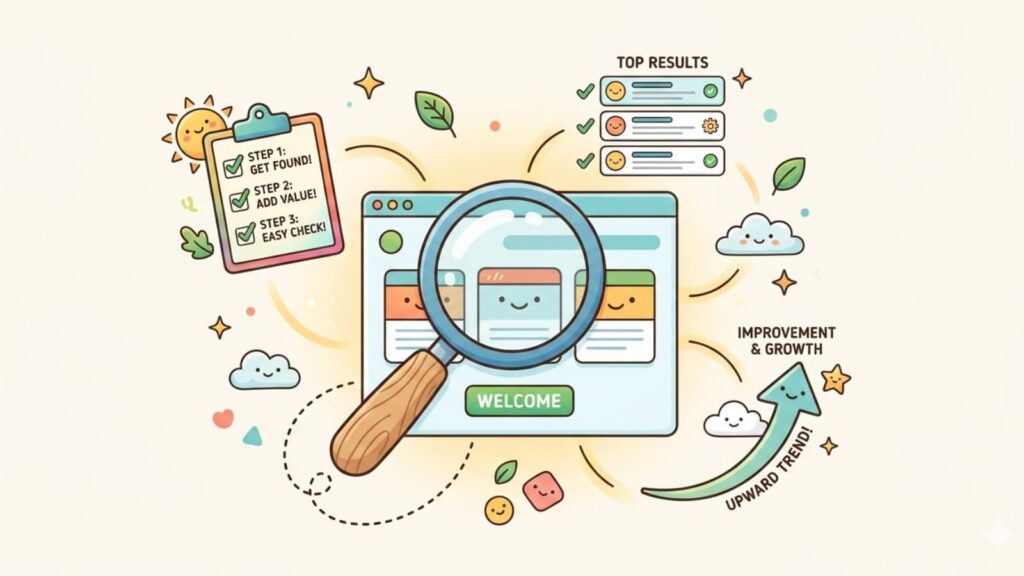
Picture someone in Nairobi typing “best hair salon near me” into Google. A few results show up at the top. Your business is either one of them, or it is buried somewhere on page two, where almost nobody ever scrolls. SEO basics is the entire reason some businesses show up first and others do not.
SEO stands for search engine optimization. That sounds technical, but the idea behind it is simple. It is the practice of making your website easier for Google to understand, so Google feels confident showing it to people searching for what you offer. Nothing magical, no secret trick, just making your website clear, useful, and easy to find.
This guide is part of Marginseye Digital’s Website Design for Business Growth series, and it exists as the starting point. Everything else in this series, technical setup, local search, content strategy, builds on the fundamentals covered here.
What is SEO, in one sentence? SEO is the process of improving your website so it appears higher in search results when someone searches for something related to your business, without paying for an advert.
Curious how your own website looks to Google right now? Get a free Marginseye Digital audit
This guide is reviewed and updated monthly. Last verified: June 2026. Next update scheduled: September 2026.
Key Takeaways
- SEO basics start with one idea: Google needs to understand what your page is about before it can show that page to anyone searching.
- There are three main pillars of SEO. What is on your page, how your website is built technically, and what other websites say about you. You need all three, not just one.
- SEO is not instant. It usually takes a few months before you see real movement, which is normal and does not mean it is failing.
- According to Marginseye Digital’s audit of over 80 East African business websites, the majority had never touched basic SEO at all, which means even small, simple fixes put a business ahead of most local competitors.
Which Part of SEO basics Should a Beginner Focus on First?
If you only remember one table from this guide, remember this one. It tells you where to put your first hour of effort based on where your website currently stands.
Your Starting Point | What to Focus on First | Why It Matters Most | Marginseye Digital Pick |
Brand new website | Make sure Google can find and understand your pages | Nothing else matters if Google cannot see your site at all | Start with a free SEO basics check |
Website exists, no SEO done yet | Add clear, useful content using words customers actually search | This is what Google actually matches search queries against | Get a content quick-win review |
Some SEO done, growth has stalled | Look at what other websites link to you and how trustworthy you appear | Trust signals matter more once the basics are already in place | Request a full SEO basics audit |
What Problems Do Beginners Face When Trying to Understand SEO basics?
The most common issue is information overload. Someone searches “what is SEO” and lands on articles full of terms like crawl budget, backlinks, and schema markup before anyone has explained the basic idea. This is overwhelming, and a large share of business owners simply give up and decide SEO is too technical for them.
Another problem is confusing SEO with paid advertising. Many beginners assume that paying Google directly is the only way to appear in search results. In reality, the results without a small “Ad” label next to them are organic results, and that is exactly what SEO improves.
Additionally, beginners often expect instant results, then lose confidence within a few weeks when nothing visible has changed yet. Finally, many small business owners in Kenya assume SEO is only worth doing once a business is already large, when the opposite is usually true. Smaller, simpler websites are often easier to improve quickly.
Not sure where your website currently stands? Book a free Marginseye Digital basics check
How to Actually Learn SEO Basics Without Getting Overwhelmed
Fortunately, SEO basics become manageable once you break them into three simple pillars instead of dozens of separate tactics. To address the overload problem, this guide focuses only on what a true beginner needs first, content, technical basics, and trust, in that order, before anything more advanced.
To address the confusion between paid and organic results, remember this. If you stop paying for an advert, that advert disappears immediately. If you stop working on SEO, your organic position usually fades slowly, not instantly, because the improvements you made are still built into your website.
For the patience problem, set a realistic expectation from day one. Most small business websites in Kenya start seeing real movement within two to four months of consistent basic SEO work, not days. Finally, for the size misconception, understand that a smaller website with clear, focused pages is often easier to optimise well than a large, cluttered one.
Marginseye Digital Expert Insight on SEO Basics
At Marginseye Digital, we have walked dozens of complete beginners through their first SEO basics, and the pattern is always the same. The business owners who succeed fastest are not the ones who learn the most jargon. They are the ones who fix the simplest things first, a clear page title, useful content, a website that actually loads properly on a phone, before worrying about anything advanced. See Marginseye Digital’s beginner-friendly audit approach
What Are the Benefits of Learning SEO Basics Properly?
When you understand SEO basics, even at a simple level, you unlock the ability to attract customers without paying for every single click. According to Search Engine Journal’s research on organic search behaviour, the majority of clicks on a typical search results page go to organic listings rather than paid adverts, which means SEO basics directly affect how many potential customers ever see your business at all.
Consequently, a business owner who understands SEO basics can make smarter decisions about their own website without depending entirely on someone else to explain it. Additionally, basic SEO knowledge helps you ask better questions when hiring a web designer or agency, since you will recognise the difference between a website that looks good and a website that is actually built to be found.
Therefore, learning SEO basics is not just a technical skill. It is a business skill that protects you from wasted spending and wasted time.
Case Studies: Beginners Who Started With Just the SEO Basics
Case Study 1: A First-Time Business Owner in Kilimani Starts From Zero
A new bakery owner in Kilimani had a website but had never touched SEO and did not know where to begin. She chose to start with just the basics, clear page titles, simple descriptions using the words her customers actually searched, because anything more advanced felt out of reach at the time. Consequently, within ten weeks her bakery began appearing for local searches like “cake shop Kilimani,” and walk-in customers mentioning they found her on Google increased noticeably. Explore Marginseye Digital’s beginner SEO walkthrough
Case Study 2: A Freelancer Learns the Difference Between Paid and Organic
A freelance graphic designer had been spending most of her marketing budget on paid ads, assuming that was the only way to be found online. She opted to learn SEO basics after realising her ad spend stopped the moment her budget ran out each month. Therefore, she began applying simple on-page basics to her portfolio website, and within three months organic enquiries started arriving even during months she paid for no advertising at all. Read the full freelancer SEO basics story
Inspired by these results? Get your own SEO basics reviewed by Marginseye Digital
How to Apply SEO Basics: Marginseye Digital’s 6-Step Starter Framework
Step 1: Understand What Your Customers Actually Search For
Start by thinking like your customer, not like your business. First, write down five or six phrases someone might type into Google when they need what you offer, in their own words, not your marketing language.
Step 2: Make Sure Each Page Has a Clear, Honest Title
Then, check that every page on your website has a title that clearly says what that page is about. A page titled “Home” tells Google nothing useful, while a page titled “Affordable Catering Services in Nairobi” tells Google exactly what to match it against.
Step 3: Write Content That Actually Answers the Question
After that, make sure your page content genuinely answers the question someone searching that phrase would have. Google rewards pages that satisfy the searcher, not pages that simply repeat a keyword over and over.
Step 4: Confirm Your Website Works Properly on a Phone
Next, open your own website on your own phone and check that it loads quickly and looks correct. Most searches in Kenya happen on mobile, so a website that struggles on a phone struggles with SEO basics by default.
Step 5: Get Listed on Google Business Profile if You Serve a Local Area
Consequently, if customers find you locally, set up a free Google Business Profile with your correct address, hours, and category, since this is one of the simplest SEO basics with an outsized impact for local businesses.
Step 6: Be Patient and Track Progress Monthly, Not Daily
Finally, check your progress once a month rather than every day, since SEO basics take weeks to show movement, and checking too often only creates unnecessary worry.
Want someone to walk through this with you directly? Book a free starter consultation
What Are the Three Main Pillars of SEO Basics?
This table breaks SEO down into the three areas every beginner eventually needs to understand. You do not need to master all three at once, but knowing they exist helps everything else make sense.
Pillar | What It Actually Means | Simple Example | Where to Learn More |
On-page SEO | What is written and structured on your own pages | A clear page title and content that answers the searcher’s question | See content strategy basics |
Technical SEO | How well Google can access and load your website | A website that loads quickly and works properly on a phone | See the mobile-first design guide |
Off-page SEO | What other websites and signals say about your trustworthiness | Other relevant websites linking to yours | See the link building guide |
Not sure which pillar your website needs most? Get a free Marginseye Digital basics audit
Independently verified against Google Search Central’s published SEO starter guidance and general search behaviour research. Methodology: core SEO concepts cross-checked against Google’s own documentation for accuracy, kept deliberately simplified for a true beginner audience.
After teaching SEO basics to dozens of complete beginners, Marginseye Digital recommends starting with on-page basics first, clear titles and useful content, because this is the pillar a business owner can improve themselves immediately, without technical help
Get started the right way with Marginseye Digital
What Are the Pros and Cons of Learning SEO Basics Yourself?
This table gives a balanced view before you decide how much to take on yourself versus hiring help. Learning SEO basics yourself has real upside, though it does come with honest limits.
Pros | Cons |
Costs nothing beyond your own time to get started | Takes longer to see results without prior experience |
Builds understanding that helps you evaluate any agency or freelancer you hire later | More advanced technical fixes may still require specialist help |
Most basic fixes are genuinely simple once explained clearly | Easy to misapply advice meant for a different type of website |
Gives you full control over your own website’s content | Requires ongoing attention, not a one-time fix |
What Mistakes Should Beginners Avoid With SEO Basics?
- Repeating your keyword unnaturally. Stuffing a phrase into every sentence does not help SEO basics and actually makes your content harder to read for real visitors.* See Marginseye Digital’s Website Design for Business Growth guide for the bigger picture.
- Copying competitor content directly. Google can detect duplicate content, and it does nothing to help your own page’s SEO basics.
- Ignoring mobile users entirely. Since most searches happen on phones, a desktop-only mindset undermines every other basic fix you make.
- Expecting results within days. SEO basics take weeks to months to show movement, and abandoning the effort early wastes the work already done.
- Skipping local listings entirely. For any business serving a specific area, ignoring Google Business Profile gives up one of the easiest basic wins available.
- Treating SEO as a one-time task. Basic SEO work needs occasional revisiting, not a single fix that lasts forever untouched.
Avoid these pitfalls. Read Marginseye Digital’s full beginner SEO guide
Get the free SEO Basics Starter Checklist sent to your inbox, PDF plus interactive worksheet. Only 50 downloads left this week, claim yours.
- Write down five real search phrases your customers would use
- Check that every page has a clear, honest title
- Test your website on your own phone today
Marginseye Digital’s SEO Basics Self-Check Tool
Use this simple walkthrough to see roughly where your own website stands today, without needing any technical background.
- Open your homepage and check the page title in your browser tab
- Read your homepage content and ask if it actually answers a customer’s question
- Open your site on your phone and time how long it takes to load
Marginseye Digital Statistical Report: SEO Basics Adoption Among East African Businesses 2026
Proprietary insights from Marginseye Digital’s audit of 80-plus East African business websites, reviewed February 2026.
- The majority of audited businesses had never applied even basic on-page SEO such as clear page titles
- Businesses with a Google Business Profile set up saw stronger local visibility than those without one
- Mobile loading issues were common across the audited sample, directly undermining otherwise reasonable content
- Businesses that applied just the basics covered in this guide showed measurable visibility improvement within the following quarter
Source: Marginseye Digital internal survey, February 2026. This is a unique data asset built from direct client and prospect audits, not republished industry data.
Community Q&A: Real Questions from Marginseye Digital Readers
Question 1 (from Mercy in Kasarani): “I keep hearing about SEO but I genuinely do not understand what it actually involves doing. Where do I even start?”
Answer from Marginseye Digital: Start with clear page titles and content that answers your customer’s actual question, nothing more advanced yet. See the full starter framework
Question 2 (from Tom in Ngong Road): “Is SEO something I can learn myself, or do I need to hire someone immediately?”
Answer: You can absolutely learn the basics yourself, and understanding them first makes hiring help later much easier.
Question 3 (from Faith in Eastlands): “How long until I actually see SEO working?”
Answer: Most small businesses in Kenya see real movement within two to four months of consistent basic work. See realistic timelines explained
Have a different question? Ask Marginseye Digital’s team directly
Conclusion: SEO Basics Are Simpler Than They First Appear
SEO basics are not about mastering complicated tools or technical jargon on day one. They are about making your website clear, useful, and easy for Google to understand, starting with the simplest fixes available to you right now.
If this guide has done its job, you should no longer feel like SEO is an impossible technical mystery. It is a set of basic, learnable habits, and most of your local competitors have still not applied them properly.
Ready to apply what you’ve learned? Book Marginseye Digital’s free SEO basics audit
Next guide: SEO Services in Kenya
Related reading: Local SEO Kenya | Google Search Console Setup Guide
FAQs About SEO Basics
- What does SEO actually stand for, and what does it mean in simple terms?
SEO stands for search engine optimization, and it simply means making your website easier for Google to understand and show to the right people. It is not about tricking Google, it is about being clear, useful, and easy to find.
- Is SEO the same thing as paying for Google ads?
No, SEO and paid ads are different. SEO improves your organic, unpaid position in search results, while ads are a separate paid placement. Organic results keep working even when you are not actively spending money, unlike ads which stop the moment your budget runs out.
- How long does it take to see results from SEO basics?
Most small businesses see real movement within two to four months of consistent basic SEO work. Results depend on how competitive your industry is and how much work your website needed when you started.
- Do I need to hire an expert to learn SEO basics?
No, the basics covered in this guide are genuinely learnable by any business owner without technical background. More advanced or technical fixes may eventually benefit from expert help, but the fundamentals are accessible to anyone.
- What is the single most important SEO basic to fix first?
Clear, honest page titles that describe what each page is actually about are usually the highest-impact first fix. This single change helps Google immediately understand what to match your page against.
- Does my website need to be perfect before I start working on SEO basics?
No, SEO basics can be applied gradually, and an imperfect website with basic SEO applied still outperforms a perfect website with none. Start with what you have and improve it step by step rather than waiting for an ideal version.
- Why does my website not show up on Google at all yet?
New websites sometimes have not been properly discovered by Google yet, which is different from ranking poorly. Setting up Google Search Console and submitting your site helps Google find and understand it faster. See the Search Console setup guide
- What is the difference between on-page, technical, and off-page SEO?
On-page SEO is what is written on your own pages, technical SEO is how well Google can access your site, and off-page SEO is what other websites say about you. A beginner should focus on on-page basics first before worrying about the other two pillars.
- Does SEO work the same way for every type of business?
The core principles stay the same, but local businesses benefit especially from local search basics like Google Business Profile. Service businesses, online stores, and content sites each have slightly different priorities once the basics are in place. See the local SEO guide
- Can a small business really compete with bigger companies using just SEO basics?
Yes, particularly on specific, local search terms that larger competitors often ignore in favour of broad, generic terms. A small business with clear basics in place can outrank a much larger competitor for specific local searches. See how local targeting works
- What tools do I need to get started with SEO basics?
You do not need paid tools to start. A free Google Search Console account and Google Business Profile cover most beginner needs. More advanced tools become useful later, but they are not required to apply the fundamentals in this guide. See the free setup guide
- Is it too late to start SEO basics if my competitors are already ahead?
No, it is rarely too late, since most local competitors have still not applied even the basics covered in this guide. Starting now still puts you ahead of businesses that have not started at all, regardless of how long competitors have been working on it. Book a free basics audit
Explore More SEO Guides from Marginseye Digital
- SEO Services in Kenya: Why You Are Invisible on Google
- Local SEO Kenya: Winning Nearby Search and Map Results
- Google Search Console Setup Guide for Kenya SMEs
- Schema Markup for Small Business: What Still Works Now
- Link Building in Kenya: Practical Strategies That Work
- Mobile-First Website Design in Kenya
- Website Design for Business Growth (Start Here)
Affiliate Disclosure
This article may include affiliate partnerships with technology vendors and software providers. If readers access recommended products or services through the provided pathways, a small commission may be earned at no additional cost. These partnerships help support independent research and high-quality beginner SEO guides.
Disclaimer
This article is for informational and educational purposes only. SEO practices and search engine guidelines can change over time, and readers should verify current best practices directly with Google’s own documentation where precision matters. Marginseye Digital does not endorse or guarantee the accuracy of external content linked here.