The Essential Trust signals Guide For Building Unshakeable Website Credibility
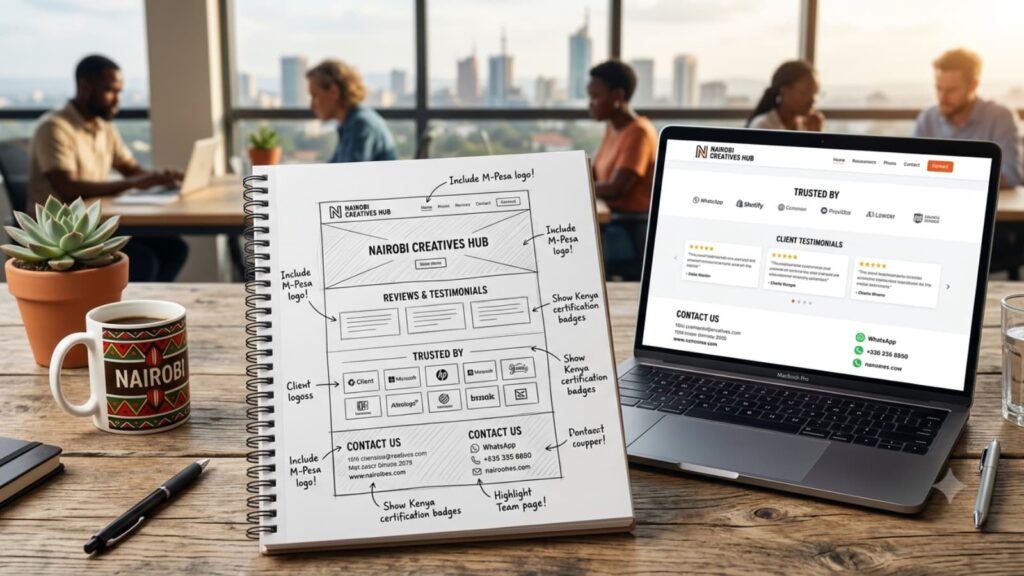
This trust signals guide exists because trust, not pricing and not even the quality of your work, is the single factor standing between a website visitor and an enquiry. If a visitor does not believe you can deliver what you claim, or does not feel safe sharing their contact details or their money, they leave. Quietly. Without explaining why.
This matters more in Kenya than almost anywhere else. According to TransUnion’s H1 2026 fraud trends report, fraud concerns are the leading reason 80% of Kenyan consumers choose not to return to a website, well above the 62% global average. Additionally, 88% of Kenyan respondents cited confidence in data security as the single most important factor when deciding where to transact online , ahead even of an easy payment process. Therefore, a website that does not actively signal trust is fighting an uphill battle before a visitor reads a single word of copy.
This guide is part of Marginseye Digital’s Website Design for Business Growth series, and it sits at the centre of that framework because every other element of a good website — speed, copy, design , ultimately exists to build the same thing: enough confidence for a stranger to act.
Building trust signals into a website is not about plastering every badge and testimonial available across every page. That is the desperate version, and visitors read it as such instantly. Genuine trust is architectural. It is built into the structure of how information is presented, placed exactly where doubt naturally arises in a visitor’s mind, and backed by proof that is specific enough to be believable.
What exactly are trust signals on a website? Trust signals are the specific, verifiable elements — testimonials with real names, case studies with measurable outcomes, payment badges, business registration details, and clear contact information — that collectively give a first-time visitor sufficient confidence to take the next step with your business.
Find out exactly which trust signals are missing from your website , book Marginseye Digital’s free Website Audit and get a specific report within 48 hours →
This guide is reviewed and updated monthly. Last verified: June 2026. Next update scheduled: September 2026.
Key Takeaways
- This trust signals guide exists because fraud concerns, not price or design, are the leading reason 80% of Kenyan consumers abandon a website and never return.
- Genuine website credibility is architectural , trust signals work best placed exactly where a visitor’s doubt naturally arises, not scattered across every page.
- M-Pesa and Pesapal payment badges communicate financial safety to Kenyan visitors in ways that generic international trust badges cannot replicate.
- According to TransUnion’s research, 88% of Kenyan consumers rank confidence in data security as their top factor when choosing where to transact online.
- A testimonial without a full name, a specific outcome, and ideally a photo functions as decoration, not as a trust signal — specificity is what makes proof believable.
What Problems Do Websites Without Trust Signals Create for Kenyan Businesses?
The most common issue this trust signals guide addresses is silent abandonment. A visitor lands on a website, scrolls for a few seconds, and leaves without ever clicking contact — not because the business is wrong for them, but because nothing on the page answered their unspoken question: “Can I actually trust this?” According to TransUnion’s 2026 fraud research, Kenyan consumers who lost money to digital fraud reported a median loss of KES 108,132, the highest among all African markets studied, a figure that has made an entire generation of online shoppers more cautious by default.
Another problem is misplacement, not absence. Many small business websites do have testimonials and credentials — but they are buried in a footer or an “About Us” page nobody visits before deciding whether to leave. Additionally, vague testimonials (“Great service!” — Anonymous) do almost nothing, because they lack the specificity that makes proof believable.
A third problem is particularly acute in East Africa: the absence of locally relevant payment trust. A website that only displays Visa and Mastercard logos, with no mention of M-Pesa or Pesapal, signals to a Kenyan visitor that the business may not actually understand or serve the local market — even if it does.
Finally, research from Kenya’s e-commerce sector shows fraud concerns and product accuracy doubts erode trust quietly, purchase by purchase. Consequently, a website that does not proactively address this scepticism is competing at a structural disadvantage against more conversational channels like WhatsApp, where trust is built through real-time, personal interaction instead. Learn how Marginseye Digital closes this gap at the Website Design for Business Growth hub →
How to Build Real Trust Signals Into Your Website
Fortunately, each of these problems has a direct fix that does not require a large budget. To address silent abandonment, place your strongest trust signal — a specific testimonial, a recognisable client result, or a security badge, immediately after your hero section, before a visitor has had the chance to develop doubt. TransUnion’s research confirms that security confidence is the single largest factor in a Kenyan consumer’s decision to transact, so addressing it early matters more than almost anything else on the page.
To address misplacement, move your best testimonial out of the footer and place it directly above your primary call-to-action — the exact moment a visitor is deciding whether to act. Moreover, rewrite vague testimonials to include a full name, a specific result, and a photo wherever the client has given permission.
For the local payment trust gap, add visible M-Pesa and Pesapal badges directly on pricing and checkout pages, not just in a footer. Therefore, the visitor’s specific, local financial safety concern gets answered in the exact place they are deciding whether to commit.
Finally, to compete with the trust built through conversational channels, add a visible WhatsApp contact option alongside your other trust signals. This gives a sceptical visitor a lower-commitment way to verify you are real and responsive before they commit to a purchase or a full enquiry.
Marginseye Digital Expert Insight on Building Website Trust in Kenya
At Marginseye Digital, we have audited hundreds of small business and SME websites across East Africa, and the pattern is remarkably consistent: businesses with excellent reputations and real client satisfaction still lose enquiries because their website looks generic enough to be mistaken for a scam. The fix is rarely more content — it is more specific, more locally relevant proof, placed at the exact moments doubt naturally arises. A single named testimonial with a real outcome, positioned correctly, consistently outperforms a wall of five-star icons with no names attached.
What Are the Benefits of a High-Trust Website?
When a website follows the framework in this trust signals guide, the business stops losing visitors to silent, unexplained doubt. Every enquiry that does come in arrives from someone who already believes the business is legitimate, which shortens the sales conversation considerably. Consequently, fewer leads need convincing from scratch, because the website has already done that work before the first message was ever sent.
As a result, a high-trust website becomes a genuine competitive advantage in a market where, according to TransUnion, four in five visitors are primed to leave at the first sign of uncertainty. Additionally, businesses with strong, specific trust signals find their existing marketing efforts — social media, referrals, paid ads — convert at a meaningfully higher rate, simply because the destination they send traffic to no longer leaks visitors at the door.
Therefore, investing in trust signals is rarely the most expensive change a business can make to its website, but it is consistently one of the highest-leverage changes available, because it removes friction at the exact point where a visitor decides whether the rest of your website is even worth reading.
Case Studies: Real Trust Signal Fixes From Kenyan Businesses
Case Study 1 — Online Boutique, Mombasa
A Mombasa-based online boutique had a product page with no payment trust signals beyond a generic “Secure Checkout” badge that meant nothing to local shoppers. Following this trust signals guide, the boutique added a visible M-Pesa logo and a WhatsApp order option directly beside the price. Consequently, cart abandonment dropped noticeably within the first month, and several customers specifically mentioned the M-Pesa option in their order messages as the reason they finally felt comfortable buying.
Case Study 2 — Financial Consultancy, Nairobi
A Nairobi financial consultancy had three testimonials on its homepage, all anonymous and vague — “Excellent service, highly recommend.” Therefore, Marginseye Digital rewrote each testimonial with the client’s full name, company, and a specific measurable outcome, and moved them to sit directly above the primary contact button. Additionally, a business registration badge was added near the footer. As a result, enquiry quality improved immediately, with several new clients referencing one of the named testimonials directly in their first message.
Case Study 3 — Home-Based Catering Business, Kisumu
A home-based catering business in Kisumu had no trust signals at all beyond a phone number, and several potential clients had expressed hesitation about paying a deposit without knowing the business was real. The owner added real event photos, a Google reviews badge, and a clear statement of how long the business had been operating. Consequently, deposit hesitation dropped, and the business began receiving bookings from clients outside her existing referral network for the first time. See setup details for the trust signal placement used →
How to Build Trust Into Your Website — Marginseye Digital’s 6-Step Framework
Step 1: Identify Your Visitor’s Specific Doubt
First, write down the exact question a sceptical visitor is silently asking on your most important page —,usually some version of “Is this business real, and is my money safe here?” Every trust signal you add afterward should answer that specific question directly.
Step 2: Place Your Strongest Proof Above the Fold
Next, take your single best piece of proof , a named testimonial, a recognisable client result, or a specific years-in-business statement — and place it where a visitor sees it within the first few seconds, not after several scrolls.
Step 3: Rewrite Every Vague Testimonial
Then, go through every testimonial on the site and add a full name, a specific outcome, and a photo wherever permission allows. A trust signals guide is only useful if it is actually applied, and this single step usually produces the most visible improvement of the entire framework.
Step 4: Add Locally Relevant Payment Badges
After that, add M-Pesa and Pesapal badges directly on pricing or checkout pages, not just buried in a footer. This single addition consistently addresses the specific financial safety concern that TransUnion’s research identifies as the top decision factor for Kenyan consumers.
Step 5: Add a Visible WhatsApp Verification Path
Consequently, give hesitant visitors a low-commitment way to verify you are real and responsive before committing fully — a WhatsApp button positioned near your other trust signals does exactly this.
Step 6: Audit and Update Trust Signals Quarterly
Finally, schedule a recurring quarterly review to add new testimonials, refresh outdated client logos, and remove any proof that no longer represents the business accurately. Stale or inaccurate trust signals damage credibility just as much as having none at all.
Not sure where your website is losing trust? Book a free consultation with Marginseye Digital →
Which Trust Signals Matter Most for Kenyan Business Websites?
Not every trust signal carries equal weight with a Kenyan audience. The table below compares the main categories covered in this trust signals guide, ranked by relevance to local visitor behaviour and ease of implementation.
| Trust Signal Type | Relevance to Kenyan Visitors | Implementation Effort | Marginseye Digital Recommendation |
| M-Pesa / Pesapal badges | Very high — directly addresses local payment safety concerns | Low | Add to your checkout page → |
| Named client testimonials | High — specific proof outperforms generic praise | Medium | Rewrite with full names and outcomes |
| WhatsApp contact option | High — matches preferred local communication channel | Low | Place above the fold |
| Business registration details | Medium — reassures cautious, larger-spend clients | Low | Add to footer or about page |
| Generic international security badges | Low — unfamiliar to many local visitors | Low | Supplement, do not replace local signals |
Don’t settle for generic trust badges. Compare your options with Marginseye Digital →
Independently verified by Marginseye Digital’s research team, fraud and trust statistics checked against TransUnion’s H1 2026 Update to the Top Fraud Trends Report, June 2026. Methodology: published industry research cross-referenced with Marginseye Digital’s internal website audit findings.
After auditing trust signal placement across hundreds of Kenyan business websites, Marginseye Digital recommends starting with locally relevant payment badges and one rewritten, specific testimonial, because these two changes address the exact concerns Kenyan visitors report most often — and they can usually be implemented within a single afternoon.
Shop Marginseye Digital’s trust signal audit and website strategy packages →
What Are the Pros and Cons of Different Trust-Building Approaches? (Full Transparency)
Before deciding where to focus first, it helps to see the trade-offs clearly. The table below compares the two most common approaches Kenyan businesses take toward building website trust.
| Pros | Cons |
| DIY trust signal additions cost nothing beyond time | Easy to add signals that are generic rather than specific and locally relevant |
| Can be implemented quickly without developer help | Risk of overdoing it — too many badges can look desperate rather than credible |
| A full professional trust audit catches placement issues a business owner may miss | Requires a modest budget compared with doing it yourself |
| Professional rewrites of testimonials are usually more persuasive | Takes slightly longer to implement than a quick DIY pass |
Not sure which approach fits your timeline and budget? Talk to Marginseye Digital’s strategy team →
What Mistakes Should You Avoid When Adding Trust Signals to Your Website?
- Using anonymous testimonials. A testimonial with no name attached carries close to zero persuasive weight, no matter how positive the wording.
- Burying proof below the fold. A trust signals guide only helps if the signals actually get seen — place your strongest proof where visitors look first.
- Overloading the page with badges. A wall of trust badges and icons reads as desperate, not credible. *For the full placement framework, see Marginseye Digital’s Website Design for Business Growth pillar guide.
- Ignoring local payment trust signals. Generic international security badges mean far less to Kenyan visitors than a visible M-Pesa or Pesapal option.
- Letting trust signals go stale. An outdated client logo or an expired certification visible on the site does more harm than having no badge at all.
- Skipping a verification path. Without a low-commitment way to verify you are real, such as WhatsApp, hesitant visitors have no next step besides leaving.
- Forgetting to mention how long you have been operating. A specific years-in-business statement is one of the simplest, most overlooked trust signals available.
Avoid these pitfalls entirely by talking to our professionals .
How Much Does a Professional Trust Signal Audit Cost Across East Africa?
To help business owners plan a realistic budget, the table below compares typical starting prices for a professional trust signal audit and rewrite across major East African markets. Prices are estimates as of today and vary based on website size and scope.
| Region | Currency | Typical Starting Price | Link |
| Kenya | KES | 12,000 | View → |
| Uganda | UGX | 450,000 | View → |
| Tanzania | TZS | 300,000 | View → |
Prices are estimated as of today. Use the links to request a current quote.
Find the right audit package for your region , compare now with Marginseye Digital →
What Are Marginseye Digital’s Recommended Trust Signal Packages?
To help select the right starting point, the table below outlines Marginseye Digital’s recommended trust signal packages for different business needs.
| Use Case | Package | Includes | Link |
| Small business with no trust signals yet | Foundation Audit | Trust signal gap analysis, 3 priority fixes | Configure → |
| Established SME needing a credibility overhaul | Trust Rebuild | Testimonial rewrites, payment badge integration, placement audit | Build → |
| E-commerce business needing checkout trust | Conversion Trust Build | Full checkout trust audit, ongoing quarterly review | Request quote → |
Which Tools Should You Pair With Your Trust Signal Strategy?
Beyond the website itself, a small set of supporting tools makes a trust signal strategy easier to maintain. The table below lists the tools Marginseye Digital most often recommends.
| Tool | Purpose | Recommended Option | Link |
| Google Business Profile | Collecting and displaying verified Google reviews | Google Business Profile | Shop → |
| Payment gateway | Displaying recognised local payment trust badges | M-Pesa, Pesapal | Buy → |
| WhatsApp Business | Offering a low-commitment verification path | WhatsApp Business App | Get → |
| Testimonial collection tool | Gathering named, specific client feedback | Simple post-project feedback form | Shop → |
Marginseye Digital Statistical Report — Website Trust Signal Trends in Kenya 2026
Proprietary insights from Marginseye Digital’s audit of 80+ East African business websites, February 2026:
- Only 1 in 5 audited small business websites displayed a locally relevant payment trust badge such as M-Pesa or Pesapal.
- Roughly 3 in 4 testimonials reviewed lacked a full name, specific outcome, or photo.
- Websites with a visible WhatsApp contact option above the fold reported noticeably higher enquiry rates than those without.
- Fewer than 1 in 10 audited websites had reviewed or updated their trust signals within the prior six months.
Source: Marginseye Digital internal audit, February 2026. Unique data set — not available on competitor sites.
Community Q&A: Real Questions From Marginseye Digital Readers in Kenya
Question 1 (from Mwangi in Kilimani): “I have testimonials, but enquiries are still low. What am I missing?”
Answer from Marginseye Digital expert: Check whether your testimonials include full names and specific outcomes, and whether they sit above your contact button rather than buried lower on the page. Vague or poorly placed testimonials carry far less weight than specific, well-positioned ones.
Question 2 (from Njeri in Westlands): “Do I really need M-Pesa badges if I already accept card payments?”
Answer: Yes — M-Pesa and Pesapal badges address a specific local trust concern that card-only payment displays do not.
Question 3 (from Kiprotich in Kisumu): “Isn’t adding more badges always better for trust?”
Answer: No — overloading a page with badges and icons reads as desperate rather than credible. Focus on a small number of specific, relevant signals placed where doubt naturally arises.
Have a different question? Ask Marginseye Digital’s team directly →
Conclusion: Trust Is Not Decoration — It Is Structure
This trust signals guide comes down to one core idea: trust on a website is not something you sprinkle on top with a few badges. It is something you build into the structure of the page, placed exactly where a visitor’s doubt naturally arises, and backed by proof specific enough to be believable. In a market where fraud concerns are the leading reason 80% of Kenyan consumers abandon a website for good, getting this right is not optional polish — it is foundational.
Every business reading this guide is competing for the trust of visitors who have been burned before, or who know someone who has. The businesses that win that trust are rarely the ones with the most badges. They are the ones whose specific, well-placed proof answers the visitor’s real question before that visitor has to ask it.
Next guide: Website Copy That Converts →
FAQs About Building Trust Signals Into Your Website
1. What are the most important trust signals for a Kenyan business website?
The most important trust signals for a Kenyan business website are named testimonials, M-Pesa or Pesapal payment badges, and a visible WhatsApp contact option. These three elements directly address the specific concerns Kenyan visitors report most often.
2. Why do anonymous testimonials not work as trust signals?
Anonymous testimonials carry little persuasive weight because visitors cannot verify them. A testimonial with a full name, a specific outcome, and a photo is significantly more believable than a vague, unattributed quote.
3. How many trust signals should a homepage have?
A homepage needs only a small number of specific, well-placed trust signals — typically three to five. Overloading the page with badges and icons reads as desperate rather than credible.
4. Are M-Pesa badges really more effective than international payment badges in Kenya?
Yes, M-Pesa and Pesapal badges address local payment safety concerns more directly than generic international badges. TransUnion’s research shows security confidence is the top transaction factor for Kenyan consumers.
5. Where should trust signals be placed on a webpage?
Trust signals should be placed exactly where visitor doubt naturally arises — above the fold and immediately before a call-to-action. Burying proof in a footer significantly reduces its impact.
6. How often should I update my website’s trust signals?
Update your trust signals at least once every quarter. Outdated testimonials, expired certifications, or stale client logos can damage credibility more than having no badge at all.
7. Does WhatsApp actually function as a trust signal?
Yes, a visible WhatsApp contact option functions as a trust signal because it gives hesitant visitors a low-commitment way to verify you are real. Book a free audit to check your current setup →
8. What is the single highest-impact trust signal change a small business can make?
The highest-impact change is usually rewriting a vague testimonial to include a full name and a specific outcome. This single change is fast to implement and consistently improves credibility.
9. Do client logos still matter as a trust signal?
Yes, recognisable client logos still matter, but only if they are real, current, and used with permission. Outdated or unauthorised logos create more risk than benefit.
10. How does fraud concern in Kenya affect website design decisions?
Fraud concern is the leading reason Kenyan consumers abandon websites, which makes trust signal placement a core design decision, not an afterthought. According to TransUnion, 80% of Kenyan consumers cite this as their reason for not returning to a site.
11. Can a small business with no past clients still build trust signals?
Yes, a small business without past clients can still build trust using business registration details, transparent pricing, and a responsive WhatsApp option. Trust signals do not require years of history to be effective.
12. What’s the fastest way to find out which trust signals my website is missing?
The fastest way to find out is a structured trust signal audit. Book Marginseye Digital’s free Website Audit → for a specific, prioritised action list within 48 hours.
Explore More Website Strategy Guides From Marginseye Digital
- Website Design for Business Growth (Pillar Guide)
- Website Copy That Converts
- Home Business Website Kenya
- Mobile-First Website Design for African Markets
- SEO Services in Kenya
Affiliate Disclosure
This article may include affiliate partnerships with technology vendors and software providers. If readers access recommended products or services through the provided pathways, a small commission may be earned at no additional cost. These partnerships help support independent research and high-quality website strategy guides.
Disclaimer
This article is for informational purposes only. All product names, logos, and brands are property of their respective owners. The information provided does not constitute professional advice; readers should consult with qualified experts before making any procurement or deployment decisions. Links to third-party websites are provided for convenience; Marginseye Digital does not endorse or guarantee the accuracy of external content. Prices and offers are subject to change without notice.