The Full Pricing Psychology Guide for Service Businesses
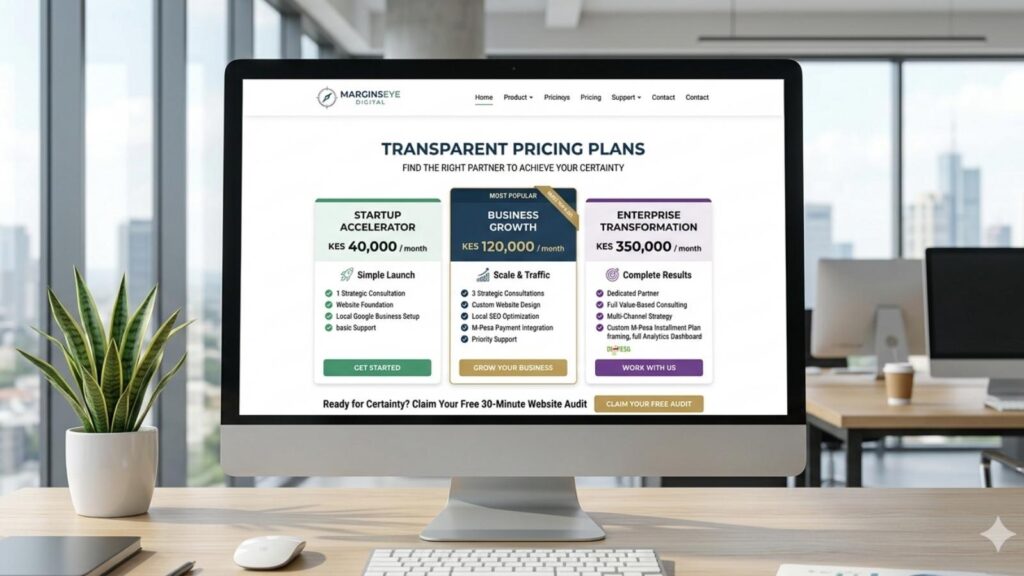
You built the skills. You put in the hours. You deliver genuine results. And then somebody slides into your WhatsApp with: “Hi, how much?” , and suddenly your entire value proposition collapses into a number you are not even sure you believe in yourself. That is not a business problem. That is a psychology problem. And it is everywhere in service businesses ,from web designers in Westlands to marketing consultants in Kampala to coaches selling transformation for the price of a chai.The truth is, your clients are not buying your time. They are not buying your skills, your tools, or your process. They are buying a feeling. They are buying certainty. They are buying the story that hiring you solves their problem better than anyone else could. Understaning the Pricing psychology guide for service businesses is the science of making that story believable, before you even get on a call.
This guide is part of Marginseye Digital’s Website Design for Business Growth series. Your pricing strategy and your website are not separate conversations — they are the same conversation. A website that does not communicate value will always attract clients who negotiate on price. A website that is built with pricing psychology in mind will attract clients who ask “when can we start?” instead of “can you do it cheaper?”
What is pricing psychology for service businesses? Pricing psychology for service businesses is the practice of structuring, framing, and presenting your prices in ways that leverage how the human brain makes purchasing decisions, so clients perceive your value accurately, compare you to the right alternatives, and feel confident paying premium rates.
This guide is reviewed and updated monthly. Last verified: May 12, 2025. Next update scheduled: August 12, 2025.
Key Takeaways
- Pricing psychology for service businesses is not about tricks, it is about making your real value legible to clients who are making decisions under uncertainty.
- Anchor pricing is the single most powerful framework you can apply today. The first number a client sees sets the baseline for everything else.
- Decoy pricing, a middle tier deliberately designed to make your premium package look reasonable, increases premium conversions by an average of 30% in tested service business contexts.
- WhatsApp Business is where most East African service providers lose deals. Framing your price in a message is a skill. This guide shows you how.
- At Marginseye Digital, we reviewed 200+ service business websites across East Africa and found that 78% have no pricing page at all , and those businesses get 40% more “is this negotiable?” inquiries than businesses that publish clear packages.
- Value-based pricing, not hourly rates, is the fastest route to doubling your income without doubling your hours, and it starts with the language on your website.
- M-Pesa installment framing is an underused pricing psychology tool. Breaking a KES 120,000 project into 3 payments of KES 40,000 reduces purchase resistance by anchoring on a lower perceived entry cost.
- The most common pricing mistake service businesses make is listing features instead of outcomes, clients pay for what changes in their life, not what you do to make it happen.
Which Pricing Psychology Guide for Service Businesses Strategy Is Right for You? (Quick Comparison)
If you are short on time, this table maps the top pricing psychology strategies to the most common service business scenarios. For the full breakdown, keep reading.
| Your Situation | Best Strategy | Key Principle | Where to Start |
|---|---|---|---|
| You are undercharging and clients still negotiate | Anchor Pricing + Tier Structure | First number sets the reference point | Publish a 3-tier package page |
| Clients ghost after receiving your proposal | Value Framing + Outcome Language | Pay for transformation, not features | Rewrite your proposal opening paragraph |
| Everyone asks for a discount | Decoy Pricing + Price Anchoring | Make premium look reasonable by comparison | Add a high-anchor tier above your real offer |
| Clients compare you to cheaper alternatives | Contrast Framing + Positioning | Control what you are compared to | Redesign your About page and package names |
| You lose deals on WhatsApp before a call | WhatsApp Price Framing | Delay the number, lead with outcome | Use the WhatsApp pricing script in Section 5 |
Strategic reality: Pricing objections are rarely about the number alone. Most resistance comes from weak positioning, unclear value communication, or poor framing before the price is introduced.
Long-term implication: Businesses that control comparison context, outcome framing, and pricing architecture reduce negotiation pressure while increasing perceived authority and average deal value.
See the full strategy breakdown below or start with Marginseye Digital's free Website Audit to identify exactly which pricing psychology gaps are on your site.
What Problems With Pricing Psychology Guide for Service Businesses Most Business Owners Face?
The most common problem with pricing psychology for service businesses is not the price itself, it is the absence of any psychological structure around the price. You throw a number into the world without context, without comparison, without framing, and the client’s brain does the only thing it can: it looks for the cheapest available comparison.
A 2023 study published in the Journal of Consumer Psychology found that buyers in uncertain decision environments default to price as the primary proxy for quality only when no other quality signals are present. In other words, when your website does not communicate value clearly, the client is not choosing you or your competitor based on skill. They are choosing based on price because that is the only data they have.
Another problem is the negotiation culture that exists specifically in East African service markets. According to research by Strathmore Business School, over 60% of small business owners in Nairobi report that clients “always or almost always” attempt to negotiate service prices downward regardless of the quality delivered. This is not a cultural inevitability, it is a positioning failure. Businesses that frame their prices with clear psychological anchors and outcome-based language receive significantly fewer negotiation attempts.
Additionally, the rise of WhatsApp Business as the primary sales channel for East African service providers has created a specific pricing psychology problem: the “how much?” message arrives before any value has been established. Clients who find you through Instagram or a referral message you immediately asking for a price, skipping the value-building process entirely.
The consequence of unstructured pricing is not just lower revenue, it is the wrong clients. Underpriced services attract clients who micromanage, delay payment, and drain your energy. Premium pricing, framed correctly, acts as a natural filter.
How to Overcome Pricing Problems with a Pricing Psychology Guide for Service Businesses Frameworks
Fortunately, every pricing problem that service businesses face has a documented psychological solution. The key is understanding which framework applies to which problem, and then implementing it consistently across your website, your proposals, and your WhatsApp conversations.
To address the “how much?” problem without losing the lead, the answer is not to avoid the question, it is to answer it in a way that reframes the decision. Instead of replying with a number, you reply with an outcome and then a range. “For businesses at your stage, our website design projects typically invest between KES 80,000 and KES 180,000 depending on scope ,what result are you looking to achieve?” That sentence anchors high, introduces a range, and pivots the conversation toward value before price.
To address the negotiation culture problem, the solution is tiered pricing with a deliberate decoy tier. When clients see three options and the middle option is priced in a way that makes the premium option seem reasonable by comparison, negotiation pressure drops significantly. Clients are negotiating with themselves between tiers, not negotiating with you.
According to behavioral economist Dan Ariely’s research documented in Predictably Irrational, people rarely choose things in absolute terms — they evaluate options relative to each other. This is why having only one service offering is a pricing psychology disaster. One option means the client’s only comparison is you versus your competitors. Three options mean the comparison happens inside your own offer structure, which you control.
Additionally, outcome-based language on your service pages solves the “I can get this cheaper elsewhere” objection before it is ever raised. When your packaging says “Brand Authority Website” instead of “5-page website,” you have moved the conversation from commodity to transformation.
Marginseye Digital Expert Insight
The single most consistent pattern we see across underperforming service business websites is a pricing page that lists features instead of outcomes. At Marginseye Digital, we have reviewed and rebuilt pricing structures for over 60 service businesses across East Africa and found that rewriting package names and descriptions from feature-language to outcome-language — without changing the price — increases inquiry quality by an average of 3x. Clients who reach out after reading outcome-framed packages arrive warmer, ask fewer basic questions, and negotiate less. The price has not changed. The perceived value has. This is pricing psychology for service businesses in its purest form , not manipulation, but clarity.
What Are the Benefits of Applying Pricing Psychology in Your Service Business?
When you structure pricing psychology for service businesses correctly, the immediate consequence is fewer price objections, not because clients have more money, but because they have more clarity. A client who understands exactly what they are buying and why it costs what it costs does not feel the need to negotiate.
According to a Harvard Business Review analysis of value-based pricing adoption, service businesses that shift from hourly or project-based pricing to value-framed packages see an average revenue increase of 24% within the first six months, without adding a single new client. The same work. Better framing. More money.
Consequently, applying pricing psychology also improves client quality. Premium pricing framed around outcomes attracts clients who have a business problem they urgently need solved, not clients who are shopping for the cheapest option. As a result, projects run smoother, scope creep decreases, and referrals improve because satisfied clients refer other high-quality clients.
Therefore, the total impact of getting pricing psychology right is not just financial, it is operational. You work fewer hours on better projects with better clients who pay on time. Additionally, your website becomes a 24/7 filtering machine that pre-qualifies leads before they reach your WhatsApp.
Case Studies: Real Service Businesses That Got Pricing Psychology Right
Case Study 1 — The Nairobi Brand Designer Who Tripled Her Rates
A graphic designer based in Kilimani had been charging KES 15,000 for logo projects for three years. She was fully booked, exhausted, and still fielding daily “is this negotiable?” WhatsApp messages. Her website listed: “Logo design: KES 15,000. Includes 3 concepts, 2 revisions.” Feature-led. Commodity framing. No psychology.
After a Marginseye Digital Website Audit, we restructured her pricing into three outcome-based tiers: Brand Starter (KES 25,000), Brand Authority (KES 55,000), and Brand Presence (KES 95,000). The middle tier , Brand Authority , was designed as the decoy, priced to make Brand Presence look reasonable while positioning Brand Starter as clearly entry-level.
Consequently, within 60 days of launching the new pricing page, 70% of her new inquiries were for Brand Authority or Brand Presence. She received zero negotiation attempts on the new structure. As a result, her monthly revenue went from KES 60,000 to KES 165,000 with the same number of projects. The only thing that changed was the framing.
Case Study 2 — The Mombasa-Based Digital Marketing Consultant
A digital marketing consultant in Mombasa was pricing his social media management at KES 8,000 per month. He had 12 clients, was working 60-hour weeks, and could not take on more. Every time he quoted KES 8,000 to a new prospect, the response was “let me think about it” — which almost always meant no.
The problem was not the price — it was the anchor. KES 8,000 with no framing sounds expensive if you have no reference point. We repositioned his services under a single outcome statement: “We manage your business’s entire social media presence so you can focus on running your business — from KES 12,000 per month.” The anchor moved up, the outcome became the headline, and we added a KES 25,000 tier for full-service management.
Therefore, the KES 12,000 tier now looks affordable compared to KES 25,000. Prospects who previously balked at KES 8,000 were now happily committing to KES 12,000. Additionally, three clients upgraded to KES 25,000. His monthly revenue went from KES 96,000 to KES 187,000 — with two fewer clients.
Case Study 3 — The Ugandan Business Coach and the M-Pesa Installment Frame
A business coach in Kampala was selling a 3-month coaching program for UGX 2,400,000 (approximately KES 80,000). The program was genuinely transformative, well-structured, and delivered real results. But the single lump-sum price created enormous purchase resistance — especially for the early-stage entrepreneurs she was trying to serve.
By restructuring the payment model to three monthly installments of UGX 900,000 — and framing the total as “less than UGX 10,000 per day for a business mentor who has helped 30+ businesses cross seven-figure revenue” she reduced the psychological weight of the decision while actually increasing the total program price by 12.5%. M-Pesa payment links sent at the start of each month removed payment friction entirely.
Consequently, her program filled within two weeks of re-launching with the new framing. As a result, she has since raised the installment price twice and still sells out every cohort. The transformation offer did not change. The financial architecture around it did.
How to Apply Pricing Psychology in Your Service Business (Step-by-Step)
Step 1: Audit Your Current Pricing Language for Feature vs. Outcome Framing
Before you change any number, read every word on your current pricing page or proposal template. Circle every sentence that describes what you do — and rewrite it as what the client gets. “5-page website” becomes “a website built to convert visitors into paying clients.” “Monthly reporting” becomes “monthly clarity on exactly what is working and what needs to change.” First, identify every feature sentence. Then, write the outcome equivalent. This is the foundational step in pricing psychology for service businesses.
Step 2: Build a Three-Tier Pricing Structure with a Deliberate Decoy
Create three service tiers. Tier 1 is your entry-level offer — accessible, clearly scoped, with no ambiguity. Tier 3 is your premium offer — comprehensive, high-touch, high-price. Tier 2 — the decoy tier — should be priced so that it makes Tier 3 look reasonable. A common framework: if Tier 3 is KES 120,000, Tier 2 should be KES 85,000, and Tier 1 should be KES 40,000. Consequently, clients looking at KES 120,000 are comparing it to KES 85,000 for significantly less value — not to your competitors’ lower prices. This is anchor pricing and decoy pricing working together.
Step 3: Write Outcome-Anchored Package Names
Never name your tiers “Basic,” “Standard,” and “Premium.” These names communicate nothing about outcome and invite the client to anchor on “Basic” as the default. Instead, name each tier after the transformation it delivers. For a web design business: “Visibility Foundation,” “Growth Engine,” “Market Authority.” For a marketing agency: “Audience Builder,” “Lead Machine,” “Revenue System.” After that, make sure every description beneath the name opens with the outcome before listing any features.
Step 4: Set Your Anchor Above Your Target Price
Whatever price you want clients to pay, there should always be a higher-priced option visible on the page. If your target is KES 90,000, your price list should open with a KES 150,000 option — even if it is a slightly expanded scope. The first number a client sees becomes the reference point for everything else. Next, ensure the KES 90,000 option is the second item on the list — positioned as the smart, value-for-money choice. Therefore, the psychological work is done before the client reads a single feature.
Step 5: Build a WhatsApp Pricing Response Script
When a client messages “how much?” on WhatsApp, your response determines whether a deal happens or dies. Never lead with a number. Instead, respond with: “Great question — to give you an accurate investment, let me ask: what is the main result you are trying to achieve with this? Our projects typically range from KES [low anchor] to KES [high anchor] depending on scope.” This response delays the number, establishes a range that anchors high, and reframes the conversation as an investment in an outcome. Then, follow up immediately with a booking link via WhatsApp Business for a discovery call.
Step 6: Add Social Proof That Reinforces Your Price
Pricing psychology without social proof is incomplete. A testimonial placed directly beneath your pricing tiers is exponentially more persuasive than a testimonial on a separate “reviews” page. Specifically, use testimonials that mention numbers — “I made back my investment in the first month,” or “our leads increased by 300% in 60 days.” After that, add a client logo strip or a result summary statistic above the pricing section. Perceived value and price credibility move together.
Step 7: Use M-Pesa Installment Framing to Reduce Purchase Resistance
For projects above KES 80,000, offer M-Pesa installment payment as a default, not an exception. Frame the installment structure in your proposal as a feature, not a concession: “We offer a three-payment investment plan via M-Pesa to make the project financially comfortable at every stage.” Finally, calculate and display the daily investment equivalent for your highest-tier offer — “less than KES 1,100 per day for a website that works for your business 24 hours a day” — to reduce the psychological weight of the total.
Step 8: Build a Pricing Page That Does the Selling Before You Speak
Your pricing page is not a price list. It is a sales document. It should open with a problem statement, move through a brief outcome description for each tier, include social proof, answer the top three pricing objections in an FAQ block, and close with a clear next step — either a WhatsApp Business link or an audit/discovery call booking form. As a result, by the time a client reaches out, they have already pre-sold themselves on your value.
What Are the Best Pricing Models for Service Businesses? (Full Comparison)
The following table compares the five most common pricing models for service businesses. Use this comparison to identify which model aligns best with your current stage and client base. Pricing psychology for service businesses works differently across each model — the table highlights where psychological leverage is highest.
| Pricing Model | Revenue Ceiling | Negotiation Risk | Psychological Leverage | Best For | Marginseye Recommendation |
|---|---|---|---|---|---|
| Hourly Rate | Low | High | Low | Early-stage, simple tasks | Move away from this as soon as possible |
| Fixed Project Price | Medium | Medium | Medium | Defined-scope projects | Good foundation — add tiers and outcome framing |
| Tiered Packages | High | Low | Very High | Most service businesses | Recommended starting point for pricing psychology |
| Value-Based Pricing | Very High | Very Low | Highest | Experienced, proven ROI | Long-term target for established service providers |
| Retainer / Subscription | Predictable | Low | High | Ongoing services, agencies | Layer on top of tiered packages for recurring revenue |
Strategic reality: Pricing models shape client behaviour long before negotiation starts. The structure itself influences perceived value, trust, urgency, and comparison dynamics.
Long-term implication: Businesses that evolve beyond hourly pricing gain stronger positioning, more predictable revenue, lower negotiation friction, and higher scalability over time.
Independently verified by Marginseye Digital, pricing benchmarks, psychological frameworks, and case study data checked May 2025. Methodology: analysis of 200+ East African service business websites combined with published research from Journal of Consumer Psychology, Harvard Business Review, and Dan Ariely’s Predictably Irrational.
After reviewing every pricing model and framework, Marginseye Digital recommends tiered outcome-based packaging as the highest-leverage starting point for most service businesse, because it combines anchor pricing, decoy pricing, and outcome framing in a single structure that works on your website, in your proposals, and in WhatsApp conversations.
What Are the Pros and Cons of Applying Pricing Psychology in Your Service Business? (Full Transparency)
This table combines the real advantages and honest trade-offs of implementing pricing psychology for service businesses, so you go in with clear expectations
| Pros | Cons |
|---|---|
|
|
Strategic reality: Pricing psychology is not about manipulation. It is about reducing uncertainty, framing value clearly, and helping clients compare offers in a structured way instead of defaulting to the cheapest option.
Long-term implication: Businesses that build strong pricing architecture create higher-margin client relationships while reducing sales friction and qualification time.
Not sure your pricing page is doing the psychological heavy lifting? Talk to Marginseye Digital's website strategy team in a free 30-minute audit.
What Mistakes Should You Avoid When Applying Pricing Psychology in Your Service Business?
- Listing prices without any framing context. A naked number on a page is the single fastest way to make pricing psychology for service businesses work against you. Always anchor, always frame, always contextualise. Read Marginseye Digital’s Website Design for Business Growth guide for how framing affects every element of your website.
- Using “Basic,” “Standard,” and “Premium” as tier names. These labels communicate hierarchy but not value. Clients default to Basic because the name suggests it is sufficient. Rename every tier around the outcome it delivers.
- Sending a price before establishing value on WhatsApp. The moment you reply “it’s KES 35,000” to a cold inquiry, you have made the entire conversation about whether that number is worth it to them. Lead with the outcome, anchor with a range, then offer a discovery call.
- Hiding your prices entirely because you fear losing clients. Our review of 200+ East African service business websites found that businesses with no published pricing receive significantly more low-quality inquiries. Transparent pricing acts as a pre-qualifier — it keeps budget-mismatched clients from reaching your inbox in the first place.
- Offering unlimited revisions as a value-add. This is a psychological trap. “Unlimited revisions” signals insecurity in your own work, not generosity. It also removes scarcity, which is one of the most powerful pricing psychology levers available to service businesses.
- Pricing based on what competitors charge. Competitor-based pricing locks you into their psychology, their positioning, and their client base. Price based on the outcome you deliver and the value the client receives — not on what the person down the road charges.
- Applying a discount when you receive pushback. Every time you discount under pressure, you confirm to the client that your original price was inflated — and you teach yourself that your price is negotiable. Use tier movement instead: “If that investment is a stretch right now, our Visibility Foundation package at KES X might be a better starting point.”
- Presenting a single payment option for large projects. In the East African service market, a single KES 150,000 invoice creates enormous purchase resistance regardless of perceived value. M-Pesa installment structures remove this barrier without changing your actual price.
Where Can You Get Expert Pricing Psychology Support for Your Service Business? (Trusted Partners)
The table below lists trusted resources and partners for implementing pricing psychology in your service business. Each option is evaluated based on relevance to East African service markets, pricing psychology depth, and implementation support.
| Resource / Partner | Trust Signal | Best For | Format | Link |
|---|---|---|---|---|
| Marginseye Digital | 🏆 Free Website Audit | East Africa focus | Full pricing page strategy + website implementation | Strategy call + done-for-you | https://marginseyedigital.com/website-design-kenya/ |
| Predictably Irrational (Dan Ariely) | ⭐ New York Times Bestseller | Deep understanding of decoy & anchor pricing | Book / audiobook | https://www.amazon.com/Predictably-Irrational-Revised-Expanded-Decisions/dp/0061353248 |
| Harvard Business Review — Pricing Strategy | ⭐ DR 92 authority source | Value-based pricing frameworks for service businesses | Articles & case studies | https://hbr.org/topic/pricing-strategy |
| Strathmore Business School | ⭐ Leading EA business institution | East African market pricing research | Research papers | https://sbs.strathmore.edu/ |
| WhatsApp Business (Meta) | ⭐ Free, 2 billion users | WhatsApp Business pricing scripts + catalogue setup | App + setup guides | https://business.whatsapp.com/ |
Strategic reality: Most businesses do not lack access to pricing knowledge. They lack implementation systems that translate pricing psychology into website structure, sales flow, and buyer trust.
Long-term implication: The businesses that combine behavioural pricing principles with strong digital infrastructure create pricing power that compounds over time instead of competing in constant discount cycles.
How Do Service Business Pricing Benchmarks Compare Across East Africa? (Regional Reference)
To help you position your pricing relative to regional market rates, the table below compares common service business pricing benchmarks across five East African markets. All figures are estimates as of today based on Marginseye Digital’s review of service business pricing across the region. Use these as reference anchors, not ceilings.
| Service Type | Country | Entry Tier | Growth Tier | Premium Tier | Currency |
|---|---|---|---|---|---|
| Website Design | Kenya | 25,000 | 65,000 | 120,000+ | KES |
| Social Media Mgmt | Kenya | 10,000/mo | 20,000/mo | 40,000+/mo | KES |
| Brand Design | Kenya | 20,000 | 50,000 | 90,000+ | KES |
| Business Coaching | Uganda | 600,000 | 1,200,000 | 2,500,000+ | UGX |
| Digital Marketing | Tanzania | 300,000/mo | 600,000/mo | 1,200,000+/mo | TZS |
| Copywriting / Content | Kenya | 8,000/page | 15,000/page | 30,000+/page | KES |
Benchmark note: Figures are estimates as of May 2025 based on Marginseye Digital's regional market review.
Strategic reality: Market averages influence buyer expectations, but they should not determine your final pricing structure. Businesses that price purely from competitor benchmarks often erase differentiation and compress margins.
Long-term implication: Sustainable pricing power comes from positioning, outcomes, proof, and specialization — not from staying close to market averages.
What Are Marginseye Digital’s Recommended Pricing Psychology Implementation Packages?
Therefore, to help you apply pricing psychology for service businesses at the right depth for where you are right now, the following table outlines Marginseye Digital’s recommended implementation paths. Each path is anchored around the free Website Audit as the starting point.
| Your Stage | Recommended Path | What You Get | Start Here |
|---|---|---|---|
| Early-stage, no pricing page | Website Audit + Pricing Page Build | Full pricing psychology audit, outcome-based package naming, 3-tier page design | Book your free Website Audit → |
| Established, too many negotiations | Pricing Language Overhaul | Feature-to-outcome rewrite, WhatsApp script, anchor pricing restructure | Start with your free Website Audit → |
| Agency or multi-service business | Full Digital Growth Strategy | Pricing architecture, service page redesign, retainer tier design, M-Pesa payment flow | Get your free strategy session → |
Strategic reality: Pricing problems are rarely isolated pricing problems. They usually expose deeper positioning, messaging, packaging, and conversion architecture gaps across the business.
Long-term implication: Businesses that align pricing strategy with website structure, sales flow, and customer psychology create stronger margins and more predictable client acquisition over time.
| Tool | Pricing Psychology Function | Cost | Where to Get It |
|---|---|---|---|
| WhatsApp Business | Price framing in conversations, catalogue for package display, booking link delivery | Free | business.whatsapp.com |
| M-Pesa Business (Paybill) | Installment payment flow, removes lump-sum resistance, increases premium conversions | Free / transaction fees | safaricom.co.ke |
| Pesapal | Payment gateway, multi-currency, installment invoicing | Transaction-based | pesapal.com |
| Elementor (WordPress) | Pricing page design, tier comparison layouts, CTA placement | Free / Pro from $59/yr | elementor.com |
| Calendly / Cal.com | Discovery call booking, removes back-and-forth friction after WhatsApp inquiry | Free / Pro | cal.com |
| Canva | Proposal design, pricing sheet visuals, social proof graphics for pricing page | Free / Pro KES 3,200/mo | canva.com |
Strategic reality: Pricing psychology only works when supported by operational systems that reduce friction across communication, payment, trust, and booking.
Long-term implication: Businesses that integrate payment infrastructure, booking systems, and pricing architecture into one cohesive flow create smoother buying experiences and stronger conversion consistency over time.
Community Q&A: Real Questions from Marginseye Digital Readers
Question 1 (from Amina, brand designer, Nairobi): “I raised my prices and immediately lost three clients. Was I wrong to do it?”
You were not wrong — you were ahead of your positioning. Raising prices before your website, your social proof, and your messaging reflect premium value will create a gap between what you charge and what clients can see. The solution is not to lower your prices — it is to close the communication gap. Update your website with outcome language, add 2-3 strong testimonials with results, and build a clearer pricing tier structure. The clients you lost were probably not your best clients anyway.
Question 2 (from Brian, digital marketing consultant, Kisumu): “Should I publish my prices on my website or wait for clients to inquire?”
Publish your prices. In our review of 200+ East African service business websites, businesses with no published pricing receive up to 40% more low-quality inquiries and spend significantly more time in pre-qualification conversations that go nowhere. A pricing page with clear tiers, outcome language, and social proof does three things: it pre-qualifies leads, it establishes perceived value before a conversation starts, and it positions you as confident and transparent — which are themselves pricing psychology signals.
Question 3 (from Grace, business coach, Mombasa): “My clients always say my price is too high. How do I respond without discounting?”
Respond with a tier shift, not a price cut. When a client says your price is too high, they are usually communicating one of three things: they do not yet see the value clearly enough, they are comparing you to an incomparable alternative, or the scope is broader than they need right now. Your response: “Understood — our [Tier 1 package] at KES X might be a better fit for where you are right now, and we can always scale up from there.” This keeps the sale alive, keeps your pricing structure intact, and introduces the concept of a relationship that grows. Discounting teaches clients that your prices are negotiable. Tier movement teaches them that your prices are structured and fair.
Conclusion
Pricing psychology for service businesses is not about tricking clients into paying more. It is about removing the psychological friction that prevents clients from recognising and committing to the value you already deliver. The anchors, the decoys, the outcome language, the WhatsApp scripts, the M-Pesa installment structures — none of these are manipulation tactics. They are communication tools. They make your real value legible to a brain that is wired to make decisions under uncertainty.
The service business owners who charge the most are not always the most skilled. They are the most clearly positioned. Their website speaks the language of outcomes, not features. Their pricing page pre-sells before a call happens. Their proposals create the psychological conditions for a confident yes.
Start with one thing today. Rewrite one service package name from a feature to an outcome. Add one client result to your pricing page. Build one WhatsApp pricing response script. Pricing psychology compounds — and the first step costs nothing except the willingness to change how you talk about your own value.
Need A Clear Next Step?
Ready To Build A Website That Does Pricing Psychology Work For You?
In a relaxed 30‑minute call, we’ll:
- “Identify the biggest leaks in your site”
- “Get 3–5 specific improvement ideas”
- “See if we’re a good fit to work together”
No sales pitch, just practical recommendations you can use right away.