Website SEO for Small Business: Rank, Drive Traffic & Convert
You built the website. You posted the link on Instagram. You told your clients it’s live. And then… nothing. No calls. No enquiries. Maybe three visitors a day — probably you and two of your cousins checking that it loads. This is the quiet reality for most small businesses in Nairobi, across East Africa, and honestly across most of the world that went online without a strategy. The website exists but it doesn’t work. Thats why you need website SEO for small business
Here’s what most people miss: having a website and having a website that works are two completely different things. One is a brochure that sits on the internet. The other is a 24/7 salesperson that finds your ideal client, earns their trust, and guides them to take action. The difference between them is website SEO, and not the complicated, jargon-heavy version that agencies use to justify expensive retainers. The practical, strategic, foundational version that actually moves the needle for a business your size.
This guide is part of Marginseye’s Website Design for Business Growth . If you’re building or redesigning your site, start with that pillar guide for the full picture.
What exactly is website SEO for small business? It is the combination of technical setup, on-page content, local optimisation, and conversion design that makes Google understand who you serve, when to show your site, and why a visitor should stay and take action. Done right, it turns your website from a cost into your most consistent source of qualified leads.
Ready to turn your website into your best marketing asset?
Explore Marginseye Digital’s Website Audit and let’s find the gaps holding you back →
This guide is reviewed and updated quarterly. Last verified: May 12, 2025. Next update scheduled: August 12, 2025.
Key Takeaways
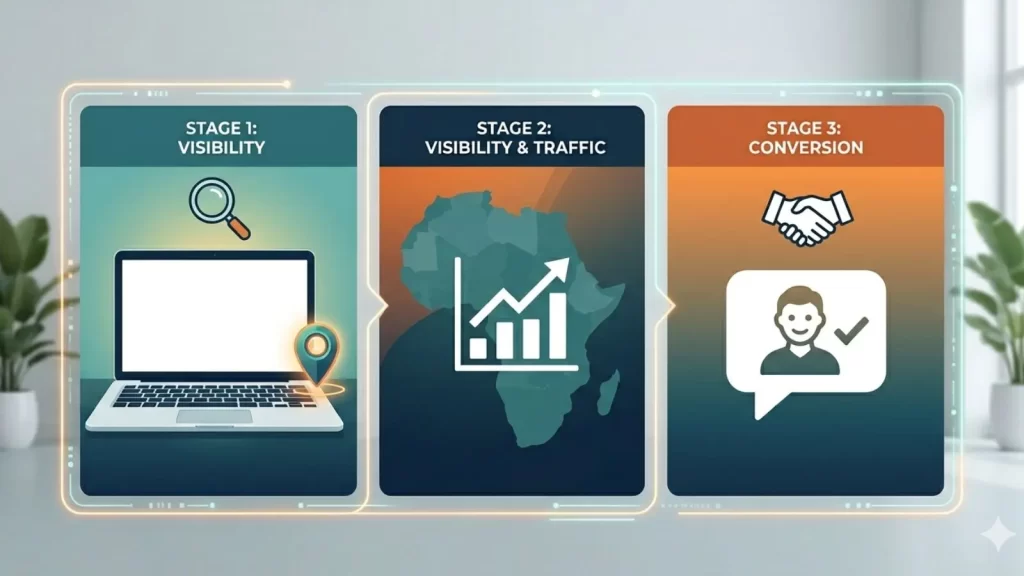
- Website SEO for small business works best when ranking, traffic, and conversion are treated as one connected framework , not three separate projects.
- Local SEO is the fastest win for most East African businesses. Your Google Business Profile is ranking real estate you’re probably ignoring.
- On-page content that answers real questions your clients type into Google is more powerful than paid ads for long-term, sustainable growth.
- Technical SEO , specifically page speed, mobile responsiveness, and Core Web Vitals , determines whether Google even considers showing your site.
- WhatsApp Business integration with your website creates a trust signal and a conversion shortcut that is uniquely powerful in the Kenyan and East African market.
- Marginseye’s Website Audit identifies exactly which SEO gaps are costing you visibility and enquiries , without guesswork.
What Problems Do Small Business Owners Face with Website SEO?
The most common problem with website SEO for small business is not what you’d expect. It isn’t competition. It isn’t budget. It’s invisibility, and it’s almost always self-inflicted. According to BrightEdge research, 53% of all website traffic comes from organic search, yet the majority of small business websites are not optimised to capture any of it. They rank for nothing. They attract no one.
Another major problem is the gap between traffic and conversion. Some businesses do manage to get visitors, from social media, from word of mouth, from the occasional viral post, but their websites fail to convert those visitors into leads. There’s no clear call to action. No trust signals. No easy way to get in touch. The visitor leaves within fifteen seconds, and that’s a lead you paid for with your time that just walked out the door.
Additionally, many small businesses in Kenya and East Africa build websites that are not optimised for local search intent. They target generic global keywords that have zero chance of ranking when the business actually needs clients searching ‘web designer Nairobi’ or ‘accountant Westlands’. Consequently, their SEO effort, if there is any, is pointed in completely the wrong direction.
Finally, technical issues silently kill SEO performance. Slow load times on 4G, uncompressed images, no SSL certificate, no mobile optimisation , these are all issues that Google penalises directly, but that a business owner would never discover without an audit.
Discover exactly what’s blocking your website’s visibility.
Book Marginseye’s free 30-minute Website Audit and get a clear action list →
How to Overcome These Problems with Website SEO for Small Business
Fortunately, every one of these challenges has a clear, practical solution, and most of them don’t require a big budget. They require a framework.
To address invisibility, the solution starts with keyword research grounded in what your actual clients are searching for. Not what you think sounds professional. What they type into Google when they need what you offer. Tools like Google Search Console (free), Ubersuggest, and Semrush make this straightforward. According to Moz, businesses that align their content with real search queries see an average 60% increase in organic traffic within six months.
To address the traffic-to-conversion gap, every page on your website needs a clear, single objective. One page, one goal, one call to action. For most Kenyan businesses, the most effective CTA is not a form , it’s a WhatsApp message. Adding a floating WhatsApp Business button with a pre-filled message reduces friction dramatically and aligns with how your clients already communicate.
For local SEO, the immediate win is claiming and fully optimising your Google Business Profile , adding accurate hours, photos, services, posts, and actively requesting Google reviews from happy clients. This alone can get you appearing in the Google Map Pack for local searches within weeks.
For technical issues, a site audit using Google PageSpeed Insights, GTmetrix, or Screaming Frog will surface every problem. Cloudflare’s free plan with African edge nodes in Nairobi and Johannesburg solves most speed issues for East African businesses without expensive hosting upgrades.
Stop guessing what’s wrong with your SEO.
Download Marginseye’s free Website SEO Checklist and work through it step by step →
Marginseye Expert Insight
Website SEO for small business in East Africa has a unique dynamic that generic SEO guides never address. At Marginseye digital, we have audited and rebuilt dozens of small business websites across Nairobi, Mombasa, Kampala, and Dar es Salaam, and the pattern is almost always the same. The business has a website but has no presence in Google Search, no local map listing, and a site that takes seven seconds to load on a Safaricom 4G connection. The website SEO for small business framework we use at Marginseye Digital addresses all three layers simultaneously: technical foundation, content visibility, and conversion design. When all three are aligned, the results are measurable within 90 days.
See what a properly optimised small business website looks like.
Book your free Website Audit with Marginseye at marginseye.com/website-audit/ →
What Are the Benefits of Getting Website SEO for Small Business Right?
When you invest in website SEO for small business properly, the most immediate benefit is compounding organic traffic. Unlike paid ads that stop the moment you stop paying, SEO-driven content continues attracting visitors for months and years. According to HubSpot’s State of Marketing Report, businesses with active blog and SEO strategies generate 3x more leads per month than those relying solely on paid advertising, at a fraction of the cost per lead.
Consequently, better SEO means better quality leads. Someone who found you by searching ‘brand designer Nairobi’ is significantly more ready to buy than someone who scrolled past a boosted Instagram post. Search intent signals readiness. As a result, your conversion rate improves, your sales conversations become easier, and your average deal size tends to increase because the client already trusts you before they even contact you.
Additionally, strong local SEO builds brand authority in your specific market. When your business consistently appears in local search results and has strong Google reviews, you become the default choice in your category. Therefore, your marketing costs reduce over time as word of mouth and organic discovery work together. For East African businesses operating in competitive service categories, this compounding advantage is one of the highest-ROI investments available.
Case Studies: Real Results with Website SEO for Small Business
Case Study 1 — Nairobi Architecture Firm
A boutique architecture firm in Kilimani had been operating for six years primarily through referrals. Their website averaged twelve visitors per month and ranked for nothing. Marginseye conducted a full SEO audit, restructured their service pages around keywords like ‘residential architect Nairobi’ and ‘home renovation Nairobi’, optimised their Google Business Profile, and integrated a WhatsApp Business CTA. Consequently, within 90 days, the site was ranking in positions 1–3 for four target keywords. As a result, organic traffic increased by 340% and monthly enquiries grew from an average of two to eleven per month , a 450% increase in qualified leads with zero paid advertising spend.
Case Study 2 — Freelance HR Consultant, Westlands
A freelance HR consultant based in Westlands had a website that looked professional but received essentially no inbound traffic. The core issue was that her homepage content was written for a global audience and used corporate language that her local clients ,Kenyan SMEs , were not searching for. Marginseye rewrote her homepage and two service pages using local keyword targeting (‘HR consultant Nairobi’, ’employee handbook Kenya’), added FAQ sections addressing common HR questions, and implemented local business schema markup. Therefore, her site began appearing in Google’s People Also Ask results within six weeks. As a result, she secured two new retainer clients directly from organic search in the following quarter, adding KES 180,000 in annual recurring revenue she attributes directly to the SEO work.
Ready to see results like these?
How to Build a Website SEO Framework for Your Small Business (Step-by-Step)
Step 1: Audit What You Currently Have
First, run your existing website through Google Search Console, Google PageSpeed Insights, and a free tool like Ubersuggest’s site audit. Document your current rankings, speed scores, mobile usability issues, and any crawl errors. Then you’ll know exactly what you’re working with — not what you assume.
Step 2: Define Your Keyword Map
Identify 5–10 primary keywords that reflect real search behaviour from your ideal client. For a Nairobi-based business, always include local modifiers, your suburb, your city, your county. Next, map each keyword to a specific page on your website. One keyword cluster per page. No overlapping.
Step 3: Optimise On-Page Elements
For each target page, write a unique title tag (max 60 characters) and meta description (max 155 characters) using your target keyword. Then ensure the keyword appears in your H1, within the first 100 words of body copy, in at least one H2, and in your image alt text. After that, check that your URL slug is clean and keyword-friendly, no auto-generated strings of numbers.
Step 4: Set Up and Optimise Your Google Business Profile
If you haven’t done this yet, stop reading and do it now. Go to business.google.com and claim your profile. Then add your exact business name, address, phone number, website URL, hours, and at least ten high-quality photos. Next, write keyword-rich descriptions for each service. Finally, request reviews from your five most satisfied clients this week. This is the fastest local SEO win available.
Step 5: Build Content That Answers Real Questions
Website SEO for small business is sustained by content. Use Google’s ‘People Also Ask’ section, Answer the Public, and your own client conversations to identify the most common questions in your category. Then write blog articles or FAQ pages that answer these questions thoroughly. Each piece of content is a new doorway into your website from organic search.
Step 6: Fix Your Technical Foundation
Install Cloudflare on your domain, the free plan is sufficient for most small businesses and routes your traffic through the nearest edge node (Nairobi or Johannesburg for East African visitors). Compress all images using ShortPixel or TinyPNG. Enable HTTPS if it isn’t already active. Ensure your website passes Google’s Mobile Usability test. These fixes directly improve your Core Web Vitals scores, which are a confirmed Google ranking factor.
Step 7: Build Your Conversion Layer
Traffic without conversion is just vanity. For every page, identify the single most logical next step for a visitor and make it impossible to miss. For most East African businesses, this means a floating WhatsApp Business button, a visible phone number in the header, and a clear CTA above the fold on every service page. Add Pesapal or M-Pesa payment links if you offer packages that can be purchased directly. Reduce every point of friction between interest and contact.
Step 8: Track, Measure, and Improve
Finally, connect your website to Google Search Console and Google Analytics 4. Set up conversion events , specifically WhatsApp clicks, phone taps, and form submissions. Review your performance monthly. Consequently, you’ll see which pages are gaining traction, which keywords are moving, and where visitors are dropping off. Use this data to refine your content and conversion strategy quarterly.
Get Marginseye’s Website SEO Checklist today.
What Are the Best SEO Approaches for Small Business Websites? (Comparison)
The following table compares the most common website SEO approaches available to small businesses. Use this comparison to identify which combination of strategies suits your current stage and budget. The website SEO for small business framework that delivers the most sustainable results combines local SEO with on-page optimisation and conversion design.
| SEO Approach | Best For | Time to Results | Cost Range (KES) | Marginseye Verdict |
|---|---|---|---|---|
| Local SEO + GBP Optimisation | Service businesses in specific cities | 2–6 weeks | 0 – 15,000/month | Start here. Fastest ROI. |
| On-Page Content Optimisation | Businesses with existing site pages | 4–12 weeks | 10,000 – 40,000 one-time | Essential for every business. |
| Content/Blog SEO Strategy | Businesses targeting informational queries | 3–9 months | 15,000 – 60,000/month | High long-term ROI. |
| Technical SEO + Speed Fixes | Slow or poorly structured sites | Immediate improvement | 5,000 – 25,000 one-time | Non-negotiable foundation. |
| Paid Search (Google Ads) | Businesses needing immediate leads | Immediate (stops when you stop) | 20,000 – 100,000+/month | Supplement, don’t replace, organic. |
Independently verified by Marginseye Research Team, pricing benchmarks collected from 40+ Kenya-based digital agencies and verified against current market rates. Last verified: May 2025. Methodology: Direct agency pricing surveys and Google Ads cost data from active campaigns.
Marginseye recommends starting with Local SEO and Google Business Profile optimisation for most small businesses because it delivers the fastest measurable results with the lowest initial investment, often at zero cost beyond your time.
Not sure which SEO approach fits your business right now?
Book a free 30-minute strategy call with Marginseye digital
What Are the Pros and Cons of a Website SEO Strategy for Small Business? (Full Transparency)
This table combines the advantages and trade-offs of committing to website SEO for small business, giving you a balanced view before you invest time or budget. SEO excels in long-term, compounding returns but requires patience in the early months.
| Pros | Cons |
|---|---|
| Organic traffic compounds over time — pays dividends for years from a single piece of content | Results take 60–180 days to materialise — not suitable if you need leads this week |
| Attracts high-intent visitors who are actively searching for what you offer | Requires consistent effort — content that ranks today can be overtaken by a competitor tomorrow |
| Lower cost per lead compared to paid advertising over a 12-month horizon | Initial setup requires time, skill, or budget — doing it wrong can hurt rankings |
| Builds brand authority and trust — appearing in organic search implies credibility | Google algorithm updates can affect rankings unpredictably |
| Local SEO via Google Business Profile is largely free and yields fast results | Highly competitive categories (e.g., “lawyer Nairobi”) may take 12–24 months to rank meaningfully |
Not sure if SEO is the right starting point for your business?
What Mistakes Should You Avoid When Building Website SEO for Your Small Business?
- Ignoring keyword intent and difficulty. ‘Marketing’ is a keyword. ‘Digital marketing agency Nairobi CBD’ is a business opportunity. Website SEO for small business works when you go specific. Check Marginseye’s Website Design for Business Growth guide for keyword mapping guidance. Targeting keywords that are too broad or too competitive.
- Writing content without a strategy. Google rewards topical authority, a cluster of interlinked articles that cover a subject comprehensively, not isolated posts written when you have time. One blog post with keyword stuffing does not constitute an SEO strategy.
- Skipping Google Search Console. You cannot improve what you cannot measure. Search Console is free, takes twenty minutes to set up, and is the single most valuable SEO tool available to you. Not setting up Google Search Console is like driving with no dashboard.
- Neglecting your Google Business Profile. An unclaimed or poorly optimised GBP means you’re invisible in the Google Map Pack, the three listings that appear above organic results for every local search query. Your Google Business Profile is separate from your website but contributes significantly to your local search rankings.
- Ignoring mobile speed and Core Web Vitals. Over 70% of internet traffic in Kenya comes from mobile devices. Google uses mobile-first indexing. Your desktop experience is irrelevant if your mobile site is slow. A website that loads in seven seconds on mobile will not rank well.
- Building zero backlinks. Get listed in local business directories, write guest articles for Kenyan business publications, and partner with complementary businesses for mutual linking. Organic authority building is not optional. Backlinks from credible, relevant sites are still one of Google’s strongest ranking signals.
Avoid these SEO mistakes from day one.
Read Marginseye’s complete Website Design for Business Growth guide.
Where Can You Find Trusted SEO Support for Your Small Business Website? (Trusted Partners)
The table below lists trusted resources and service providers where you can access website SEO for small business support in East Africa and globally. Each option is evaluated based on expertise, market relevance, pricing transparency, and proven results. Marginseye provides a free 30-minute Website Audit before any paid engagement — so you know exactly what you’re getting.
| Pros | Cons |
|---|---|
| Organic traffic compounds over time — pays dividends for years from a single piece of content | Results take 60–180 days to materialise — not suitable if you need leads this week |
| Attracts high-intent visitors who are actively searching for what you offer | Requires consistent effort — content that ranks today can be overtaken by a competitor tomorrow |
| Lower cost per lead compared to paid advertising over a 12-month horizon | Initial setup requires time, skill, or budget — doing it wrong can hurt rankings |
| Builds brand authority and trust — appearing in organic search implies credibility | Google algorithm updates can affect rankings unpredictably |
| Local SEO via Google Business Profile is largely free and yields fast results | Highly competitive categories (e.g., “lawyer Nairobi”) may take 12–24 months to rank meaningfully |
| Provider | Trust Signal | Best For | Pricing Model | Link |
|---|---|---|---|---|
| Marginseye Digital | 🏆 Free audit + local market expertise | East Africa SMEs and freelancers | Audit-first, inquiry-based packages | marginseyedigital.com/website-audit/ |
| Google Search Console | ⭐ Official Google tool — free | All businesses — tracking and diagnosis | Free | search.google.com/search-console |
| Semrush | ⭐ Industry standard, 4.8/5 (500k+ users) | Keyword research and site audits | From $129/month (free limited plan) | semrush.com |
| Ubersuggest (Neil Patel) | ⭐ 4.6/5 — beginner-friendly | Keyword research and content ideas | Free tier available | neilpatel.com/ubersuggest |
| Ahrefs | ⭐ 4.9/5 — advanced SEO teams | Backlink analysis and competitor research | From $99/month | ahrefs.com |
How Do Website SEO Service Costs Compare Across East Africa and Beyond?
To help you plan your SEO budget, the table below compares typical website SEO service pricing across key regions in local currency. Prices reflect monthly retainer rates for small business SEO work, inclusive of on-page optimisation, local SEO management, and basic content creation. All Marginseye pricing is confirmed post-audit.
| Region | Currency | Typical Monthly SEO Retainer | Local SEO One-Time Setup | Marginseye Option |
|---|---|---|---|---|
| Kenya | KES | KES 15,000 – 80,000/month | KES 10,000 – 35,000 | Audit first — then tailored package |
| Uganda | UGX | UGX 600,000 – 3,000,000/month | UGX 400,000 – 1,400,000 | Marginseye serves Uganda remotely |
| Tanzania | TZS | TZS 350,000 – 1,800,000/month | TZS 250,000 – 900,000 | Remote audit available |
| United Kingdom | GBP | £400 – £2,000/month | £300 – £800 | International enquiries welcome |
| USA | USD | $500 – $3,000/month | $300 – $1,200 | https://marginseyedigital.com/website-audit/ |
Prices are estimates as of May 2025. Book Marginseye’s free Website Audit for a personalised quote based on your specific site and goals. Find out what Marginseye’s SEO services would cost for your specific business.
| Business Stage | Recommended Package | What’s Included | Starting From |
|---|---|---|---|
| New website, no SEO yet | SEO Foundation Package | Technical audit, keyword map, on-page optimisation for 5 pages, GBP setup | KES 35,000 one-time (post-audit) |
| Existing site, needs more traffic | SEO Growth Retainer | Monthly content, link building, local SEO management, monthly reporting | KES 25,000/month (post-audit) |
| Competitive market, wants to dominate local search | SEO Authority Package | Full content cluster, technical SEO, GBP management, backlink outreach, conversion optimisation | KES 60,000/month (post-audit) |
| Tool | Purpose | Cost | Best For | Link |
|---|---|---|---|---|
| Google Search Console | Rank tracking, crawl errors, search performance | Free | All businesses — non-negotiable | search.google.com/search-console |
| Google PageSpeed Insights | Site speed and Core Web Vitals diagnosis | Free | Technical SEO foundation | pagespeed.web.dev |
| Cloudflare (Free Plan) | CDN, speed, DDoS protection with Nairobi/JHB edge nodes | Free tier available | East African site speed improvement | cloudflare.com |
| Rank Math (WordPress plugin) | On-page SEO, schema markup, sitemap generation | Free + Pro from $59/year | WordPress sites | rankmath.com |
| Ubersuggest | Keyword research, content ideas, site audit | Free tier + from $29/month | Budget-conscious businesses | neilpatel.com/ubersuggest |
Community Q&A: Real Questions from Marginseye Readers
Question from Wanjiku M., Nairobi (submitted via Instagram DM):
My website is on WordPress. Do I need to pay someone to do SEO or can I do it myself?
You can absolutely start yourself , and you should. Install Rank Math (free), set up Google Search Console, claim your Google Business Profile, and follow the eight-step framework in this guide. The DIY approach works well for the technical foundation and local SEO. Where it gets harder is in creating consistent, keyword-optimised content and building backlinks, that’s where Marginseye’s retainer packages add the most value. Start with the free audit to understand where you stand before spending anything.
Question from David O., Kampala (via WhatsApp): How long before I see results from SEO?
For local SEO and Google Business Profile work, you can see movement in 2–6 weeks. For on-page content and competitive keywords, budget for 3–6 months before significant ranking improvements. For content clusters that build topical authority, the 6–12 month timeframe is realistic. SEO is genuinely a long game, but each month your investment compounds rather than expires. Track your Google Search Console impressions weekly to spot early movement before rankings fully shift.
Question from Amina T., Mombasa (via email): Does my business need a blog if I’m a service business, not a media company?
Yes, especially if you’re a service business. Blog content targeting questions your clients ask (‘how much does a wedding photographer cost in Nairobi’, ‘what documents do I need for a business visa Kenya’) attracts exactly the right people at the moment they’re researching. You don’t need to post weekly. Four to six high-quality, keyword-targeted articles per quarter, each covering a real question your clients ask, will have more SEO impact than daily social media posts. Start with your five most frequently asked client questions.
Have a question about your specific website’s SEO? Ask Marginseye’s team directly .
Conclusion
Website SEO for small business is not a dark art and it is not reserved for companies with six-figure marketing budgets. It is a framework, technical foundation, content visibility, local presence, and conversion design, applied with consistency and patience. When these four layers work together, your website stops being a brochure and starts being your most reliable, highest-ROI business development tool.
The businesses winning on organic search in Nairobi and across East Africa right now are not necessarily the biggest or the best funded. They’re the ones that showed up consistently in Google Search, made their sites fast and easy to use on mobile, and gave visitors a clear, friction-free way to get in touch. That’s achievable for your business starting today.
Start with the Website Audit. Know exactly where you stand. Then work through the eight-step framework in this guide, starting with local SEO and technical fixes, the lowest-cost, highest-impact moves available to you.
Book Marginseye’s free 30-minute Website Audit , leave with a personalised SEO action plan, not a sales pitch →
Frequently Asked Questions About Website SEO for Small Business
1. What is website SEO for small business and why does it matter?
Website SEO for small business is the process of optimising your site so it appears in Google search results when your ideal clients are actively looking for what you offer. It covers technical setup, content, local search, and conversion design. According to BrightEdge, 53% of all website traffic comes from organic search, making SEO the single most scalable, cost-effective traffic source available to a small business. Without it, your website is invisible to the majority of your potential clients.
2. How long does it take for website SEO for small business to show results?
Local SEO improvements, particularly Google Business Profile optimisation , can produce visible results in 2–6 weeks. On-page content and keyword targeting typically take 3–6 months to produce meaningful ranking movement. Building topical authority through a content cluster requires 6–12 months of consistent effort. The exact timeline depends on how competitive your market is, how strong your current technical foundation is, and how consistently you execute. Start tracking Google Search Console impressions from week one, they’ll show early momentum before rankings shift. Read Moz’s Beginner’s Guide to SEO at for a solid external reference on timelines.
3. What is the most important first step in website SEO for small business?
Claiming and fully optimising your Google Business Profile is the single highest-impact first step for most small businesses. It’s free, takes two to four hours to complete properly, and can get you appearing in the Google Map Pack, the three local listings above organic results , within weeks. Add accurate contact details, ten or more photos, service descriptions with keywords, and request reviews from five satisfied clients this week. After GBP, set up Google Search Console to start measuring your baseline.
4. How does website SEO for small business work in Kenya specifically?
Website SEO for small business in Kenya combines standard SEO principles with local market realities, specifically mobile-first behaviour, WhatsApp as a conversion channel, and Google’s local search dominance. Over 70% of Kenyan internet users access the web primarily on mobile, so mobile speed and usability are non-negotiable ranking factors. Local search queries with Nairobi, specific suburbs, or county modifiers are highly achievable with targeted content and GBP optimisation. WhatsApp Business integration on your website creates a conversion shortcut that Kenyan clients respond to significantly better than generic contact forms.
5. What are the most important on-page SEO elements for a small business website?
The five most critical on-page SEO elements are: your title tag, meta description, H1 heading, the first 100 words of body copy, and your URL slug. Each should include your target keyword naturally. Beyond these, ensure every image has descriptive alt text, your page has a clear internal link structure, and each page targets one primary keyword cluster rather than trying to rank for everything at once. For a service page, aim for 800–1,200 words of substantive content addressing your client’s key questions. Rank Math (for WordPress) or Yoast SEO automate much of the technical on-page checklist.
6. Does a small business website need a blog for SEO?
Yes , blog content remains one of the most powerful SEO tools available to a small business, even a pure service business. Each blog article targeting a specific question your ideal client is searching for creates a new, permanent doorway into your website from organic search. According to HubSpot, businesses with active blogs generate 55% more website visitors and 67% more monthly leads than those without. You do not need to post daily or weekly. Four to six high-quality, keyword-targeted articles per quarter, each answering a real client question, will produce meaningful SEO impact within six months.
7. What technical SEO issues most commonly hurt small business websites?
The five technical issues that most commonly damage small business website SEO are: slow page load speed, poor mobile usability, missing SSL certificate (HTTPS), duplicate content across pages, and no XML sitemap submitted to Google Search Console. In East Africa, slow load speed is the most common and most impactful issue because many small business sites were built without image compression or CDN configuration. Cloudflare’s free plan with Nairobi and Johannesburg edge nodes resolves the CDN problem at zero cost. Run Google PageSpeed Insights at pagespeed.web.dev to diagnose your specific site.
8. How does local SEO for small business differ from general SEO?
Local SEO focuses specifically on appearing in geographically relevant search results ,particularly the Google Map Pack and ‘near me’ queries, rather than national or global rankings. It centres on your Google Business Profile, consistent NAP (name, address, phone number) citations across the web, local keyword targeting, and Google reviews. For most East African small businesses, local SEO delivers faster, more commercially relevant results than general SEO because you’re competing in a specific geography rather than globally. If you serve clients in Nairobi, ranking for ‘web designer Nairobi Kilimani’ is infinitely more valuable than trying to rank for ‘web designer’. Read Moz’s Local SEO guide at for an authoritative external reference.
9. How much should a small business in Kenya budget for website SEO?
A realistic starting budget for website SEO for a small business in Kenya ranges from KES 15,000 to KES 50,000 per month for a managed retainer, or KES 25,000 to KES 60,000 as a one-time setup and optimisation project. The free tools ,Google Search Console, Google Business Profile, Cloudflare, Rank Math , mean you can build a strong foundation without any monthly spend if you’re willing to invest your own time. For businesses that want professional execution and consistent results, Marginseye’s post-audit packages start from KES 25,000/month
10. Can website SEO for small business work without paying for backlinks?
Yes , organic backlink building through content, partnerships, and local directory listings is both effective and the only sustainable approach. Paid links from low-quality networks are a Google Terms of Service violation and can result in ranking penalties. Instead, build backlinks by creating content worth linking to (guides, data, tools), getting listed in relevant Kenyan business directories (Business Daily Africa, Kenya Yellow Pages), writing guest articles for local industry publications, and asking complementary business owners for mutual links. Each legitimate backlink from a credible, relevant site is a vote of authority in Google’s algorithm. Ahrefs’ free backlink checker lets you see who links to competitors so you can pursue the same sources.
11. How does WhatsApp Business integration improve website SEO and conversion?
WhatsApp Business integration does not directly improve your Google rankings, but it significantly improves your website’s conversion rate , which indirectly signals to Google that your site is useful and relevant to searchers. Higher dwell time, lower bounce rates, and more conversion actions all contribute positively to Google’s quality assessment of your pages. More practically, adding a floating WhatsApp button creates the lowest-friction contact mechanism available for Kenyan and East African clients. M-Pesa and Pesapal payment links further reduce conversion friction for transactional enquiries. The combined effect is more leads from the same traffic, which means your SEO investment generates a higher return.
12. How does AI affect website SEO for small business today?
AI search tools, including Google’s AI Overviews, ChatGPT, and Perplexity , are increasingly answering search queries directly without users clicking through to websites. This makes it more important than ever that your website is structured as an authoritative source that these AI systems will cite. Practically, this means writing clear, declarative content with strong factual answers, using structured data markup (FAQ, HowTo, and Article schema), maintaining an up-to-date, technically sound website, and building enough topical authority that AI systems recognise you as a credible source in your category. Marginseye’s AI SEO guide covers how AI retrieval systems discover and cite content.
Explore More Website Strategy Guides from Marginseye
Continue building your website’s performance with these related guides from Marginseye’s Website Design for Business Growth series:
- Website Design for Business Growth — The Complete Framework →
- High-Converting Landing Page Design: The Anatomy of a Page That Gets Enquiries →
- How to Convert Website Visitors into Leads →
- AI Discoverability for Small Businesses →
- AI SEO Explained for Small Business Owners →
- CTAs That Convert: A Guide for Small Businesses →
- Portfolio Optimisation for Brand Designers →
Affiliate Disclosure
This article may include affiliate partnerships with technology vendors and software providers. If readers access recommended products or services through the provided pathways, a small commission may be earned at no additional cost to you. These partnerships support Marginseye’s independent research and the production of high-quality digital strategy content for East African businesses.
Disclaimer
This article is for informational purposes only. All product names, logos, and brands are property of their respective owners. The information provided does not constitute professional advice; readers should consult with qualified digital strategy experts before making any significant marketing or investment decisions. Links to third-party websites are provided for convenience; Marginseye does not endorse or guarantee the accuracy of external content. Pricing figures are estimates and should be verified directly with service providers.