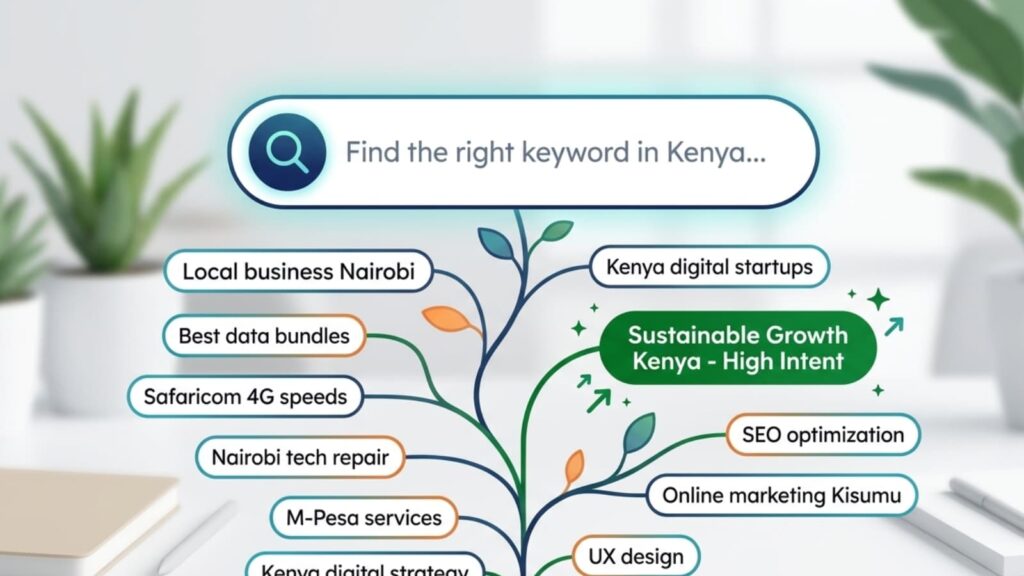
Here is a pattern Marginseye Digital sees constantly. A business owner writes a blog post about “the importance of professional photography for your brand,” feels proud of it, publishes it, and waits. Nothing happens. Meanwhile, somewhere in Nairobi, a hundred people that month searched “wedding photographer prices Nairobi” instead, and that business never showed up for a single one of those searches. This is the entire problem keyword research strategies exist to solve. It is not about guessing what sounds good or what you wish people searched for. It is about finding the actual words real people type into Google, then building your content around those exact words instead of your own internal language.
This guide builds directly on Marginseye Digital’s SEO Basics guide, which introduced the idea of writing down search phrases your customers might use. This article goes much deeper into how to actually find those phrases properly, using real strategies and real tools, not guesswork.
What are keyword research strategies, in simple terms? Keyword research strategies are repeatable methods for discovering the exact words and phrases real customers search for, so you can build content that matches genuine demand instead of assumptions.
See which keywords your competitors are already winning. Book a free Marginseye Digital audit
This guide is reviewed and updated monthly. Last verified: June 2026. Next update scheduled: September 2026.
Key Takeaways
- Effective keyword research strategies start with how customers actually talk, not with industry language or how a business describes itself internally.
- Long-tail keywords, longer and more specific phrases, are usually easier to rank for and often convert better than short, highly competitive terms.
- Search intent matters more than search volume. A keyword with fewer searches but clear buying intent often outperforms a high-volume but vague one.
- According to Marginseye Digital’s audit of over 80 East African business websites, the majority of underperforming content was built around assumed keywords rather than researched ones.
Which Keyword Research Strategies Should You Start With?
If you only have twenty minutes today, pick the row that matches your situation and start there. The full explanation of each method follows below.
|
Your Situation |
Best Strategy to Start With |
Why It Works |
Marginseye Digital Pick |
|
Brand new website, no content yet |
Google autocomplete and “People also ask” |
Free, fast, and shows real search behaviour instantly |
Get a free starter keyword list |
|
Some content, unsure what to write next |
Competitor keyword gaps |
Shows what is already proven to attract search traffic |
Request a competitor gap review |
|
Established site, want to scale |
Search intent clustering by topic |
Builds topical authority instead of isolated pages |
Plan a full content cluster |
What Problems Do Businesses Face When Looking For Keyword Research Strategies?
The most common issue is what Marginseye Digital calls the inside-language problem. Business owners write using the words they use internally, “bespoke solutions”, “end-to-end service”, while actual customers search in plain, simple terms like “affordable wedding photographer Nairobi.” These two vocabularies rarely overlap.
Another problem is chasing keywords that are far too competitive for a small or new website. Targeting “photographer” alone means competing against thousands of established websites, while a more specific phrase has a real chance of ranking within months rather than years.
Additionally, many businesses confuse search volume with search value. A keyword searched a thousand times a month sounds impressive, but if those searchers are not ready to buy, the traffic does little for the business. Finally, most beginners stop after finding one or two keywords, when a proper strategy usually requires building a small cluster of related terms.
Find out which keywords are actually worth targeting. Book a free Marginseye Digital audit
How to Fix Your Keyword Research Using Proven Strategies
Fortunately, every one of these problems has a straightforward fix once you know where to look. To address the inside-language problem, start every keyword research session by typing your topic into Google and reading the autocomplete suggestions and the “People also ask” box. These are real questions real people are asking, in their own words, for free.
To address the overly competitive keyword problem, favour long-tail keywords, phrases of four or more words that are more specific. “Affordable wedding photographer Nairobi for small weddings” is far easier to rank for than “photographer” alone, and the person searching it is much closer to actually booking.
For the volume-versus-value confusion, always ask what the searcher actually wants before chasing a number. Moreover, for the single-keyword trap, build a small cluster of five to ten related phrases around one core topic rather than stopping at the first idea that comes to mind.
Marginseye Digital Expert Insight on Keyword Research Strategies
At Marginseye Digital, we have run keyword research for businesses across nearly every sector in Kenya, and one pattern holds steady almost every time. The businesses that win are not the ones chasing the highest search volume. They are the ones who find the specific phrase a ready-to-buy customer actually types, even if only a few hundred people search it each month. See Marginseye Digital’s full keyword research approach
What Are the Benefits of Using Proper Keyword Research Strategies?
When you apply real keyword research strategies instead of guessing, you unlock content that actually meets existing demand instead of hoping demand will appear. According to SimilarWeb’s research on organic search behaviour, content built around researched, intent-matched keywords consistently outperforms content built around assumed topics.
Consequently, a business that researches keywords properly spends less time writing content nobody searches for. Additionally, ranking for specific, intent-matched long-tail keywords often brings fewer but far more qualified visitors, people who are closer to actually making a decision.
Therefore, proper keyword research strategies do not just improve your rankings, they improve the return on every hour spent creating content in the first place.
Case Studies: Businesses That Fixed Their Keyword Research
Case Study 1: A Catering Business Stops Guessing and Starts Researching
A small catering business in Westlands had been writing blog posts about “event planning trends” for months with almost no traffic. They chose to apply real keyword research strategies after realising their content never matched what people actually searched. Consequently, after switching to phrases like “affordable corporate catering Nairobi” and “small event catering packages Kenya,” found through simple autocomplete research, their organic enquiries rose noticeably within ten weeks. Explore Marginseye Digital’s keyword research walkthrough
Case Study 2: A Freelance Accountant Finds an Overlooked Long-Tail Opportunity
A freelance accountant serving small businesses had been targeting only the broad term “accountant Nairobi,” a hugely competitive phrase for a one-person operation. She opted for a long-tail strategy instead, after recognising she could never outrank established firms on the broad term alone. Therefore, she built content around “tax filing help for freelancers Kenya” and similar specific phrases, and within four months began ranking on page one for several of these less competitive but highly relevant terms. Read the full long-tail keyword story
Inspired by these results? Get your own keyword opportunities mapped by Marginseye Digital
How to Do Keyword Research: Marginseye Digital’s 7-Step Strategy Framework
Step 1: Start With a Broad Topic, Not a Specific Keyword
Begin with the general subject your business covers, not a single guessed phrase. First, write down three or four broad topics related to what you offer before narrowing anything down.
Step 2: Mine Google Autocomplete and “People Also Ask”
Then, type each broad topic into Google and note every autocomplete suggestion and every question in the “People also ask” box. These are real, current searches happening right now, for free.
Step 3: Check What Competitors Are Already Ranking For
After that, look at two or three competitor websites ranking for your topic and note the specific phrases their page titles and headings use, since this often reveals proven, working keywords.
Step 4: Sort Every Keyword by Search Intent
Next, label each keyword you have found as informational, someone learning, or transactional, someone ready to act, since the type of content you create should match the intent behind the search.
Step 5: Favour Long-Tail Phrases Over Broad Terms
Consequently, prioritise more specific, longer phrases over single broad words, since long-tail keywords are usually less competitive and attract more ready-to-act searchers.
Step 6: Group Related Keywords Into a Small Cluster
Therefore, organise your final list into a small cluster of five to ten related keywords around one core topic, rather than treating each keyword as a completely separate idea.
Step 7: Revisit Your Keyword List Every Few Months
Finally, revisit your keyword research every few months, since search behaviour shifts over time and new phrases emerge as your market and customers change.
 Download Marginseye Digital’s illustrated Keyword Research Framework (PDF)
Want help applying this to your specific business? Book a free consultation
Which Free Keyword Research Tools Should You Actually Use?
You do not need an expensive subscription to do real keyword research. The table below compares free tools beginners and small businesses can start using today.
|
Tool |
What It Shows You |
Best For |
Marginseye Digital Note |
|
Google Autocomplete |
Real-time search suggestions as you type |
Quick, instant keyword ideas |
Always start here, it costs nothing |
|
Google “People Also Ask” |
Related questions real users are asking |
Finding content angles and FAQ ideas |
Great source for blog subheadings |
|
Google Search Console |
What you already rank for, even faintly |
Finding hidden opportunities on your own site |
See the full setup guide |
|
Google Trends |
Whether interest in a topic is rising or falling |
Spotting seasonal or emerging topics |
Use to time content, not to replace research |
Want a deeper, done-for-you keyword list? Get one from Marginseye Digital
Independently verified against publicly available Google Search features and general SEO industry research. Methodology: strategies cross-checked against free, currently available tools rather than paid platforms, to keep this guide accessible to any business regardless of budget.
After running keyword research for businesses across many sectors, Marginseye Digital recommends starting with Google autocomplete and “People also ask” before anything else, because it costs nothing and reveals real search behaviour within minutes.
Get your keyword strategy mapped properly with Marginseye Digital
What Are the Pros and Cons of Doing Keyword Research Yourself?
This table gives a balanced view before deciding how much of this to take on personally. Doing your own keyword research has real advantages, with a few honest trade-offs.
|
Pros |
Cons |
|
Free tools cover most of what a small business genuinely needs |
Takes longer without prior experience or a clear process |
|
Builds a real understanding of how your own customers search |
Easy to misjudge keyword difficulty without paid tools |
|
Keeps your content strategy grounded in real demand, not guesswork |
Requires occasional revisiting as search behaviour shifts |
|
Helps you brief a freelancer or agency more effectively later |
Competitive niches may eventually benefit from paid keyword tools |
Want a second opinion on your keyword list? Talk to Marginseye Digital
What Mistakes Should You Avoid With Keyword Research Strategies?
- Writing in your own internal language. Industry terms rarely match how real customers search, so keyword research strategies must start from the customer’s words, not yours.* See Marginseye Digital’s SEO Basics guide for the foundational concept this builds on.
- Chasing only high-volume keywords. A high search volume means nothing if the searcher has no real intent to buy what you offer.
- Targeting keywords far too competitive for your website’s size. A new or small website rarely beats established competitors on broad, single-word terms.
- Stopping after finding just one keyword. A single keyword rarely supports a full content strategy the way a small cluster of related terms does.
- Ignoring search intent entirely. Writing a sales page for an informational keyword, or a basic explainer for a transactional one, mismatches content to what the searcher actually wants.
- Never revisiting old keyword research. Search behaviour changes, and keyword lists built once and never reviewed slowly become outdated.
Avoid these pitfalls. Read Marginseye Digital’s full keyword strategy guide
Marginseye Digital’s Keyword Intent Sorter Walkthrough
Use this simple process to sort any keyword list you have already gathered by what the searcher actually wants, so your content matches the right intent.
- List every keyword you have found in one place
- Mark each one as informational, someone learning, or transactional, someone ready to act
- Match your content format to that intent before writing anything
Get your full keyword list sorted and prioritised by Marginseye Digital
Marginseye Digital Statistical Report: Keyword Research Habits Among East African Businesses 2026
Proprietary insights from Marginseye Digital’s audit of 80-plus East African business websites, reviewed February 2026.
- The majority of audited businesses had published content with no prior keyword research at all
- Sites using long-tail, intent-matched keywords showed stronger organic visibility than those targeting only broad terms
- Few audited businesses had revisited or updated their keyword targeting in the previous twelve months
- Businesses with even a basic keyword cluster strategy outperformed single-keyword pages in the audited sample
Source: Marginseye Digital internal survey, February 2026. This is a unique data asset built from direct client and prospect audits, not republished industry data.
Community Q&A: Real Questions from Marginseye Digital Readers
Question 1 (from Linda in Westlands): “I don’t have money for paid keyword tools. Can I still do this properly?”
Answer from Marginseye Digital: Yes, Google autocomplete and “People also ask” are free and genuinely effective for most small businesses. See the full free tools breakdown
Question 2 (from Brian in Kasarani): “How many keywords should I actually target on one page?”
Answer: Focus each page around one main keyword, supported by a small handful of closely related phrases. Read the full cluster strategy
Question 3 (from Aisha in the CBD): “Should I just target the keyword with the highest search volume I can find?”
Answer: Not necessarily. A lower-volume keyword with clear buying intent often performs better than a high-volume vague one. See search intent explained
 Have a different question? Ask Marginseye Digital’s team directly
Conclusion: Real Keyword Research Strategies Beat Guesswork Every Time
Keyword research strategies are not about finding a magic phrase that instantly fixes your rankings. They are about replacing assumptions with real evidence of what your customers actually search for, then building your content around that evidence deliberately.
If you take only one thing from this guide, let it be this. Stop writing in your own internal language and start writing in your customer’s. Every other strategy in this article builds on that single shift.
Ready to find your real keyword opportunities? Book Marginseye Digital’s free audit
Previous guide: SEO Basics: Master the Fundamentals for Success Now
FAQs About Keyword Research Strategies
- What is the easiest keyword research strategy for a complete beginner?
Typing your topic into Google and reading the autocomplete suggestions and “People also ask” box is the easiest starting strategy. It costs nothing, takes minutes, and shows genuinely current search behaviour rather than guesswork.
- What are long-tail keywords, and why do they matter?
Long-tail keywords are longer, more specific search phrases, usually four or more words, rather than single broad terms. They are typically easier to rank for and attract searchers who are further along in their decision, closer to actually buying.
- Do I need to pay for a keyword research tool to do this properly?
No, free tools like Google autocomplete, “People also ask,” and Search Console cover most small business needs. Paid tools become more useful once you are managing a large, competitive content strategy, but they are not required to start.
- What is search intent, and why does it matter for keyword research?
Search intent is what the searcher actually wants, whether they are learning something or ready to take action. Matching your content format to that intent, an explainer versus a sales page, is often more important than the keyword itself.
- How many keywords should one page target?
Each page should target one main keyword, supported by a small number of closely related secondary phrases. Trying to target too many unrelated keywords on a single page usually dilutes its relevance for all of them.
- Should I target high search volume keywords or more specific ones?
More specific, lower-volume keywords with clear intent often outperform broad, high-volume but vague ones. A smaller, highly relevant audience frequently converts better than a larger but less interested one.
- How often should I redo my keyword research?
Revisiting your keyword research every few months helps you catch shifts in how your customers are searching. Markets, language, and search behaviour all change gradually, even when your business itself has not changed much.
- Can I find good keywords by looking at my competitors?
Yes, reviewing competitor page titles and headings often reveals keywords that are already proven to attract search traffic. This is not about copying content, it is about identifying which phrases are worth targeting in your own original content.
- What is the difference between informational and transactional keywords?
Informational keywords come from someone learning about a topic, while transactional keywords come from someone ready to act or buy. Matching the right content type to each intent prevents mismatched pages that fail to satisfy the actual searcher.
- Is keyword research only useful for blog content?
No, keyword research applies to service pages, product pages, and any page you want found through search, not just blog posts. Every page on your website benefits from being built around researched, real search phrases rather than assumptions
- How do I know if a keyword is too competitive for my website?
Checking who currently ranks for a keyword gives you a rough sense of competitiveness, large established sites usually signal high difficulty. Favouring more specific, long-tail variations is generally a safer starting point for newer or smaller websites.
- Does keyword research strategy differ for local businesses in Kenya?
Local businesses benefit from including location-specific terms, such as a neighbourhood or city name, alongside their core keywords. This helps match searches from nearby customers who are often closer to making an immediate decision.
Explore More SEO Guides from Marginseye Digital
- SEO Basics: Master the Fundamentals for Success Now
- Local SEO Kenya: Winning Nearby Search and Map Results
- Link Building in Kenya: Practical Strategies That Work
- Google Search Console Setup Guide for Kenya SMEs
- Website Design for Business Growth (Start Here)
- Proven-website-seo-for-small-business-ranking-traffic and conversion
Affiliate Disclosure
This article may include affiliate partnerships with technology vendors and software providers. If readers access recommended products or services through the provided pathways, a small commission may be earned at no additional cost. These partnerships help support independent research and high-quality SEO guides.
Disclaimer
This article is for informational purposes only. Search engine features and tools can change over time, and readers should verify current functionality directly where precision matters. Marginseye Digital does not endorse or guarantee the accuracy of external content linked here.