Digital Marketing in Kenya: What Actually Works Right Now
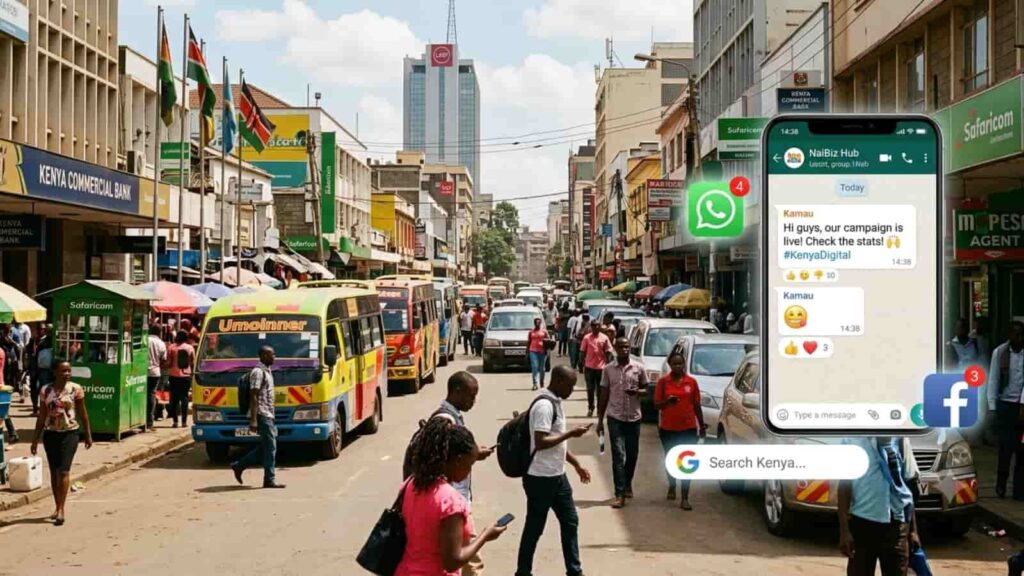
Most articles about digital marketing are written for an American or European audience not for digital marketing in kenya. The advice talks about email marketing funnels, LinkedIn thought leadership, and Google Ads as if every market behaves the same way. Kenya does not behave that way, and pretending otherwise wastes budget.
Here is what actually shapes digital marketing in Kenya. The majority of internet access happens on mobile, often on Safaricom’s network. WhatsApp is not a side channel, it is frequently the primary place a customer actually converts. M-Pesa is the trust signal that makes or breaks an online purchase decision. Generic global advice rarely accounts for any of this, which is exactly why so many Kenyan businesses try digital marketing, follow advice that does not fit their market, and conclude it simply does not work for them.
This guide is part of Marginseye Digital’s Website Design for Business Growth series, and it works as your starting point. Each section below introduces one core digital marketing channel as it actually functions in Kenya, then links to the full Marginseye Digital guide if you want to go deeper.
What does digital marketing in Kenya actually involve? Digital marketing in Kenya combines search visibility, social media presence, and WhatsApp-based conversion, built around a mobile-first audience and M-Pesa as the dominant trust and payment signal, rather than channels and tactics imported unchanged from other markets.
Get a free Marginseye Digital audit to see where your business actually stands
This guide is reviewed and updated monthly. Last verified: June 2026. Next update scheduled: September 2026.
Key Takeaways
- Digital marketing in Kenya works differently from global default advice, mobile-first usage, WhatsApp as a conversion channel, and M-Pesa as a trust signal all shape what actually performs.
- Most Kenyan businesses do not need every digital marketing channel at once. Starting with one or two that match where your actual customers already are produces faster results than spreading thin.
- WhatsApp Business and search visibility together cover the majority of practical opportunity for most Kenyan SMEs, before social media, paid ads, or anything more advanced becomes worth the investment.
- According to Marginseye Digital’s audit of over 80 East African business websites, the majority were applying global digital marketing advice without adapting it to local platform behaviour or payment habits.
Which Digital Marketing Channel Should Your Business Start With When doing digital marketing in kenya?
Find your business type below for a quick starting point. The full breakdown of each channel follows after the table.
|
Business Type |
Best Starting Channel |
Why |
Marginseye Digital Pick |
|
Local service business |
WhatsApp Business plus local search visibility |
Most enquiries come through direct conversation, not a contact form |
Get a free WhatsApp and SEO review |
|
Online retailer |
Search visibility plus Instagram or Facebook |
Customers research before buying, then convert through chat |
See the social media strategy guide |
|
B2B or professional services |
Search visibility plus content authority |
Decision-makers search specific problems before reaching out |
See the SEO strategy services guide |
See the full breakdown below
What Problems Do Kenyan Businesses Face With Digital Marketing In Kenya?
The most common issue Marginseye Digital sees is importing strategy wholesale from content built for a different market. A business owner reads a global guide recommending email funnels and LinkedIn content, invests time there, and gets minimal traction, because their actual customers are checking WhatsApp and Instagram on a mobile phone, not opening marketing emails on a desktop.
Another problem is trying to do everything at once. Many businesses launch Facebook, Instagram, TikTok, email, and paid ads simultaneously with no clear priority, spreading limited time and budget so thin that nothing gets done well enough to actually produce results.
Additionally, many businesses treat their website and their social channels as disconnected efforts rather than parts of one system, meaning traffic from one channel has no clear path into the other. Finally, some businesses underestimate how much trust signals like M-Pesa payment options and local case studies matter to Kenyan buyers specifically, leaving these out of their marketing entirely.
How to Build Digital Marketing That Actually Fits the Kenyan Market
Fortunately, every one of these problems has a clear, practical fix. To address the imported-strategy problem, build your digital marketing around how your specific customers actually behave, mobile-first browsing, WhatsApp conversations, and trust built through local proof, rather than a generic global checklist.
To address the spread-too-thin problem, choose one or two channels where your actual audience already spends time, and get those working well before adding anything else. Moreover, to fix the disconnected-channels problem, make sure every social post, every search result, and every advert eventually points toward the same conversion path, usually a WhatsApp message or a clear website action.
Finally, for the trust-signal gap, build M-Pesa visibility, real local case studies, and recognisable Kenyan business proof directly into your marketing, since this matters more to a Kenyan buyer’s decision than most generic marketing advice accounts for.
Download Marginseye Digital’s free Digital Marketing Starter Checklist
Marginseye Digital Expert Insight on Digital Marketing in Kenya
At Marginseye Digital, we have worked across nearly every sector doing business in Kenya, and the businesses that succeed with digital marketing are rarely the ones doing the most. They are the ones who picked the channels that matched where their actual customers already were, WhatsApp, local search, sometimes Instagram, and built a genuinely connected system between them, rather than running five disconnected efforts at once. See Marginseye Digital’s full digital marketing approach for Kenyan businesses
What Are the Benefits of Digital Marketing Built Specifically for the Kenyan Market?
When digital marketing is genuinely built around how Kenyan customers behave, the return on every shilling spent improves significantly. According to Datareportal’s Kenya digital reports, internet usage in Kenya is overwhelmingly mobile, and marketing built mobile-first from the outset consistently outperforms desktop-oriented strategy adapted after the fact.
Consequently, a business that prioritises WhatsApp as a conversion channel captures enquiries that a website-only strategy would lose entirely, since many Kenyan customers prefer a direct conversation over filling in a form. Additionally, building search visibility specifically around how Kenyans actually phrase their searches, often including a city or neighbourhood name, captures local intent that generic, broad keyword targeting misses.
Therefore, the benefit of Kenya-specific digital marketing is not philosophical. It directly produces more enquiries and more conversions from the same marketing budget.
Case Studies: Kenyan Businesses That Built Digital Marketing the Right Way
Case Study
1: A Westlands Salon Builds Its Entire Funnel Around WhatsApp
A beauty salon in Westlands had been running Instagram content for months with reasonable engagement but few actual bookings. They chose to restructure their digital marketing around a single conversion path, every post and every search result leading directly to a WhatsApp booking link, because their previous approach scattered attention across multiple disconnected channels with no clear next step. Consequently, monthly bookings generated from digital channels rose noticeably within two months, without any increase in advertising spend. Explore Marginseye Digital’s WhatsApp-first marketing approach
Case Study
2: A Mombasa Retailer Combines Local Search With M-Pesa Trust Signals
An online retailer based in Mombasa had decent product pages but a checkout process that did not clearly highlight M-Pesa as a payment option, leading to a high rate of abandoned purchases. They opted to rebuild their digital marketing around local search visibility paired with visible M-Pesa and delivery trust signals throughout their content, after recognising that payment trust was the actual barrier, not traffic volume. Therefore, conversion rate on existing traffic improved measurably within a month of the changes, without any additional marketing spend. Read the full local trust signal story
Inspired by these results? Get a free digital marketing review from Marginseye Digital
How to Approach Digital Marketing in Kenya: Marginseye Digital’s 6-Step Framework
Step 1: Identify Where Your Actual Customers Already Spend Time
Start by checking your own existing data, website analytics, social platform insights, or even just asking recent customers how they found you, rather than assuming based on global trend reports. First, this single step prevents months of effort aimed at the wrong channel.
Step 2: Choose One or Two Channels to Focus On First
Then, commit to one or two channels rather than spreading attention across five. For most Kenyan small businesses, this means search visibility and WhatsApp Business as the foundation, with social media added once those are working well.
Step 3: Build a Single, Clear Conversion Path
After that, ensure every channel points toward the same specific next step, usually a WhatsApp message or a clear website action, rather than leaving visitors to figure out what to do next on their own.
Step 4: Add Visible Local Trust Signals Throughout
Next, build M-Pesa payment visibility, real Kenyan customer proof, and recognisable local case studies directly into your marketing content, since this addresses the specific hesitation a Kenyan buyer is likely to have.
Step 5: Track Results by Channel, Not Just Overall
Consequently, measure enquiries and conversions separately for each channel, so you know specifically which one is actually producing results rather than judging your overall effort as a single blended number.
Step 6: Expand Only Once the First Channels Are Working
Therefore, add a new channel only once your first one or two are reliably producing results, rather than adding complexity before the foundation is proven.
Want this built out for your specific business? Book a free strategy consultation
What Are the Core Digital Marketing Channels for a Kenyan Business, and Where Do You Go Deeper?
This table introduces each core channel as it actually works in Kenya, then links to the full Marginseye Digital guide covering execution in detail.
|
Channel |
How It Actually Works in Kenya |
Marginseye Digital Deep-Dive Guide |
|
Search visibility (SEO) |
Local, specific search terms convert better than broad national keywords |
See how to rank on Google |
|
WhatsApp Business |
Often the primary conversion channel, not a secondary support tool |
See the WhatsApp AI chatbot setup guide |
|
Social media |
Facebook and WhatsApp dominate time spent, Instagram strong for visual brands |
See the social media management strategy guide |
|
Website strategy |
Mobile-first design and a clear conversion path matter more than visual polish alone |
See the website strategy guide |
|
AI tools and automation |
Increasingly used to handle repetitive enquiries and content production affordably |
See the AI tools for small business guide |
Not sure which channel deserves your focus first? Get a free Marginseye Digital audit
After reviewing digital marketing approaches across many Kenyan businesses, Marginseye Digital recommends starting with WhatsApp Business and local search visibility together, because this combination covers the majority of where Kenyan customers actually research and convert, before any other channel becomes worth the investment.
Get your starting strategy mapped with Marginseye Digital
What Are the Pros and Cons of a Kenya-Specific Digital Marketing Approach?
This table gives a balanced view before you commit. Building digital marketing specifically for the Kenyan market has real advantages, with honest trade-offs worth knowing.
|
Pros |
Cons |
|
Marketing matches how your actual customers research and buy, not a generic global assumption |
Requires more upfront research than copying a generic checklist |
|
WhatsApp-first conversion paths often outperform website-only funnels for local businesses |
Some platforms and tools are built primarily for global markets and need local adaptation |
|
Local trust signals like M-Pesa visibility directly address real customer hesitation |
Fewer ready-made templates and case studies exist for the Kenyan market specifically |
|
Focusing on one or two genuinely effective channels produces faster results than spreading thin |
Requires ongoing attention as platform usage and customer behaviour continue to shift |
Want help building this for your specific business? Talk to Marginseye Digital
What Mistakes Should You Avoid With Digital Marketing in Kenya?
- Copying global digital marketing advice without adapting it locally. Strategies built for a desktop-first, email-driven market often underperform significantly in Kenya’s mobile-first, WhatsApp-centric environment.* See Marginseye Digital’s Website Design for Business Growth guide for the broader strategic picture.
- Spreading effort across too many channels at once. Running five channels poorly produces worse results than running one or two genuinely well.
- Treating WhatsApp as an afterthought rather than a primary channel. For many Kenyan businesses, WhatsApp is where the actual conversion happens, not a secondary support tool.
- Ignoring M-Pesa and local trust signals in marketing content. Kenyan buyers often hesitate specifically around payment trust, and addressing this directly removes a real barrier.
- Leaving channels disconnected from each other. A visitor from social media, search, or an advert should land on the same clear conversion path, not three different disjointed experiences.
- Measuring success by vanity metrics instead of enquiries. Follower counts and likes matter far less than actual WhatsApp messages, calls, and sales generated.
Avoid these pitfalls. Read Marginseye Digital’s full digital marketing guide
Marginseye Digital’s Digital Marketing Channel Fit Check
Answer these three questions to identify which channel deserves your attention first.
- Where do most of your current enquiries actually come from, WhatsApp, a phone call, social media, or your website?
- Do you know roughly what percentage of your customers are browsing on mobile versus desktop?
- Does every one of your current marketing channels point toward the same specific next step for a visitor?
Get your full channel fit assessment from Marginseye Digital, free and no obligation
Marginseye Digital Statistical Report: Digital Marketing Gaps in East Africa 2026
Proprietary insights from Marginseye Digital’s audit of 80-plus East African business websites, reviewed February 2026.
- The majority of audited businesses were applying global digital marketing advice without local adaptation
- Businesses using WhatsApp Business as a core conversion channel, rather than an afterthought, showed stronger enquiry volume
- Few audited businesses had visible M-Pesa or local trust signals integrated into their marketing content
- Businesses focused on one or two well-executed channels consistently outperformed those spread across many channels at once
Source: Marginseye Digital internal survey, February 2026. This is a unique data asset built from direct client and prospect audits, not republished industry data.
Community Q&A: Real Questions from Marginseye Digital Readers
Question 1 (from Stella in Kilimani): “I keep trying digital marketing tips I find online and nothing seems to work for my shop. What am I missing?”
Answer from Marginseye Digital: Most online advice is not built for the Kenyan market. Start by checking where your actual customers already spend time.
Question 2 (from Victor in Industrial Area): “Should I be on every social media platform to do digital marketing properly?”
Answer: No, focusing well on one or two channels outperforms spreading thin across many.
Question 3 (from Rita in Lavington): “Is WhatsApp really considered digital marketing, or just customer service?”
Answer: It is genuinely both, and for many Kenyan businesses it is the primary conversion channel, not a secondary support tool. See the WhatsApp chatbot setup guide
Have a different question? Ask Marginseye Digital’s team directly
Conclusion: Digital Marketing in Kenya Works When It Fits the Kenyan Market
Digital marketing in Kenya does not fail because the discipline does not work. It fails when businesses apply advice built for a completely different market, desktop-first, email-driven, card-payment-default, onto a mobile-first, WhatsApp-centred, M-Pesa-trusting audience that behaves very differently.
Start by understanding where your actual customers already are. Focus on one or two channels that genuinely fit. Build a clear, connected path from every channel to a real conversion. Everything else in this guide, and the deeper guides it links to, builds from that single foundation.
Go deeper: How to Rank on Google | Social Media Management Strategy
More guides: Website Strategy | AI Tools for Small Business
FAQs About Digital Marketing in Kenya
- What is digital marketing in Kenya, in practical terms?
Digital marketing in Kenya combines search visibility, social media presence, and WhatsApp-based conversion, adapted specifically for a mobile-first audience and M-Pesa as a dominant trust signal. It differs meaningfully from generic global digital marketing advice, which often assumes desktop usage and card payment as the default.
- Which digital marketing channel should a small business in Kenya start with?
WhatsApp Business combined with local search visibility is usually the strongest starting point for most Kenyan small businesses. These two channels cover the majority of where Kenyan customers actually research and convert, before social media or paid advertising become worth the investment.
- How much does digital marketing typically cost for a small business in Kenya?
Costs vary widely depending on scope, though many Kenyan SMEs start with a modest monthly budget covering basic SEO, WhatsApp setup, and simple social content. Investing in one or two channels properly typically produces better returns than spreading a small budget across many channels at once.
- Is WhatsApp actually considered part of digital marketing, or just customer support?
WhatsApp functions as both. For many Kenyan businesses, it is the primary conversion channel where actual sales and bookings happen, not just a support tool. Treating it as a core marketing channel, with a clear strategy behind it, produces meaningfully better results than treating it as an afterthought.
- Why does generic digital marketing advice often fail for Kenyan businesses?
Most digital marketing content online is written for desktop-first, email-driven, card-payment-default markets that behave differently from Kenya’s mobile-first, WhatsApp-centred reality. Applying that advice unchanged often produces weak results, leading some business owners to wrongly conclude that digital marketing simply does not work for them.
- Should a Kenyan business focus on Facebook, Instagram, or both?
This depends on your specific audience, though Facebook tends to have broader reach across age groups while Instagram skews younger and more visual. Checking your own analytics, rather than assuming based on global trends, gives the clearest answer for your specific business.
- How important is M-Pesa to digital marketing success in Kenya?
Very important, since payment trust is a real and common barrier for Kenyan online buyers, and visible M-Pesa integration directly addresses that hesitation. Marketing content that highlights M-Pesa, delivery options, and real local proof tends to convert better than content that ignores these local trust factors entirely.
- Does SEO still matter for digital marketing in Kenya given how much happens on WhatsApp?
Yes, search visibility remains essential, since many Kenyan customers research a business or product through Google before reaching out, often on WhatsApp. The two channels work together rather than competing, search builds discovery, WhatsApp completes the conversion
- Can a small business manage digital marketing in Kenya without an agency?
Yes, particularly in the early stages, focusing on one or two channels with a clear, realistic plan. An agency or specialist becomes more valuable once a business is ready to scale beyond what owner time alone can manage well.
- How do I know if my digital marketing is actually working in the Kenyan context?
Track enquiries and conversions by specific channel, WhatsApp messages, calls, website actions, rather than relying on follower counts or likes. This channel-specific tracking reveals exactly which part of your digital marketing is producing real business results.
- What role does mobile-first design play in digital marketing success in Kenya?
A significant one, since the large majority of Kenyan internet usage happens on mobile devices, often over 4G connections. A website or content experience that performs poorly on mobile undermines every other digital marketing effort pointing toward it.
- Is it too late for a Kenyan business to start digital marketing if competitors are already active online?
No, many local competitors are still applying generic, poorly adapted strategies, which leaves real room for a properly localised approach to stand out. Starting now with a Kenya-specific strategy can outperform a competitor who has been active longer but never adapted their approach to the local market.
Explore Every Digital Marketing Guide From Marginseye Digital
- How to Rank on Google in 2026
- Social Media Management Strategy: Practical Steps That Work
- Website Strategy: How to Build a Business Website That Actually Does Something
- How to Set Up a WhatsApp AI Chatbot for Your Business
- AI Tools for Small Business
- SEO Strategy Services: Why Most Businesses Outgrow DIY SEO
- SEO Services in Kenya: Why You Are Invisible on Google
- CTA Guide for Small Businesses: Copy Formulas That Convert
- Website Design for Business Growth (Start Here)
Affiliate Disclosure
This article may include affiliate partnerships with technology vendors and software providers. If readers access recommended products or services through the provided pathways, a small commission may be earned at no additional cost. These partnerships help support independent research and high-quality digital marketing guides.
Disclaimer
This article is for informational purposes only. Platform features, costs, and market behaviour referenced throughout can change over time, and readers should verify current specifics directly where precision matters. Marginseye Digital does not endorse or guarantee the accuracy of external content linked here.