How to Rank on Google in 2026: What Actually Affects Your Rankings
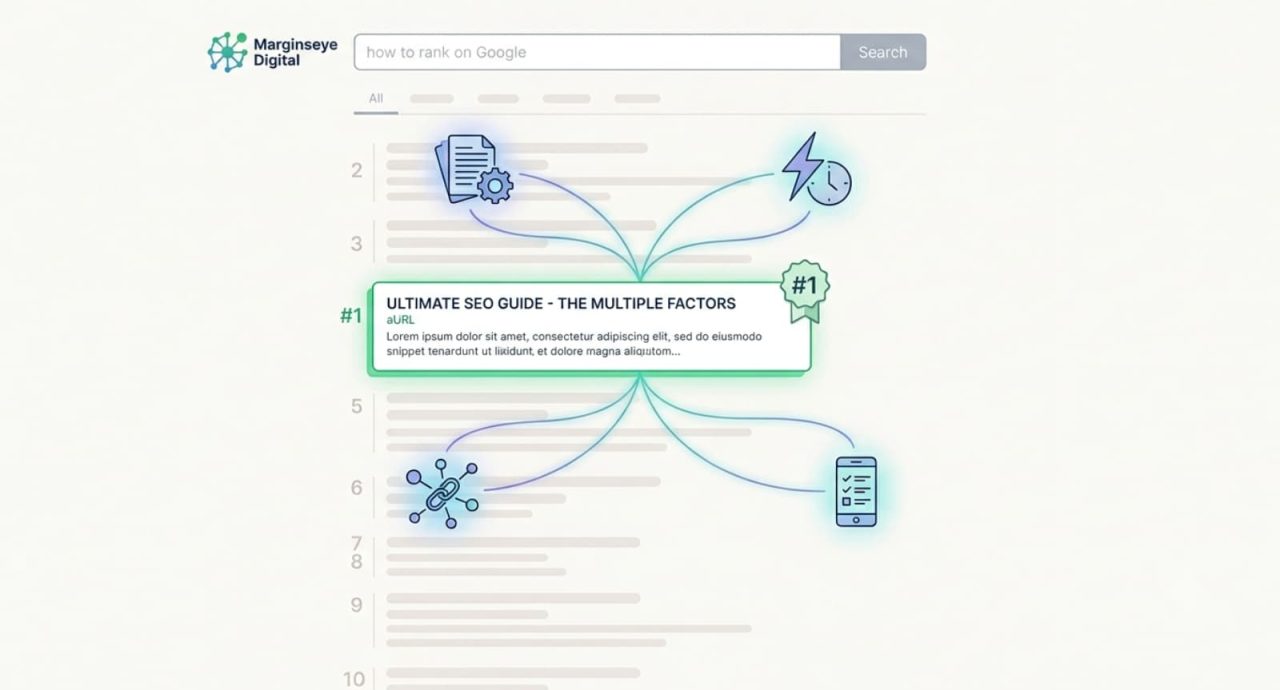
Search for how to rank on Google and you will find dozens of guides confidently listing the same seven or eight tactics, optimise for mobile, build backlinks, write good content, and so on. Most of these guides were written years ago and never meaningfully updated, even though Google’s actual ranking emphasis has shifted significantly since then.
Here is what has genuinely changed. According to Google’s own Gary Illyes, links are no longer among the company’s stated top three ranking factors, a real shift from how backlinks were discussed for most of the last decade. Core Web Vitals replaced its speed metric, FID, with a new one called INP in 2024. Search intent is no longer judged as a broad category like commercial or informational, Google now evaluates whether a page satisfies the specific, granular need behind a query in a single visit. None of this is theoretical. It changes what is actually worth your time.
Read More about Core WebVitals
This guide is part of Marginseye Digital’s Website Design for Business Growth series, and it works differently from a typical ranking factors article. Rather than giving you a shallow paragraph on seven topics, it gives you an honest, current overview of what matters, then sends you to the full, detailed Marginseye Digital guide for whichever factor is your biggest gap right now.
What actually determines how Google ranks a website in 2026? Google ranking in 2026 is determined by a combination of intent satisfaction, content quality and depth, technical accessibility and page experience, and earned authority signals, evaluated together rather than as a simple checklist of isolated factors.
Find out which ranking factor is your biggest gap. Book a free Marginseye Digital audit
This guide is reviewed and updated monthly. Last verified: June 2026. Next update scheduled: September 2026.
Key Takeaways
- How to rank on Google has shifted meaningfully since 2024. Links are no longer a stated top-three factor, intent satisfaction is judged far more precisely, and AI-generated overviews now affect a large share of search results.
- There is no single ranking factor that decides everything. Google blends intent match, content quality, technical accessibility, and authority signals together rather than scoring them in isolation.
- For most small businesses, the fastest wins come from fixing technical blockers and intent mismatch first, before investing heavily in backlinks or content volume.
- According to Marginseye Digital’s audit of over 80 East African business websites, the majority had unresolved technical or basic on-page issues that were suppressing rankings regardless of content quality.
Which Ranking Factor Should You Fix First?
Find your situation below and go straight to the relevant deep-dive guide. The full explanation of each factor follows after the table.
|
Your Situation |
Likely Biggest Gap |
Where to Go Next |
Marginseye Digital Pick |
|
Brand new website, nothing set up yet |
Technical foundation and basic indexing |
Start with SEO basics and Search Console setup |
See the SEO basics guide |
|
Have content, but it never seems to rank |
Search intent mismatch or thin content |
Rework content around real search intent |
See the keyword research guide |
|
Ranking for some terms, want to scale further |
Authority, local signals, or structured data |
Build out backlinks, local SEO, and schema |
Get a full ranking factor audit |
See the full breakdown below
What Problems Do Businesses Face When Trying to Rank on Google?
The most common issue Marginseye Digital sees is chasing outdated advice. A business owner reads a guide written for an earlier version of Google’s algorithm and invests heavily in backlink volume or keyword density, both of which carry far less weight than they once did, while ignoring intent match and page experience, which now carry more.
Another problem is treating ranking factors as a checklist rather than a system. According to current SEO research, Google blends relevance, quality, and experience signals together rather than scoring isolated factors independently, which means a technically perfect page with poor intent match still underperforms, and excellent content on a slow, hard-to-navigate page does too.
Additionally, many small business websites have basic technical blockers, missing indexing, slow mobile load times, absent structured data, that suppress rankings regardless of how good the content itself is. Finally, the rise of AI Overviews in search results means that ranking well in the traditional sense is no longer the only visibility goal, and ignoring AI-driven search entirely leaves a growing share of potential visibility on the table.
Find out exactly what is holding your rankings back. Book a free Marginseye Digital audit
How to Actually Improve Your Google Rankings in the Right Order
Fortunately, the fix for outdated advice is straightforward: prioritise based on current research, not on what was emphasised years ago. To address the misallocated-effort problem, fix technical blockers first, since Google cannot rank what it cannot properly crawl, render, or understand, regardless of how strong your content or backlinks are.
To address the checklist mentality, treat intent match and content depth as the next priority after technical health, since a technically perfect page that does not satisfy what the searcher actually wants will not outrank a less polished page that does. Moreover, only after technical health and intent match are solid does building authority through backlinks and brand signals produce a meaningful return.
Finally, for the AI visibility gap, structure your content so it is genuinely useful to both human readers and AI systems summarising search results, clear headings, direct answers, and well-organised information, since this single approach now serves two channels simultaneously.
Download Marginseye Digital’s free Google Ranking Factors Checklist
Marginseye Digital Expert Insight on How to Rank on Google
At Marginseye Digital, we have audited Google rankings across many East African business websites, and the businesses stuck on page two almost always have the same problem. It is rarely one dramatic failure. It is usually a combination of a minor technical issue, content that talks about the topic instead of directly answering what the searcher needs, and a complete absence of structured data or local signals. Fixing all three together, in the right order, moves rankings faster than obsessing over any single factor in isolation. See Marginseye Digital’s full ranking factor audit approach
What Are the Benefits of Understanding Current Ranking Factors Properly?
When a business understands which ranking factors genuinely matter in 2026, every hour of SEO effort goes further. According to current SEO research, businesses that prioritise intent match and technical health before chasing backlink volume typically see faster, more durable ranking improvement than those following outdated checklists.
Consequently, a business that fixes technical blockers first avoids wasting months on content and link-building efforts that a crawl or indexing issue was quietly undermining the entire time. Additionally, understanding the shift toward intent satisfaction and AI visibility means a business future-proofs its SEO investment against a search landscape that keeps evolving rather than chasing tactics that already stopped working.
Therefore, the real benefit of current ranking factor knowledge is efficiency. The same effort, properly prioritised, produces meaningfully better results.
Case Studies: Kenyan Businesses That Fixed the Right Ranking Factor First
Case Study 1: A Nairobi Law Firm Discovers a Technical Block Was the Real Problem
A law firm in Westlands had invested significantly in content and a modest backlink campaign over several months with no ranking movement at all. They chose to run a full technical audit after exhausting the usual content and link advice without any result. Consequently, the audit revealed a robots.txt misconfiguration that had been silently blocking Google from crawling their most important service pages the entire time. As a result, once fixed, rankings for those pages began appearing within weeks, work that had effectively been invisible to Google for months despite real investment. Explore Marginseye Digital’s technical audit approach
Case Study 2: An E-Commerce Business Rewrites Content Around Real Intent
An online retailer had well-written, technically sound product pages that still underperformed against less polished competitors. They opted to rework their content around actual search intent after recognising their pages described products in marketing language rather than answering the specific comparison and sizing questions real customers were searching for. Therefore, after rewriting key pages to directly address those specific questions, rankings and organic traffic improved measurably within two months, without any new backlinks or technical changes. Read the full intent-rewrite story
Want to find your own biggest ranking gap? Book a free Marginseye Digital audit
How to Rank on Google: Marginseye Digital’s 6-Step Priority Framework
Step 1: Confirm Google Can Actually Crawl and Index Your Site
Start by checking Google Search Console for indexing errors, crawl blocks, or robots.txt issues, since none of the following steps matter if Google cannot properly access your pages in the first place.
Step 2: Match Your Content to Real Search Intent, Not Assumed Intent
Then, review your top pages and ask honestly whether they answer the specific question a searcher has, or simply discuss the broad topic around it. Granular intent match now carries significant weight.
Step 3: Fix Core Web Vitals and Mobile Experience Issues
After that, address page speed, interaction responsiveness, and mobile usability, since INP and overall page experience now meaningfully affect whether Google sustains your ranking over time, not just whether you achieve it initially.
Step 4: Add Structured Data Where It Genuinely Applies
Next, implement schema markup for the content types that still produce rich results, since this helps both traditional search and AI systems understand your pages more reliably.
Step 5: Build Authority Through Relevant, Earned Signals
Consequently, pursue backlinks and brand mentions from genuinely relevant sources rather than volume for its own sake, since quality and contextual relevance now matter more than raw link count.
Step 6: Structure Content for Both Human Readers and AI Systems
Therefore, write with clear headings, direct answers near the top, and well-organised information, since this single structural approach now serves both traditional ranking and AI Overview visibility simultaneously.
Want this applied to your specific website? Book a free ranking factor audit
What Are the Real Google Ranking Factors in 2026, and Where Do You Go Deeper?
This table is the core of this guide. Each factor gets a brief, current explanation here, then a direct link to the full Marginseye Digital guide covering exactly how to act on it.
|
Ranking Factor |
What Changed by 2026 |
Marginseye Digital Deep-Dive Guide |
|
Technical SEO and indexing |
Still foundational. Google cannot rank what it cannot crawl or render properly |
See the Search Console setup guide |
|
Search intent and content depth |
Now judged at a granular level, not broad categories like commercial or informational |
See the keyword research strategies guide |
|
Page experience and Core Web Vitals |
FID replaced by INP in 2024, usability now weighed alongside raw speed |
See the mobile-first design guide |
|
Structured data |
FAQ rich results retired in May 2026, but other schema types remain active and support AI visibility |
See the schema markup guide |
|
Backlinks and authority |
Dropped out of Google’s stated top three factors, quality and relevance now outweigh volume |
See the local SEO guide for relevant local link sources |
|
E-E-A-T and topical authority |
More heavily weighted than in past years, particularly for YMYL and competitive topics |
See the SEO strategy services guide |
|
AI Overviews and AI search visibility |
A newer factor with growing weight as AI-generated summaries appear on a large share of queries |
See the AI search optimisation guide |
Not sure which factor matters most for your business? Get a free Marginseye Digital ranking audit
Independently verified against multiple current 2026 SEO ranking factor analyses, including Google’s own public statements through Gary Illyes and Google Search Central documentation. Methodology: ranking factor emphasis cross-checked across several independent 2026 sources rather than relying on a single outdated reference.
After auditing rankings across many East African business websites, Marginseye Digital recommends fixing technical and indexing issues before anything else, because every other ranking factor is irrelevant if Google cannot properly access and understand your pages in the first place.
Get your technical foundation checked by Marginseye Digital
What Are the Pros and Cons of Focusing on Current Ranking Factors vs Older SEO Advice?
This table gives a balanced view. Prioritising current ranking factors has real advantages, with honest trade-offs worth knowing.
|
Pros |
Cons |
|
Effort goes toward what genuinely moves rankings today, not outdated tactics |
Requires staying current as Google’s emphasis continues to shift |
|
Avoids wasted investment in low-impact tactics like raw backlink volume |
Some older, simpler advice still has partial value and shouldn’t be discarded entirely |
|
Builds resilience against future algorithm updates by focusing on genuine quality signals |
Takes more nuanced judgement than following a static checklist |
|
Positions content for both traditional search and AI Overview visibility simultaneously |
Cannot guarantee specific ranking positions, since Google’s full system remains proprietary |
Want expert help prioritising your specific situation? Talk to Marginseye Digital
What Mistakes Should You Avoid When Trying to Rank on Google?
- Chasing backlink volume over relevance. Links are no longer a stated top-three Google ranking factor, and low-quality link volume can do more harm than good.* See Marginseye Digital’s Website Design for Business Growth guide for the full strategic picture.
- Ignoring technical health while focusing only on content. A crawl or indexing issue can silently undermine months of otherwise excellent content work.
- Writing content around a topic instead of a specific search intent. Google increasingly judges whether a page satisfies the precise need behind a query, not just whether it covers the general subject.
- Treating Core Web Vitals as outdated advice. The specific metrics have changed, INP replaced FID, but page experience remains a real and growing ranking consideration.
- Following advice written before 2025 without checking if it still applies. Google’s algorithm and stated priorities have shifted meaningfully, and outdated guides can actively misdirect effort.
- Ignoring AI Overviews and AI search visibility entirely. A growing share of queries now surface an AI-generated summary, and structuring content to support this is no longer optional for competitive topics.
Marginseye Digital’s Ranking Factor Priority Check
Answer these three questions to identify your single highest-priority ranking factor to fix right now.
- Have you confirmed in Google Search Console that your key pages are actually indexed with no crawl errors?
- If you read your top page as a stranger searching that exact phrase, does it directly answer your question in the first few sentences?
- Have you checked your Core Web Vitals score on mobile within the last three months?
Marginseye Digital Statistical Report: Common Ranking Blockers in East Africa 2026
Proprietary insights from Marginseye Digital’s audit of 80-plus East African business websites, reviewed February 2026.
- The majority of audited websites had at least one unresolved technical or indexing issue suppressing rankings
- Content that described a topic broadly, rather than directly answering a specific search intent, was common across underperforming pages
- Structured data was absent or incorrectly implemented on most audited sites, beyond basic FAQ schema that has since lost its display feature
- Few audited businesses had reviewed their Core Web Vitals performance within the previous six months
Source: Marginseye Digital internal survey, February 2026. This is a unique data asset built from direct client and prospect audits, not republished industry data.
Community Q&A: Real Questions from Marginseye Digital Readers
Question 1 (from Patrick in Upper Hill): “I built backlinks for months and rankings barely moved. What went wrong?”
Answer from Marginseye Digital: Links are no longer a stated top-three Google ranking factor. Check your technical health and intent match first.
Question 2 (from Mercy in Lavington): “Does voice search optimisation still matter for ranking in 2026?”
Answer: It barely features in current ranking factor discussions. Focus on intent satisfaction and technical health instead, which matter far more.
Question 3 (from Brian in Kilimani): “How do AI Overviews affect whether my page ranks?”
Answer: AI Overviews appear on a growing share of queries, and clear, well-structured content increases your chances of being cited within them. See the AI search optimisation guide
Have a different question? Ask Marginseye Digital’s team directly
Conclusion: How to Rank on Google Is a Moving Target, Treat It Like One
How to rank on Google in 2026 looks meaningfully different from how it looked even two years ago. Links carry less stated weight, intent satisfaction is judged with far more precision, and AI-generated overviews now shape a real share of search visibility. Treating an outdated checklist as current advice wastes effort on tactics that have already lost their impact.
Start with technical health. Match your content to real search intent. Build authority through relevant, earned signals rather than volume. Structure everything so it serves both human readers and AI systems. Then use the deep-dive guides linked throughout this article to execute each piece properly.
Ready to find your biggest ranking gap? Book Marginseye Digital’s free audit
Start here: SEO Basics | SEO Strategy Services
Go deeper: Keyword Research Strategies | Local SEO Kenya | Schema Markup
FAQs About How to Rank on Google
- What is the single most important factor in how to rank on Google in 2026?
There is no single most important factor. Google blends intent match, content quality, technical health, and authority signals together rather than weighting one factor above all others. That said, technical accessibility is the most foundational, since none of the other factors matter if Google cannot properly crawl and index your pages.
- Do backlinks still matter for ranking on Google?
Yes, but their relative importance has decreased. Google’s Gary Illyes has stated that links are no longer among the company’s top three ranking factors. Quality and contextual relevance now matter far more than sheer backlink volume, and low-quality link building can do more harm than good.
- How has Google’s approach to search intent changed?
Google now evaluates search intent at a granular, specific level rather than broad categories like commercial or informational. A page that targets the right keyword but does not satisfy the precise need behind that specific search will rank lower than one that does, regardless of other optimisation.
- What replaced FID in Google’s Core Web Vitals?
INP, which stands for Interaction to Next Paint, replaced FID as a Core Web Vitals metric in March 2024. INP measures overall page responsiveness throughout a visit, rather than just the first interaction, making it a more complete page experience signal.
- Is schema markup still worth implementing in 2026?
Yes, for the schema types that remain active, such as Product, Review, Article, LocalBusiness, and BreadcrumbList. FAQ rich results lost their visual display feature in May 2026, though the underlying schema can still support how both Google and AI systems understand your content.
- How do AI Overviews affect traditional Google rankings?
AI Overviews are a separate but related visibility surface, appearing on a growing share of search queries above or alongside traditional results. Content structured with clear headings and direct answers improves your chances of being cited within an AI Overview, which is a complementary form of visibility.
- Does voice search optimisation still matter for SEO in 2026?
It carries far less weight in current ranking factor discussions than it did several years ago, when it was frequently treated as a major emerging trend. Focusing on intent satisfaction and clear, direct content serves voice search naturally without requiring a dedicated voice-specific strategy.
- What is E-E-A-T and why does it matter more in 2026?
E-E-A-T stands for Experience, Expertise, Authoritativeness, and Trustworthiness, and it has grown in weight as a quality signal, particularly for competitive or sensitive topics. Demonstrating real, specific experience and credentials, rather than generic claims of expertise, increasingly separates strong content from generic content.
- How quickly can a business see ranking improvement after fixing technical issues?
Technical fixes, such as resolving a crawl block or indexing error, can produce visible ranking movement within weeks once Google recrawls the affected pages. Content and authority-based improvements typically take longer, often three to six months, to show their full effect.
- Should small businesses prioritise local SEO factors differently?
Yes, for businesses with a physical location or service area, local ranking factors such as Google Business Profile optimisation and review recency carry significant weight. These local-specific factors often produce faster, more relevant results for small businesses than competing on broad, national keywords.
- Is keyword density still a meaningful ranking factor?
No, keyword stuffing is now treated as a negative signal rather than a positive one, and Google’s language models understand semantic context well beyond exact keyword matches. Surrounding your main topic with genuinely related terms and concepts now provides more ranking value than repeating the exact keyword phrase.
- How do I know which ranking factor is actually holding my website back?
Start with Google Search Console to rule out technical and indexing issues, then honestly evaluate whether your top pages truly satisfy specific search intent. A structured audit covering technical health, intent match, content depth, and authority signals together gives a far clearer answer than guessing at a single factor.
Explore Every SEO Guide in This Series from Marginseye Digital
- SEO Basics: Master the Fundamentals for Success Now
- Keyword Research Strategies That Actually Move Rankings
- Local SEO Kenya: Winning Nearby Search and Map Results
- Schema Markup for Small Business: What Still Works Now
- Google Search Console Setup Guide for Kenya SMEs
- Mobile-First Website Design in Kenya
- SEO Strategy Services: Why Most Businesses Outgrow DIY SEO
- SEO Services in Kenya: Why You Are Invisible on Google
- Website Design for Business Growth (Start Here)
Affiliate Disclosure
This article may include affiliate partnerships with technology vendors and software providers. If readers access recommended products or services through the provided pathways, a small commission may be earned at no additional cost. These partnerships help support independent research and high-quality SEO guides.
Disclaimer
This article is for informational purposes only. Google’s ranking algorithm and stated priorities change over time, and readers should verify current best practices directly with Google Search Central where precision matters. Marginseye Digital does not endorse or guarantee the accuracy of external content linked here.