Keyword Research Strategies That Actually Move Rankings in Kenya and Africa
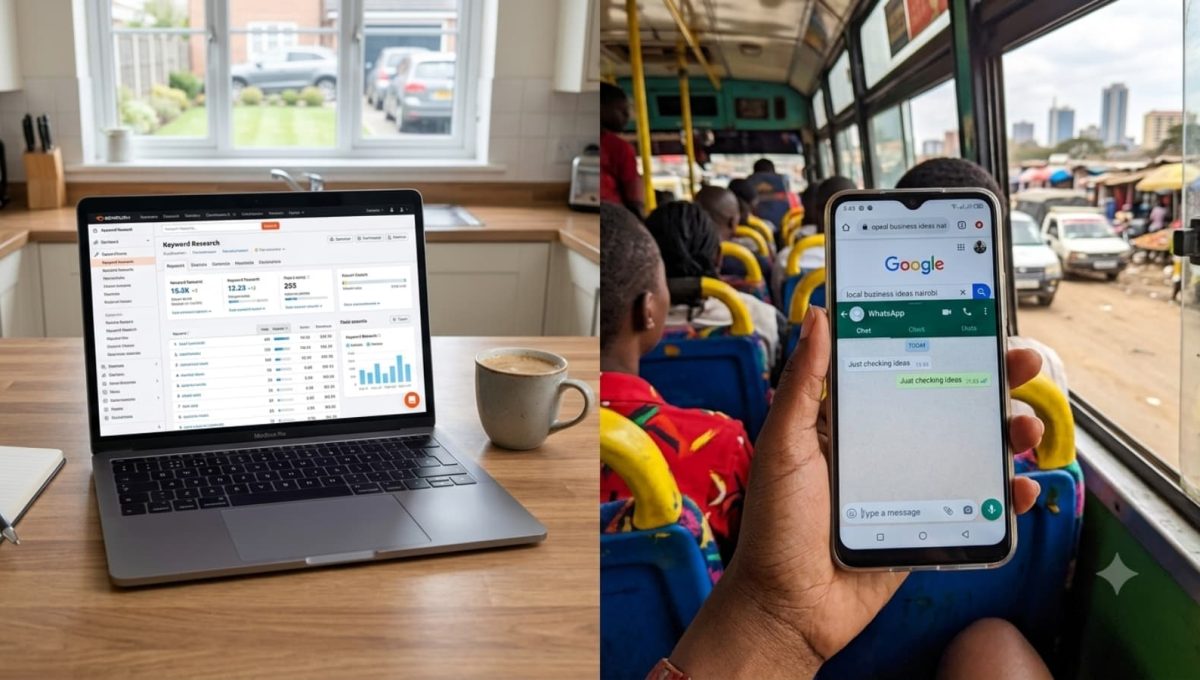
Every keyword research strategies guide you have read was written by someone sitting in a country where Google autocomplete gives you clean English suggestions, your customers browse on desktop with reliable broadband, and your biggest competitor is another professional with a content team. That is not our reality and pretending it is has cost people time, money, and rankings.
Your customer in Nairobi might search ‘bei ya cement Nairobi’ and ‘cement price Nairobi’ on different days, depending on their mood and who they last talked to. Your customer in Kampala might type ‘posho mill for sale Kampala’ in one tab and ‘maize milling machine Uganda’ in another, same person, same need, completely different language. Your customer in Mombasa might not be searching Google at all. They asked someone in a WhatsApp group and got three recommendations before they touched a search bar.
None of that is in the guides. And yet that is your market. This article is part of Marginseye Digital’s Website Design for Business Growth series, and it sits alongside two other keyword research pieces that go in different directions. The beginner guide is for someone who has never thought about keywords at all. The strategies deep-dive is platform-by-platform execution. This one is about how keyword research works differently when you are building for an African audience, and why that difference matters more than any tool you could buy.
What makes keyword research strategies different for Kenya and Africa? Your customers search in multiple languages sometimes mid-sentence, they trust WhatsApp more than Google for recommendations, and your real competitor is not the American blog dominating broad terms but the business around the corner who just figured out a specific local phrase you have not targeted yet.
Get keyword research built specifically for your market. Book a free Marginseye Digital session
This guide is reviewed and updated monthly. Last verified: June 2026. Next update scheduled: September 2026.
Key Takeaways
- Standard keyword research tools were built for English-first, desktop-first markets. They undercount searches that happen in Swahili, Sheng, Luganda, or mixed language, which means they give you an incomplete picture of how your actual customers search.
- WhatsApp is a search engine in this market. A significant number of product and service decisions in Kenya and East Africa start with a WhatsApp group recommendation, not a Google search, and your keyword strategy needs to account for what people then type when they go to verify what they heard.
- Your real competitors for local search are the businesses around you, not the international content sites dominating broad terms. A business three roads away who discovered ‘plumber Kilimani same day’ is your actual keyword competitor, not Plumbing World Magazine.
- According to Marginseye Digital’s audit of over 80 East African business websites, most were targeting generic English keywords that global competitors dominated, while ignoring the specific local phrases where they could actually win.
Which Keyword Research Strategy Fits Your African Business Context?
The right strategy depends on how your customers actually find you, not how a US marketing blog says they should. Find your reality below.
| How Your Customers Actually Find You | Which Strategy to Prioritise | Why It Matters Here Specifically |
| Mostly WhatsApp referrals, some Google | Research what people search after they hear your name via WhatsApp | People use Google to verify what WhatsApp told them, those verification searches are your easiest keywords to win |
| Mix of Swahili and English searches | Build separate keyword lists per language and test both | Google Kenya autocomplete shows different results for Swahili phrases than English translations of the same need |
| Mostly local, specific area customers | Neighbourhood and estate-level keywords before city-level ones | You can own ‘electrician South B Nairobi’ long before you can compete for ‘electrician Nairobi’ |
| B2B, suppliers, contractors | Industry-specific Swahili and English terms plus price-signal keywords | Decision-makers in this market search for specific specs and prices more than general category terms |
What Happens When You Apply Standard Keyword Research to an African Market?
The most common issue is the volume trap. You open a keyword tool, type in a phrase, and it shows you search volume from a dataset built primarily on US, UK, and European searches. A phrase with ‘low volume’ on that tool might have significant local traffic that isn’t being captured properly, because the tool is not counting searches made in Swahili, in Sheng, or in the regional language variants your actual customers use.
Another problem is the competition illusion. A tool tells you a keyword has high difficulty, meaning many authoritative sites are ranking for it. But those sites are global English-language content farms. You are not competing with them for a customer searching ‘bei ya tiles Mombasa.’ That customer is not going to click on an American tile installation blog. They want a local supplier. Local keyword competition looks completely different from what the global difficulty score implies.
Additionally, there is the missing-channel problem. Google Keyword Planner cannot show you what is trending in Kenyan WhatsApp groups this week, but your competitors who are paying attention to those conversations are finding keyword ideas you will never discover from any tool. The market signals exist, they just exist in different places than the guides tell you to look.
Get a keyword strategy built for your actual market. Book a free Marginseye Digital audit
How to Build Keyword Research Strategies That Actually Fit This Market
Fortunately, fixing this does not require expensive tools. It requires changing where you look for signals. To fix the volume trap, run every keyword search directly on Google Kenya, meaning google.co.ke, not a generic tool, and read what the autocomplete actually suggests to someone searching from Nairobi or Kampala or Dar. Those suggestions reflect actual local search behavior rather than global dataset extrapolations.
To fix the competition illusion, search your keyword from your actual location and look at who is really ranking. If the first page is all local Kenyan businesses, the real competition is much more winnable than a difficulty score suggests. Moreover, to fix the missing-channel problem, spend time in the relevant Facebook groups, WhatsApp groups you have legitimate access to, and local online communities, because the language people use there is the language they will type into Google when they want to verify something.
Finally, build two keyword lists for every important topic: one in English and one in Swahili or the relevant local language, and treat them as genuinely separate opportunities. The same person searching ‘bei ya laptop Nairobi’ and ‘laptop price Nairobi’ might be the same customer, but Google may rank different pages for those two searches.
Marginseye Digital Expert Insight: This Is What We Actually See in African Search Data
At Marginseye Digital, we have done keyword research across many sectors for businesses in Kenya, Uganda, and Tanzania, and the thing that surprises people most is how much is being left on the table by ignoring local language search. A business selling construction materials in Nairobi that only targets English keywords is invisible to the site manager who types ‘mjenzi wa nyumba Nairobi’ every single time because that is just how they think about the search. The keywords are not hard to find. You just have to stop looking in the tools designed for a different market and start listening to the one you are actually in. See Marginseye Digital’s local search approach
What Are the Benefits of Kenya and Africa-Specific Keyword Research Strategies?
When you build keyword research strategies around how your market actually searches rather than how global tools assume it does, the competitive landscape changes dramatically. Most of your direct local competitors are following the same generic advice and targeting the same overcrowded English keywords. The specific local phrases, the Swahili variations, the estate-level location keywords, are frequently wide open.
Consequently, a business that targets ‘electrician Ruaka’ or ‘mkopo wa biashara Nairobi haraka’ or ‘price of iron sheets Mombasa’ is competing against a much smaller field than a business targeting ‘electrician Kenya’ or ‘business loans’ or ‘roofing materials.’ Additionally, winning a specific local keyword often converts better because the person searching it already has a clear, geographically relevant intent.
Therefore, the benefit of Africa-specific keyword research strategies is not just easier rankings. It is rankings that turn into customers because you matched the specific language and context of someone who actually needed what you offer.
Case Studies: What Changed When These Businesses Stopped Using Generic Keyword Advice
Case Study 1: A Hardware Store in Eldoret Finds Its Real Keywords
A hardware supplies business in Eldoret had been targeting ‘hardware shop Kenya’ and ‘building materials Kenya’ for months with no meaningful movement on either phrase. After switching their keyword research to Google Kenya autocomplete and specifically searching for how their actual customers described materials in both English and Swahili, they discovered phrases like ‘bei ya cement Eldoret leo’ and ‘iron sheets prices Eldoret’ had almost no competition and genuine local search volume. Consequently, after building content around those specific phrases, organic traffic from people who were actually ready to buy started appearing within weeks. Explore Marginseye Digital’s local keyword approach
Case Study 2: A Mombasa Tour Operator Targets What Visitors Actually Search in Arabic and English
A tour operator in Mombasa targeting primarily domestic tourists from Nairobi had ignored the search behavior of their other significant audience: visitors from the Gulf, who search for Kenyan coast experiences in Arabic and in Gulf-specific English phrasing. After adding keyword research specifically for that audience, including phrases like ‘beach safari Kenya halal’ and ‘Mombasa holiday packages family,’ they opened a traffic stream that their competitors had entirely overlooked. Therefore, within three months those pages were generating enquiries from a market segment that had been sitting invisible and untargeted. Read the full multilingual keyword story
Keyword Research Strategies for Kenya and Africa: Marginseye Digital’s 7-Step Framework
Step 1: Search on Google Kenya, Not a Global Tool, First
Start at google.co.ke and type your topic into the search bar. Before pressing enter, read the autocomplete. This is what people in Kenya are actually searching right now, not an extrapolation from a global dataset. Write down every suggestion.
Step 2: Repeat Every Search in Swahili and Any Other Relevant Local Language
Then, translate your topic into Swahili or the dominant local language for your market and run the same searches again. You will often find different autocomplete suggestions, different related searches, and different competitors ranking, meaning a separate and potentially more winnable opportunity.
Step 3: Add Estate and Neighbourhood Level Location Modifiers
After that, add the most specific location that makes sense for your business. Not ‘Nairobi’ but ‘South B’, not ‘Kampala’ but ‘Ntinda.’ Estate-level keywords are often completely uncontested and convert at a higher rate because the search intent is extremely specific.
Step 4: Listen to What Your Market Is Saying in WhatsApp Groups and Facebook Communities
Next, spend twenty minutes reading recent posts in relevant Kenyan Facebook groups or local business communities you have legitimate access to. Note the exact language people use when they describe problems, ask for recommendations, or respond to offers. That language is raw keyword data.
Step 5: Add Price and Urgency Signal Keywords
Consequently, build a set of keywords that include price signals like ‘bei ya,’ ‘price,’ ‘cost,’ ‘rates,’ and urgency signals like ‘haraka,’ ‘same day,’ ‘urgent,’ ‘leo,’ because in this market, price and speed are frequently the deciding factors and people who search those terms have already made the decision to buy.
Step 6: Check Google Search Console for What Is Already Finding You
Therefore, open Google Search Console and look at which search queries are already bringing people to your website, even in small numbers. Kenyan businesses frequently discover they are already ranking on page two or three for local phrases they never intentionally targeted, and a small content improvement can move those to page one.
Step 7: Build Separate Content for Each Language, Do Not Translate the Same Page
Finally, create genuinely separate content for Swahili keyword targets rather than running a translated version of an English page, because the search intent and the conversational register are different enough that a direct translation rarely performs as well as content written natively for that search.
Want this done for your specific business and market? Book a free session
How Keyword Research Strategies Differ Between Western Markets and Kenya and Africa
This table is direct about the differences because pretending they do not exist is what produces keyword strategies that do not work.
| Factor | Standard Western Market Assumption | Kenya and Africa Reality | What to Do Instead |
| Search language | English only | English plus Swahili, Sheng, Luganda, Amharic, and regional variants depending on country | Build separate keyword lists per language and treat each as a distinct opportunity |
| Search device | Desktop majority, mobile secondary | Mobile majority, often only device | Test keyword ideas on mobile Google Kenya specifically, autocomplete differs from desktop |
| Competitor profile | Other businesses with content teams | Local businesses plus international content farms who are irrelevant to local buyers | Research local competitors separately from global ones, the difficulty looks completely different |
| Trust and conversion channel | Website contact form or phone | WhatsApp in most cases, M-Pesa payment as the trust signal | Keywords that drive WhatsApp messages convert differently and should be built around conversation starters |
| Search volume data | Reliable from major tools | Undercounted for local languages and phrases | Weight Google Kenya autocomplete and actual local data over tool-reported volumes |
Get keyword research built specifically for this reality. Book a free Marginseye Digital audit
What Are the Pros and Cons of Building an Africa-Specific Keyword Strategy?
Honest trade-offs before you commit time to this approach.
| Pros | Cons |
| Local and language-specific keywords are frequently uncontested, meaning you can rank faster | Requires more research time because you are not just pulling a list from one tool |
| Multilingual content reaches customers your competitors are entirely missing | Content production doubles or triples if you are creating genuinely separate pieces per language |
| Estate and neighbourhood keywords convert better because the intent is extremely specific | Smaller search volumes per phrase, so you need more keywords to add up to meaningful traffic |
| WhatsApp-optimised keyword strategy captures intent from a channel tools never measure | Hard to validate with standard volume data, requires comfort with qualitative signals |
Want help making these decisions for your specific market? Talk to Marginseye Digital
What Mistakes Should You Avoid With Keyword Research in the African Market?
- Trusting global keyword volume data as the final word. Tools undercount Swahili and local language searches, which means low-volume flags on local phrases are often wrong.* See Marginseye Digital’s Website Design for Business Growth guide for how keyword research fits the bigger strategy.
- Only searching in English. If your customer thinks about their problem in Swahili first, they may search in Swahili first, and you will never know until you check.
- Using city-level keywords before you have won estate-level ones. ‘Plumber Nairobi’ is a much harder fight than ‘plumber Langata’ for a business that only serves Langata anyway.
- Ignoring WhatsApp as a source of keyword intelligence. The language people use in WhatsApp group recommendations is the language they use to verify on Google. That is free keyword research that no tool can replicate.
- Assuming your competitors are the same as in a Western market. The mama mboga who just figured out ‘mboga ya bei nafuu Gikomba’ is your competitor, not the international vegetable industry publication.
- Building one piece of content and translating it. A translated page rarely captures the specific conversational register and intent of someone searching in Swahili natively. Write for the language, not from the language.
Avoid these mistakes. Get a keyword strategy built for your actual market
Marginseye Digital’s African Market Keyword Research Diagnostic
Answer these three questions before you build your keyword list.
- Have you searched your topic on google.co.ke specifically, or are you relying on data from a global tool that may not reflect Kenyan search behavior accurately?
- Do you know the Swahili or local language equivalent of your main keyword, and have you searched it to see whether different content is ranking for it?
- Do you know the specific estate or neighbourhood your best customers are in, and have you searched your keyword with that location included?
Get your full Africa-specific keyword audit from Marginseye Digital, free and no obligation
Marginseye Digital Statistical Report: Keyword Research Gaps in East Africa 2026
Proprietary insights from Marginseye Digital’s audit of 80-plus East African business websites, reviewed February 2026.
- The majority of audited businesses were targeting generic English keywords where global competitors dominated, while equivalent Swahili or local language phrases were available and uncontested
- Almost none of the audited businesses had separate keyword strategies for Swahili and English versions of their core topics
- Estate and neighbourhood-level keyword targeting was almost entirely absent across the audited sample, despite these keywords converting at higher rates in local service businesses
- Businesses that had identified and targeted local language or specific location keywords showed stronger ranking positions for those specific terms than competitors with significantly more overall content
Source: Marginseye Digital internal survey, February 2026. This is a unique data asset built from direct client and prospect audits, not republished industry data.
Community Q&A: Real Questions from Marginseye Digital Readers
Question 1 (from Boniface in Eldoret): “Keyword tools show low volume for my local area. Does that mean nobody is searching?”
Answer from Marginseye Digital: Not necessarily. Tools undercount local and Swahili searches. Check google.co.ke autocomplete directly before trusting the tool number.
Question 2 (from Amina in Mombasa): “Should I build a Swahili website separately or just translate my English pages?”
Answer: Write for the language, not from the language. A translated page rarely captures how someone searching in Swahili actually thinks about their need.
Question 3 (from Victor in Kampala): “How do I find keywords that my WhatsApp group customers actually use?”
Answer: Read the conversations. The language in relevant Facebook groups and community chats is raw keyword data that no tool will ever give you.
Have a different question?
Conclusion: We Move Different, So Our Keyword Strategies Have to Move Different Too
The tools were not built for us. The guides were not written for us. The search behavior data is mostly pulled from markets where customers sit at a desktop, search in one language, and would never think to ask their WhatsApp group first. That is not us and it has never been us.
Building keyword research strategies that actually move rankings in Kenya and Africa means listening to how your actual customer searches, in their actual language, at the actual location where they need you. That intelligence is not inside a keyword tool. It is in google.co.ke autocomplete at 9pm when someone in Ruaka types the first four letters of what they are looking for. It is in the Facebook group question nobody from a marketing agency ever reads. It is in the way someone switches from English to Swahili halfway through a WhatsApp message because that’s just how we talk.
Related reading: Local SEO Kenya | How to Rank on Google
Start here if you’re new: Keyword Research for Small Business | SEO Basics
FAQs About Keyword Research Strategies for Kenya and African Businesses
- Why do standard keyword research strategies not work for African markets?
Standard tools and guides are built on search data that primarily reflects English-speaking, desktop-using, Western markets. They undercount searches in Swahili and other African languages, and they don’t reflect the role WhatsApp plays as a first-touch discovery channel in East Africa. The strategies are not wrong, they are just incomplete when applied unchanged to a market with different language, device, and trust dynamics.
- Should I do keyword research in both English and Swahili?
Yes, if your customers think and search in both. In Kenya, many product and service categories have significant search volume in Swahili that English-only research entirely misses. Treat each language as a separate keyword opportunity rather than translating between them, because the search intent and phrasing often differ meaningfully.
- How do I find local keywords that tools don’t capture?
Search directly on google.co.ke and read autocomplete suggestions at the estate and neighbourhood level. Also read relevant local Facebook groups and WhatsApp communities for the language people naturally use. These signals are more accurate for your specific market than any global keyword tool’s extrapolated volume data.
- Are estate-level keywords like ‘plumber South B Nairobi’ worth targeting?
Yes, especially for service businesses. Estate-level keywords are typically uncontested, the searcher has a specific location intent, and local businesses can win these against much larger competitors. Winning several estate-level keywords often produces more business than fighting for a single contested city-level term.
- How does WhatsApp affect keyword research in Kenya?
WhatsApp functions as a first-touch discovery channel where many Kenyan customers get recommendations before they search Google. When they do search, they are often verifying a specific name or checking a price, which are high-intent searches. Understanding this behavior helps you identify the verification keywords that convert quickly because the customer already has buying intent from the WhatsApp conversation.
- Why does Google Show different results on google.co.ke versus google.com?
Google personalises search results and autocomplete suggestions based on location and local search behavior data. The Kenyan index reflects what people in Kenya are actually searching, which often differs significantly from global results for the same query. Always do keyword research on the local domain version to get relevant data for your actual market.
- What language should I build my website content in for best SEO in Kenya?
English remains dominant for business content SEO in Kenya, but Swahili content for specific product and service categories is increasingly valuable and far less competitive. Rather than choosing one, building specific Swahili-language content pages for high-potential local phrases alongside English content is the strongest approach.
- How do I research keywords for a B2B business in East Africa?
B2B keyword research in East Africa tends to be more English-dominant but still benefits from including price and specification signals. Phrases like ‘wholesale prices Kenya’ or ‘bulk order minimum Nairobi’ often reflect the specific intent of business buyers. Also research how decision-makers in your industry describe their needs in procurement conversations, which are often more technical and specific than consumer searches.
- Is it worth targeting keywords in regional languages like Luganda or Kikuyu?
It depends on your market and product. For businesses serving specific regional communities or targeting customers whose primary language is not Swahili or English, regional language keywords can be highly effective and almost entirely uncontested. This requires native language input for accuracy, since mistranslated regional language keywords damage trust more than they help.
- How does M-Pesa affect what keywords convert?
M-Pesa as a trust signal means that keywords mentioning M-Pesa payment options, ‘lipa kwa M-Pesa’ or ‘M-Pesa accepted,’ can attract customers who would otherwise hesitate because they distrust online payment systems. Including payment channel visibility in your content and keyword strategy directly addresses a real Kenyan buyer hesitation.
- What tools are best for keyword research specific to the Kenyan and African market?
Google’s own tools, specifically google.co.ke autocomplete, People Also Ask, Related Searches, and Google Search Console, are more reliable for local market data than international platforms. Google Trends set to Kenya or specific African countries also reveals seasonal and emerging local search behavior that global keyword tools miss.
- How often should I update my keyword strategy for an African market?
More frequently than a Western market, because mobile internet adoption, platform behavior, and economic conditions shift faster and affect search behavior more visibly. Checking your Search Console data monthly and revisiting your keyword list every three to four months is a practical minimum for staying ahead of market shifts.
Explore More Kenya and Africa Specific Guides from Marginseye Digital
- Keyword Research for Small Business: Where to Start if You Are Completely New
- Keyword Research Strategies: The Platform-by-Platform Deep-Dive
- Local SEO Kenya: Winning Nearby Search and Map Results
- How to Rank on Google in 2026
- Google Search Console Setup Guide for Kenya SMEs
- Website Design for Business Growth (Start Here)
Affiliate Disclosure
This article may include affiliate partnerships with technology vendors and software providers. If readers access recommended products or services through the provided pathways, a small commission may be earned at no additional cost. These partnerships help support independent research and high-quality guides built for African markets.
Disclaimer
This article is for informational purposes only. Search behavior and platform dynamics in African markets change over time, and readers should verify current local search data directly rather than relying solely on this guide. Marginseye Digital does not guarantee specific ranking outcomes.